



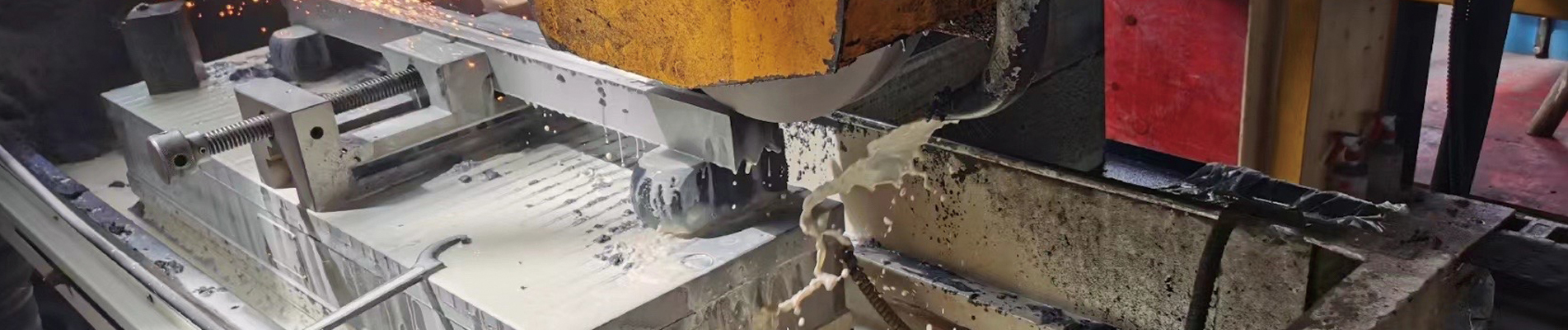

Choosing metal slitting knives is not simply a matter of ordering a round blade with the correct outside diameter. A stainless-steel service center, a carbon-steel strip processor and an aluminum-coil converter may use similar rotary slitting equipment, but the materials behave differently as the knives shear them. A knife that delivers an acceptable edge on mild steel may leave troublesome burrs on hard stainless strip. A knife that survives a demanding steel production campaign may be unnecessarily expensive—or have the wrong cutting geometry—for thin, soft aluminum.
For purchasing managers, maintenance engineers, line operators and equipment OEMs, the useful buying question is: Which knife material, edge geometry and dimensional specification will produce the required slit quality for this coil, on this machine, at a justifiable total cost? This guide explains how to answer that question. It covers stainless steel, carbon steel and aluminum by alloy and temper; compares D2-type tool steel, M2 and M42 high-speed steel, specialty grades and cemented carbide; and shows how clearance, overlap, arbors, spacer stacks, stripper rings and inspection criteria affect buying decisions.
GUANG CHUAN, operated by Ma'anshan Guangchuan Machinery Knife Mold Technology Co., Ltd., manufactures industrial cutting tools and provides drawing-based or sample-based custom blade services. Buyers who want broader background can first review the company's circular slitter knife selection guide. Here, the emphasis is narrower and more commercial: specifying and evaluating coil slitter knives for real metal-strip production.
Quick selection answer: Start with the coil's actual grade, temper, thickness and mechanical-property certificate—not just the label “steel” or “aluminum.” Verify the machine's top/bottom knife arrangement, OD, bore, thickness, bevel orientation, stack geometry and maximum operating conditions. Choose an economical qualified steel-knife baseline first, then trial more wear-resistant grades only when operating evidence justifies them. Set horizontal clearance and vertical overlap from the equipment maker's method and confirm them by inspecting actual slit edges. Never use a published clearance percentage as a guaranteed universal setting.
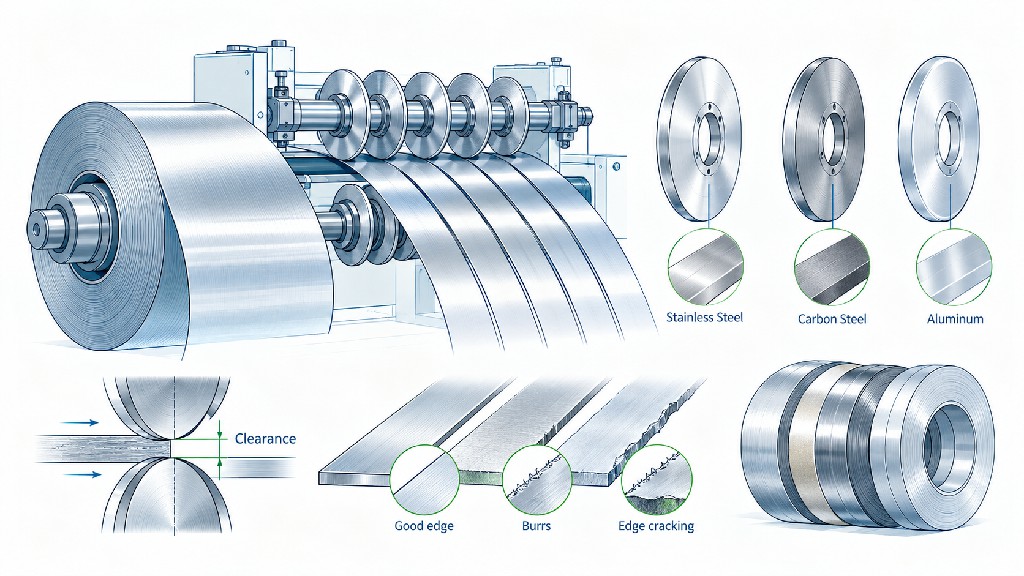
The following table is a selection framework, not a promise that a named alloy always needs a specific knife grade. Real requirements vary with material strength, thickness, surface condition, edge quality, holder rigidity and line operating history.
| Coil application | Main cutting challenge | Reasonable knife-material starting point | Important geometry or setup concern | What to confirm before purchase |
|---|---|---|---|---|
| Annealed 304 / 316 stainless strip | Higher loading, strain hardening, burr and edge consistency | D2-type circular shear steel or a suitable HSS grade | Correct per-cut clearance, controlled overlap, rigid arbor assembly | Actual temper, strength, thickness and burr acceptance limit |
| Cold-worked 301 or other high-strength stainless | Higher edge stress, potential chipping and accelerated wear | Tough, application-qualified tool steel or HSS; specialty grade as needed | Knife support, edge strength, machine capacity and approved clearance | Mill-test properties, load history and cutting trial |
| Commercial-quality cold-rolled carbon steel | Production consistency and cost per accepted meter | Appropriately heat-treated D2-type steel as a baseline | Stack precision, repeatable clearance and blade sharpening | Gauge range, edge criteria and planned campaign length |
| HSLA or harder carbon-steel strip | Greater shear load, fracture behavior and localized knife damage | High-toughness tool steel or suitable HSS, validated on the line | Machine load rating, bevel robustness, support rings | Tensile/strength condition rather than generic trade name |
| Soft 1xxx / 3xxx aluminum | Ductile flow, edge smearing, pickup and surface marks | Sharp, carefully finished tool steel or HSS | Controlled cutting gap, polished faces and gentle strip handling | Temper, surface finish and cosmetic acceptance criteria |
| Work-hardened 5xxx / 6xxx aluminum | Alloy- and temper-dependent load, pickup and edge condition | D2-type steel or HSS; specialty coatings only after testing | Finish, wear mechanism and correct grade-specific setup | Alloy/temper and whether the stock is sheet, coil or heat-treated product |
Not every line needs tungsten carbide or M42. More expensive knives earn their place when they make more conforming product between interventions, lower defects, or reliably complete planned production campaigns. An exceptionally hard blade used on an unstable machine can be a worse purchase than a tougher, properly ground tool steel blade.
Metal coil slitting normally uses rotary shear cutting. A wide master coil passes through a set of upper and lower circular knives mounted on arbors. Each opposing knife pair establishes a shearing plane; successive planes divide the master coil into narrower strips, which are separated, tensioned and rewound. This arrangement differs from a circular saw, which normally has teeth that remove material. Metal coil rotary knives create separation primarily through local plastic deformation followed by fracture.
A typical slit edge contains four observable regions: an entry-side rollover, a smoother burnished or sheared area, a rougher fracture surface and an exit-side burr. Their proportions are affected by the coil's ductility and strength, the true knife clearance, edge radius, overlap and equipment stiffness. A visible burr does not automatically mean that the knife is blunt. Excessive or insufficient clearance, incorrectly assembled spacers, blade-face movement, worn bearings and unstable strip travel can all produce defects that resemble a knife-material problem.
This distinction matters during procurement. If the previous blade was removed because of a worn edge after a predictable campaign, a more wear-resistant grade might help. If it was removed because it chipped at a location where two cutting faces contacted one another, changing to a harder grade may increase the risk. If edge quality changes dramatically with coil batch, inspect the incoming material properties before blaming the replacement supplier.
A robust metal coil slitter includes the upper and lower knives, accurately finished spacers, stripper or support rings, clamping devices, well-supported arbors, bearings, entry guidance and recoil tension control. The knife drawing must be compatible with the rest of this system. An apparently identical outside diameter and bore do not guarantee the right working edge position or side-face geometry. For a detailed explanation of the paired arrangement, see GUANG CHUAN's article on top and bottom slitter knives.
Downstream customers may bend, stamp, weld, roll-form, hem, stack, laminate or paint the strips. A large burr can create handling risks, scratch adjacent coils, interfere with forming dies or compromise a tightly controlled edge specification. Edge wave and camber can cause feeding trouble even when nominal strip width appears acceptable. Better steel coil slitter blades therefore have value only when they help the processor consistently deliver strips that meet the customer's actual quality specification.
“Stainless steel,” “carbon steel” and “aluminum” are useful purchasing categories, but none describes a single fixed cutting behavior. Alloy designation identifies chemistry or a product family; temper and processing history influence strength, hardness and ductility. Coils of the same nominal alloy but different cold-reduction levels can behave differently under the same knives. Surface coatings, lubricant films, scale, oxide, thickness variation and contamination also influence wear and damage.
Request a material certificate or incoming-coil specification that identifies, at minimum, the grade, temper or condition, thickness range, relevant tensile or hardness information, coating, surface finish and any special downstream edge requirements. This is more useful than simply telling the knife factory that the line slits “0.8 mm stainless.”
| Material document or designation | What it tells a knife supplier | What it does not establish |
|---|---|---|
| Alloy or steel grade | Likely alloy family, chemical composition and broad behavior | Actual temper, production strength or ideal slitting gap |
| Temper / processing condition | Whether material is annealed, strain-hardened, solution-treated or otherwise processed | Exact blade life on a particular slitter |
| Measured thickness range | Gauge variation and minimum/maximum cutting duty | That the edge quality will be acceptable |
| Yield strength, tensile strength, hardness | Useful evidence about cutting resistance and material condition | A universal correction factor for knife overlap |
| Surface finish, plating or coating | Risks of abrasion, pickup, scratches and contamination | Whether a coating on the knife will solve the problem |
| Customer burr and width tolerance | Acceptance thresholds for knife trials and production release | The cutting parameters needed to reach those thresholds |
Relevant material standards help document these distinctions. For example, ASTM A240/A240M addresses stainless sheet, plate and strip; ASTM A1008/A1008M covers specified cold-rolled carbon and higher-strength sheet categories; and the Aluminum Association's ANSI H35.1/H35.1M designation system distinguishes aluminum alloy and temper identification. These standards describe input materials or their designation—not a certification that a finished slitter knife will be suitable.
Stainless steel slitter knives must cope with material behavior that can change substantially across stainless families. The terms stainless and non-stainless should never be interpreted as a simple hardness ranking. Austenitic, ferritic and martensitic stainless grades differ in microstructure, response to deformation and available strength. Cold-worked austenitic strip can be much more demanding than annealed stock of the same nominal grade.
Type 304 and Type 316 are common austenitic stainless steels. They can strain-harden during cold deformation, and rolling history strongly influences the force and fracture behavior experienced at a slitter. Type 316 contains molybdenum and is selected in many applications for improved corrosion resistance, but that does not mean a 316 coil automatically requires a harder knife than every 304 coil. Condition matters at least as much as the familiar grade number.
For annealed 304 or 316, a properly designed D2-type rotary shear knife may form a useful baseline. M2 HSS becomes worth evaluating when the line's measured wear pattern, production interval or finish requirement calls for a different performance balance. Do not specify carbide simply because the substrate is stainless steel. Cemented carbide can resist abrasion but may be vulnerable to edge chipping under heavy side loading, impact or unstable alignment.
Pay close attention to polished or decorative stainless. The customer may reject scratches and pressure marks that would be insignificant on an industrial-grade surface. Knife side-face finish, separator rings, coil guidance, housekeeping and lubrication can be as important as nominal blade hardness. A low burr is not sufficient if the strip surface is damaged during the cutting process.
Type 430 belongs to the ferritic stainless family and may behave differently from austenitic grades during forming and slitting. Its actual tensile condition, thickness and finish should drive the setup. An engineering team may be able to use the same general knife material family across 304 and 430, yet still need different clearance, overlap, ring pressure or sharpening intervals. The right approach is controlled qualification rather than assuming all stainless grades share one setup chart.
Cold-worked Type 301 and other high-strength stainless-strip conditions can impose much greater localized loads. Here, a procurement decision should prioritize fracture resistance, robust edge geometry, machine rigidity and actual available shear capacity. The hardest commercial knife may not be the safest or most economical. If the current cutting edge develops small chips, inspect load and contact before ordering M42 or cemented carbide.
For stainless slitting, ask whether the workpiece is annealed, quarter-hard, half-hard, full-hard or defined by a particular mechanical-property range. A written temper designation helps, but a mill certificate with measured properties is more informative. In special applications, conduct a supervised pilot with comparable coil batches and a defined burr/width limit rather than relying on a supplier's generic “stainless” life claim.
The International Stainless Steel Forum and industry bodies have published practical fabrication literature discussing slitting, horizontal clearance, vertical overlap, sharp knife edges and lubrication. A stainless-steel fabrication guide includes process-specific reference guidance. Other coil-tooling suppliers publish substantially different clearance ranges across strength classes. That variation is not a reason to invent one “correct” stainless percentage. It demonstrates why knife geometry, process definition, material condition and edge requirements must accompany any number quoted in an RFQ.
When stainless edges are consistently torn or develop heavy burrs, use GUANG CHUAN's metal coil slitting burr troubleshooting guide to investigate clearance, edge condition, stack position and strip tracking before changing the steel grade of the knife.
Carbon-steel coil often appears to be the simplest slitting application because it is familiar and produced in large volumes. In practice, the category includes soft forming steels, ordinary commercial-quality cold-rolled stock, hot-rolled material, galvanized or painted coil, harder strip and high-strength low-alloy products. These cannot all be cut optimally with one blade and a single fixed clearance.
For many stable, ordinary cold-rolled carbon-steel duties, D2-type alloy tool steel is a reasonable economic reference. A good blade should provide predictable sharpening intervals, repeatable geometry and an edge that remains within the customer's burr limit throughout the intended campaign. Thickness variation and stack precision frequently matter more than paying for the most expensive high-speed steel.
Do not assume the word “cold-rolled” means the strip is particularly soft. Cold reduction, annealing status and product designation determine final mechanical properties. A full-hard condition may behave very differently from drawing-quality annealed material. If the current knife passes every batch successfully, an expensive material upgrade may produce no economic gain, even if its theoretical wear resistance is higher.
Hot-rolled coil can involve different surface textures, residual oxide or scale, and broader thickness or mechanical-property ranges than precision cold-rolled sheet. Some hot-rolled material arrives pickled and oiled; other stock may retain a more abrasive surface. This affects the cutting edge and should be stated to the supplier. An abrasive scale problem cannot be fixed by quoting a low nominal hardness alone: the supplier needs to understand the surface condition, allowable edge wear and cleaning or lubrication environment.
Higher-strength steel may require a more robust edge geometry and a knife material with the right balance between wear resistance and toughness. A stronger strip can also demand a different horizontal gap to produce controlled fracture. Machine force capacity, arbor support and separator-ring behavior must be verified before recommending the knife. If the cutting line is operating near its intended capability, a harder blade is not a substitute for adequate structural support.
Galvanized, pre-painted and other coated coils introduce a separate quality issue: the coating may chip, crack, smear or mark at the edge even if the base steel is separated cleanly. The correct purchasing specification includes permitted coating damage and debris as well as burr and strip width. For appearance-critical coils, document the surface protection requirements during handling, grinding, assembly and packaging.
A steel processor may run several grades on one slitter in a single week. Buying one expensive “universal” grade can simplify inventory but may not minimize cost. A practical alternative is to classify jobs by material strength, gauge, run length and customer acceptance criteria, then maintain a limited set of qualified blade specifications. Record which knives can be moved between recipes and which require dedicated edge geometry. The right inventory is not necessarily the smallest inventory; it is the one that prevents wrong-tool setup, excessive wear and unplanned downtime.
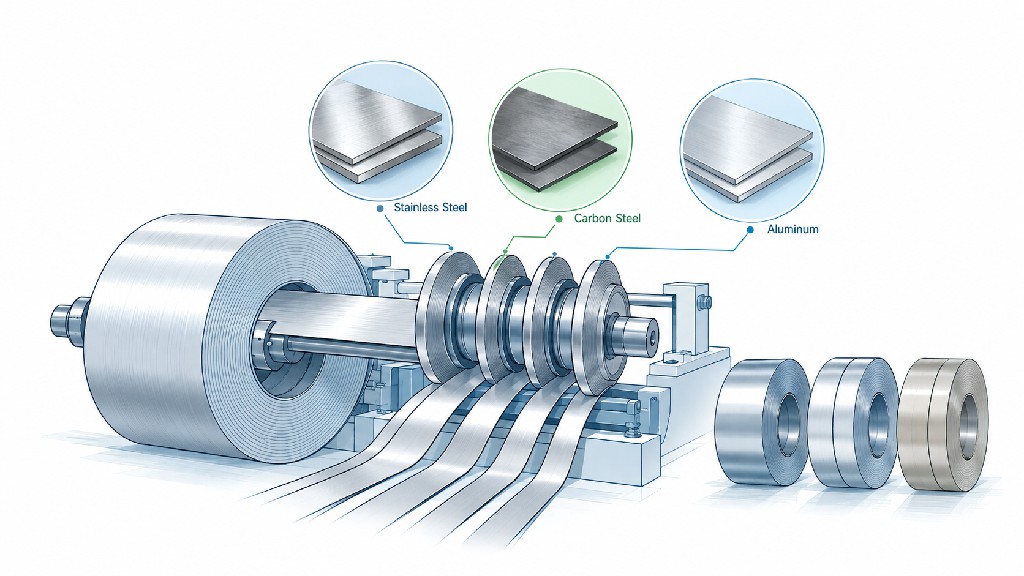
Aluminum slitting knives face a different challenge. Compared with many steels, soft aluminum often deforms readily rather than fracturing cleanly. If the gap, edge condition or support arrangement is unsuitable, the edge can roll, smear, drag or leave material attached to the knife face. A harder knife grade does not automatically prevent these defects. Blade sharpness, face finish, material temper and strip handling may dominate.
High-purity 1xxx aluminum and certain soft 3xxx tempers may exhibit strong ductile flow. With excessive clearance, the material may fold before separating, producing a poor edge or a raised burr. With unwanted friction, aluminum can adhere to the blade face and form a deposit that disturbs subsequent cuts. This makes carefully finished cutting faces and appropriate, tested lubrication important considerations. Avoid promising a coating or lubricant will cure pickup before testing compatibility with the finished product and downstream process.
For soft aluminum coil, the starting point may be a sharp, smooth-faced steel or HSS knife rather than the hardest blade offered in the catalog. A well-maintained edge and stable knife stack can be more useful than a high alloy surcharge. Aluminum coil destined for exposed architectural, automotive or decorative surfaces may have extremely strict scratch and staining criteria, so discuss handling and protective-film compatibility early.
The 5xxx series includes magnesium-bearing aluminum alloys, and 5052 is widely encountered in sheet and coil applications. An O temper and an H32 or other strain-hardened temper do not share identical deformation behavior. The knife supplier needs both the alloy and the temper, as well as actual gauge and surface finish. A suitable D2-type or HSS design can be qualified on the basis of trial data; a grade choice should follow the real failure mode, whether it is edge rounding, pickup, chipping or surface damage.
Some users request knives for 6061 coil or strip. The supplier should confirm whether the stock is actually in a coiled sheet form, the heat-treatment/temper condition and the intended thickness. It would be misleading to treat every 6061-T6 sheet or plate example as representative of every 6xxx coil product. Material supply form, work condition and feasible slitting geometry must be validated before extrapolating from other aluminum applications.
For exposed aluminum surfaces, create an inspection plan that looks beyond burr height. Check knife marks, scratches, rolled edges, smearing, particulate contamination, coating compatibility, separator-ring imprints and edge discoloration. Specify where the inspection occurs, lighting or magnification where needed, and whether the finished material is inspected before or after rewinding. If the strip is later anodized, painted or bonded, verify that the selected lubrication and cleaning process will not compromise that downstream step.
For authoritative alloy identification, refer to the Aluminum Association's alloy and temper designation reference. For commercial sheet and coiled-sheet requirements, consult the appropriate edition of ASTM B209/B209M. Neither document supplies a ready-made knife clearance for every production line, but both help buyers write more meaningful input-material specifications.
| Decision factor | Stainless steel coil | Carbon steel coil | Aluminum coil |
|---|---|---|---|
| Key input identifier | Grade, condition or temper, measured strength | Grade, cold/hot-rolled condition, strength class, coating | Alloy, temper, product form, surface finish |
| Frequent cutting concern | Load, work hardening, burr, edge consistency | Controlled fracture, batch consistency, abrasive or coated surfaces | Smearing, adhesion, rollover, cosmetic marks |
| Knife priority | Edge strength plus wear resistance, reliable pair geometry | Cost-effective wear resistance, repeatable sharpenings | Sharpness, suitable finish, stable low-damage contact |
| Do not overlook | Cold-worked high-strength conditions | HSLA and surface scale/coatings | Soft versus work-hardened tempers |
| Most useful trial evidence | Burr trend by lane and length, chipping, accepted strip quality | Burr/width stability, tool changes, coil-to-coil repeatability | Pickup, scratch count, rolled edge, surface finish, accepted yield |
| Preferred quotation style | Matched knife set for named stainless duty | Qualified blade specification by duty class | Matched blade plus finish/cleanliness requirements |
Material names alone are inadequate because the same alloy can be supplied in multiple conditions. A supplier who asks for your tensile condition, edge acceptance limit and existing knife drawing is gathering the information needed for a useful engineering recommendation—not merely complicating the sale.
Material selection should begin with an observed wear or damage mechanism. If a tool becomes unusable because its edge gradually rounds, higher wear resistance may help. If it chips or cracks, the design may need greater toughness, a stronger bevel or correction of mechanical contact. If material transfers to the face, surface finish and lubrication may be more important than alloy hardness. This is why there is no responsible universal answer to “Which material makes the best metal slitting knives?”
AISI D2 is a high-carbon, high-chromium cold-work steel with a long history in punches, shears and cutting tools. It is attractive for many coil-slitting jobs because it combines useful abrasion resistance with established manufacturing and regrinding methods. The manufacturer Uddeholm identifies Sverker 21 as an AISI D2-type grade and shows an application recommendation of approximately 58–60 HRC for circular shears. That is a published grade-specific reference, not a mandatory hardness for every blade.
The market often uses D2, 1.2379, SKD11 and related commercial names as approximate equivalents. They should not be silently substituted on a high-precision purchase order: relevant standards, actual chemical composition, heat treatment and acceptance tolerances must be agreed. An inexpensive knife described only as “D2, high hardness” does not establish its bevel quality, bore fit or durability.
M2 high-speed steel is a practical upgrade candidate when a conventional tool-steel knife fails to complete its planned run under controlled conditions. Its alloy chemistry and processing give a different balance of hardness, wear behavior and hot-hardness capability. The Griggs Steel HSS composition chart lists a typical tempered M2 hardness of approximately 64 HRC. That value is not a guaranteed finished-knife hardness and must not be interpreted as a minimum requirement.
“High-speed steel” does not promise that a slitter can run faster. Maximum safe line speed also depends on the drive, arbors, bearings, blade dimensions, dynamic behavior, strip tension and OEM limits. An M2 knife may deliver more accepted production between planned changes; the improvement must be measured instead of inferred from the material name.
M42 contains cobalt and has greater attainable hot-hardness potential than conventional M2. The same Griggs Steel chart reports a typical tempered M42 hardness of about 67 HRC and a representative cobalt content of 8.25%. It may deserve a controlled trial where M2's edge deterioration is genuinely limiting production. However, a higher HRC value does not prove a lower cost per meter, and extra hardness cannot overcome knife-to-knife impact or a loose stack.
Some demanding strip applications benefit from a steel grade engineered for better wear resistance and fracture behavior than a conventional baseline. Powder-metallurgy tool steels and specialized cold-work grades may offer an attractive combination, depending on their composition and processing. They also differ significantly in cost, available sizes, heat treatment and grinding behavior. Ask the supplier to name the proposed grade and explain which current failure mechanism the alternative is expected to address.
In commercial blade catalogs, “tungsten carbide” usually means cemented WC with a metallic binder. The binder content, carbide-grain size and manufacturing quality affect both abrasion resistance and chipping risk. Carbide can be valuable for selected thin, abrasive or high-volume applications with controlled loads, but it is not automatically suitable for high-force coil slitting. A cracked carbide ring may cause more expensive downtime than an ordinary regrindable steel knife.
Do not compare an HRC number for tool steel directly with an HV or HRA number for cemented carbide. These hardness tests use different scales and are not interchangeable purchase specifications. Request the named carbide grade, binder information, hardness scale, fracture-resistance considerations and approved grinding method if carbide is proposed. GUANG CHUAN's separate D2 vs M2/M42 vs carbide guide provides a deeper economic and metallurgical comparison.
| Knife material family | Representative published hardness reference | Potential advantage | Important qualification risk | Typical purchasing role |
|---|---|---|---|---|
| D2-type cold-work tool steel | Uddeholm D2-type circular shear reference: 58–60 HRC | Established wear resistance and economical regrinding | Not a cure for severe chipping, poor alignment or high impact | Baseline for many qualified steel-coil duties |
| M2 HSS | Griggs Steel typical tempered value: 64 HRC | Wear and hot-hardness capability with a useful engineering balance | Higher purchase and sharpening expense; life gain not guaranteed | Upgrade trial after baseline wear is documented |
| M42 cobalt HSS | Griggs Steel typical tempered value: 67 HRC | Higher attainable hardness and hot-hardness potential | High premium, no universal advantage, possible edge-damage trade-offs | Specialist trial for a verified demanding condition |
| Specialty or PM tool steel | Grade- and treatment-dependent | Can target selected wear/toughness combinations | Exact grade, lead time, heat treatment and stock availability | Engineered option for recurring difficult duties |
| Cemented tungsten carbide | Specify supplier's grade and HRA/HV test method | Excellent abrasion resistance for suitable loads | Chipping, fracture, special sharpening and handling | Precision/high-wear trial where machine dynamics are controlled |
Data interpretation: The cited hardness numbers are supplier-published examples for particular steels and conditions, not a side-by-side guarantee of a finished knife's cut quality. Your purchase order should define the exact grade, the permitted finished hardness range where relevant, and the inspection method.
Two circular knives made from the same steel can behave differently because of edge geometry. The bevel determines how cutting force concentrates at the working edge and how the blade supports that edge against load. A relatively acute edge may cut more readily but can be sensitive to damage under heavy contact. A more robust edge may resist chipping but increase forces or deform the slit edge if applied incorrectly. A supplier should not recommend a single universal bevel angle for every stainless, carbon-steel and aluminum thickness.
Single-bevel knives have an orientation that must match the opposing knife and assembly. Turning such a blade over may relocate the functional edge and change the result. Double-bevel configurations and specialized profiles are useful in certain systems, but their suitability depends on the machine's shear architecture. Some blades require specific relief faces, chamfers or land widths; others depend on a precision-ground flat face. The correct drawing must show the edge orientation, not only an angle written beside the part number.
A knife with the right OD and ID but the wrong side-face profile can create unintended contact, change lateral clearance or induce strip displacement. For replacement buying, measure an unused OEM knife if possible. An old, repeatedly sharpened knife may have lost diameter or acquired a modified profile. Treat a used sample as evidence of the current part, not automatically as proof of the original design.
Finished blade thickness is not merely a catalog dimension. It determines where the cutting faces sit relative to spacers and adjacent blades. Small individual thickness errors can accumulate across a wide slitter arbor. Flatness, face parallelism, surface finish and the way spacers seat against the knife are equally important. Specify tolerances appropriate to the finished strip-width requirement, machine capability and measurement system rather than copying an impressive but unsupported “micron precision” claim.
Many metal slitters rely on complete assemblies with matched spacer rings, rubber stripper rings and carefully controlled blade-face positions. A supplier who quotes the circular knives alone may not be able to guarantee the performance of the customer's existing stack. Where edge quality is critical, procure or inspect the knife-and-spacer system as a unit and document which face is the reference datum.
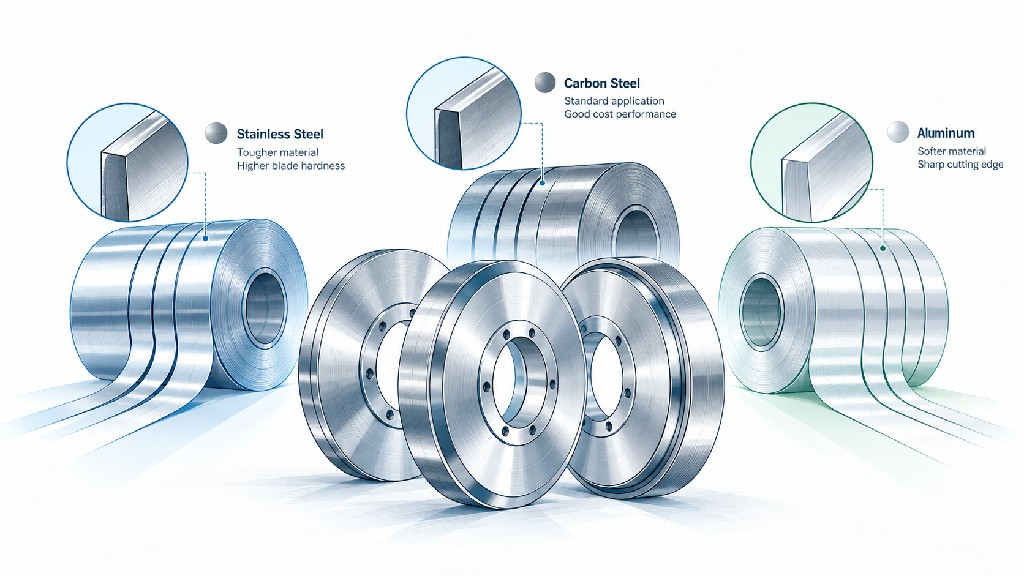
Horizontal clearance is among the most important metal-coil slitting variables, and one of the easiest to misunderstand. In a controlled-gap rotary shear system, it generally refers to the lateral gap between the working side faces of the upper and lower knife at one cutting plane. Each narrow strip normally has two boundary cuts, so the spacer calculation may account for gaps at both edges. That is not the same as dividing the individual shear-plane clearance by two.
Before accepting any clearance chart, verify its definition: Does it describe a single cutting gap, a combined two-edge allowance, a theoretical geometrical distance or an adjustment measured on a particular machine? A calculation can be numerically accurate and still be physically wrong if those definitions are mixed.
Per-cut arithmetic: If the defined clearance at one shear plane is C and the strip thickness is t, the nominal percentage is 100 × C / t. Conversely, C = t × (percentage / 100). Do not automatically halve C unless your machine maker explicitly defines the input number as a two-gap or combined allowance.
Published industry starting points differ, particularly for stainless steel and for varying strength or gauge. For example, the Goodklife metal-coil knife clearance discussion presents strength-dependent ranges and explicitly says the final clearance is established through production adjustment. A separate coil slitting clearance guide from Maxwell Slitter Industries also organizes illustrative starting bands by tensile-strength groups. Neither source replaces an OEM setup specification or proves that one percentage is suitable for every line.
This table is a dimensional calculator, not a recommendation that every aluminum, carbon-steel or stainless grade must run at 5%, 8% or 12%. It shows what different trial percentages mean in actual millimeters for one individual cutting plane.
| Coil thickness, t | Illustration at 5%: C = 0.05t | Illustration at 8%: C = 0.08t | Illustration at 12%: C = 0.12t | Measurement interpretation |
|---|---|---|---|---|
| 0.30 mm | 0.015 mm | 0.024 mm | 0.036 mm | Gap at one cutting plane |
| 0.50 mm | 0.025 mm | 0.040 mm | 0.060 mm | Gap at one cutting plane |
| 0.80 mm | 0.040 mm | 0.064 mm | 0.096 mm | Gap at one cutting plane |
| 1.00 mm | 0.050 mm | 0.080 mm | 0.120 mm | Gap at one cutting plane |
| 1.50 mm | 0.075 mm | 0.120 mm | 0.180 mm | Gap at one cutting plane |
| 2.00 mm | 0.100 mm | 0.160 mm | 0.240 mm | Gap at one cutting plane |
Example: An engineering team has a validated trial recipe calling for an 8% individual shear-plane gap on a specific 1.00 mm steel strip. The theoretical gap is 1.00 × 0.08 = 0.080 mm per cutting plane. That does not mean 0.040 mm on each side of the same shear plane. The blade-and-spacer stack calculation separately considers how the two boundary cuts define a strip width.
For a 0.50 mm stainless trial, the numerical difference between 5% and 12% is only 0.035 mm. That is a small physical distance, which helps explain why blade thickness variation, worn spacers or axial movement can have major effects on thin-gauge work. It also illustrates why a tolerance stated without a measurable reference datum is not useful.
The purpose of a chart is to narrow down a trial, not to eliminate the trial. Where the strip has extreme strength, thin gauge, special coatings or a demanding downstream edge specification, involve the slitter OEM and a qualified process engineer before altering the setup.
Vertical overlap describes the geometric engagement of the upper and lower knife cutting circles. Penetration before fracture describes how far deformation or the burnished zone progresses into the material before the crack completes separation. These are related but not identical quantities. A material with greater ductility may deform further before fracture, but that fact does not establish a universal overlap dial setting.
Too little effective engagement can create incomplete slits or intermittent separation on some machines. Excessive engagement may cause unwanted load, rubbing, deformation, knife deflection or bearing stress. Depending on machine and material, a correctly engineered process can use positive overlap, nearly zero overlap or another approved relative position. There is no one-size-fits-all overlap percentage for all metal coils.
The safest practice is to use the machine manufacturer's geometry definition and validated recipe. Confirm the overlap or vertical position with the specified gauge or measurement method and inspect the result. A blade that is dimensionally correct on its own can be positioned incorrectly by the stack or machine. GUANG CHUAN's explanation of slitter knife overlap distinguishes machine engagement from the material's fracture response in more detail.
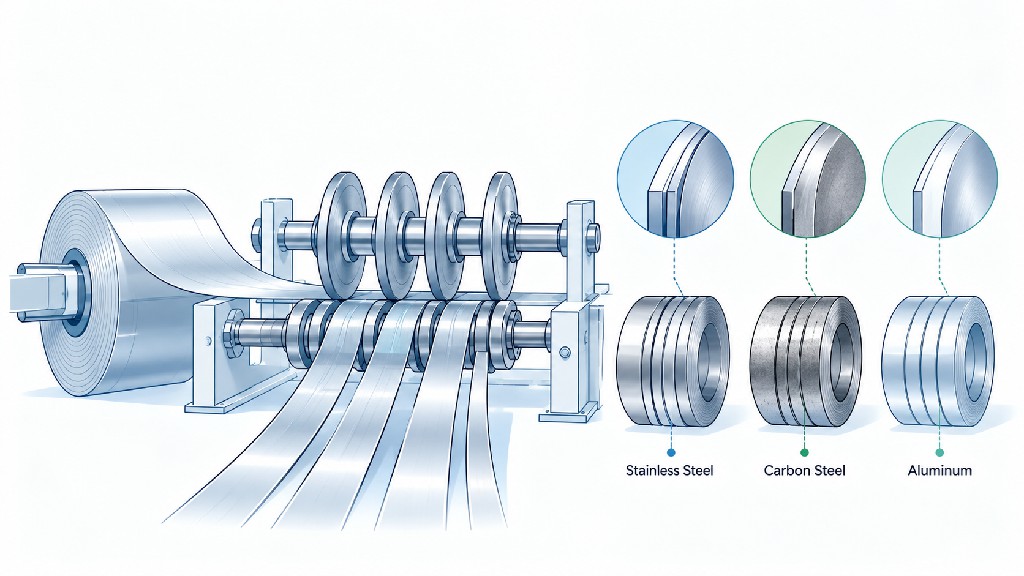
A metal-coil slitter is a precision assembly under load. A knife may be finished accurately at the factory yet produce irregular burrs if its arbor has excessive radial or axial movement, the spacer stack contains contamination, the clamping force is inconsistent or the stripper rings do not adequately support the strip. Paying more for HSS or carbide will not correct these mechanical errors.
Radial runout changes the position of the cutting circumference relative to the rotating axis. Axial or face runout can change the lateral relationship between working faces. Both may lead to periodic changes in cutting action. If an edge defect repeats at intervals related to rotation, inspect the knife, mounting surface, arbor, bearings and stack rather than assuming only the blade material is responsible.
Every spacer and blade thickness contributes to the final positions of the cutting planes. Even when a knife has excellent nominal tolerances, a wrong stack sequence or damaged reference face can shift a slit width or change a lateral gap. Build an assembly record showing component sequence, nominal and measured widths, orientation and the resulting target strip layout. Keep spacers clean and inspect for burrs or raised damage on their faces.
Rubber or other compliant stripper rings support strip release and help control material behavior around the knife. Their size, material and compression condition should suit the metal and machine. A ring system that works on carbon steel may leave unacceptable marks on decorative stainless or soft aluminum. If the buyer needs new metal slitting knives because of surface defects, include the ring arrangement and coil handling system in the technical review.
Correctly diagnosing defects prevents unnecessary spending on the wrong knife grade. Do not rely on one visual impression. Inspect several lanes, sample the beginning and end of the coil, measure both sides of each slit and compare the results with the line's recorded settings.
| Observed defect | Possible causes to investigate | First practical check | Purchasing implication |
|---|---|---|---|
| Heavy burr across all lanes | Unsuitable clearance, worn edges, shared setup issue | Confirm grade and recipe; inspect representative edges | Do not assume all knives need a harder grade |
| Burr on one or two lanes | Local knife damage, spacer error, axial movement | Check that knife pair, adjacent spacers and reference faces | May need replacement of a subset, not a full material upgrade |
| Burr rises progressively along coil length | Edge wear, pickup, temperature change, drifting setup | Plot burr height against production length | Measured wear may justify an HSS or specialty-steel trial |
| Edge wave or camber | Incoming residual stress, unequal cutting conditions, strip tension | Compare incoming material, lane position and rewinding | Knife geometry alone may not solve the defect |
| Aluminum smeared on knife face | Adhesive pickup, unsuitable finish, excess rubbing | Examine cleaned edge and face; check lubrication approval | Face finish or process correction may be more valuable than hardness |
| Knife edge chips or cracks | Contact, high local load, foreign objects, inadequate edge toughness | Stop and inspect alignment, overlap, supports and damage pattern | A harder or more brittle upgrade may be inappropriate |
| Stainless scratch or aluminum cosmetic mark | Stripper rings, abrasive particles, handling, side-face contact | Trace mark location and inspect complete strip path | Specify surface-protection and cleanliness requirements |
| Slit width is out of tolerance | Stack arithmetic, spacer damage, clamping movement, heat | Measure assembly position and strip width across lanes | Order matched stack components or tighter controlled inspection |
Always stop and investigate if chipping, unexpected knife contact, dangerous strip instability or abnormal noise creates a machine-safety concern. A product brochure cannot substitute for the OEM's safety and maintenance instructions.
A useful RFQ describes both the finished knife and the application. “Please quote 200 mm stainless steel slitter blades” leaves most of the critical engineering questions unanswered. It does not identify the bore, cutting thickness, bevel, edge position, actual coil grade or matched lower-knife requirements. The drawing and application sheet should be considered together.
| Specification item | What to provide | Why it matters |
|---|---|---|
| Outside diameter (OD) | Nominal finished diameter and tolerance; regrind minimum if known | Engagement, working geometry and service-life allowance |
| Inside diameter (ID) / bore | Finished size, fit and datum requirement | Concentric mounting and rotational stability |
| Knife thickness | Finished thickness, tolerance and parallelism | Cut position and spacer-stack accuracy |
| Profile / edge | Single/double bevel, angle definition, orientation, edge radius or land | Correct shear action and edge strength |
| Face / edge finish | Functional Ra/Rz limit or reference sample if needed | Friction, pickup, scratches and consistency |
| Geometric controls | Flatness, radial/axial runout, datum references, inspection method | Reliable cut position across a rotating set |
| Material | Named steel grade and accepted standard or specified carbide grade | Avoids ambiguous commercial substitution |
| Heat treatment | Agreed hardness window and suitable test method/location | Controls wear/toughness balance |
| Coil duty | Grade, temper, gauge range, surface/coating, actual strength if available | Allows supplier to evaluate cutting load and failure mechanism |
| Machine and arrangement | OEM/model, arbor layout, top/bottom set, spacers, stripper rings | Checks interoperability and contact geometry |
| Quality target | Burr, width, camber, edge appearance, sampling and acceptance method | Turns “high quality” into an auditable result |
| Commercial details | Trial quantity, annual demand, delivery destination, required documents | Supports a comparable landed-cost quotation |
For advanced or high-speed applications, include any OEM balance or speed limits. Never assume a replacement knife has the same safe rotational capability simply because its dimensions resemble those of an installed part. Specify the machine maker's applicable rotating-tool requirements and have the assembly approved before production use.
Suppose a buyer needs a replacement knife for an existing 1.00 mm commercial-quality carbon-steel line. The RFQ might state that the finished OD, ID, thickness and orientation must match an attached OEM drawing; the steel grade is to be proposed as D2-type or equivalent under a named standard; the supplier must provide measured thickness and runout results; and the line will use its already validated clearance recipe. The buyer specifies the incoming coil's mechanical-property range and requires a documented test showing acceptable burr and strip-width stability through a defined production batch.
This is deliberately more useful than inventing universal micrometer tolerances or an arbitrary bevel angle. The actual numerical OD, bore, edge profile and tolerance values belong on the customer's drawing or in an approved replacement specification. If an old blade is the only available evidence, submit photographs, dimensional measurements, mounting details and the number of previous regrinds. Ask the supplier to flag uncertain original geometry rather than copying wear damage into a new tool.
The lowest purchase price does not always create the lowest slitting cost. A knife that must be changed in the middle of a profitable production campaign may generate labor cost, scrap, changeover time, rescheduling and customer delivery risk. Conversely, a premium HSS or carbide knife that costs twice as much but does not extend an already sufficient run length may be a poor investment.
For an objective comparison, measure cost per accepted meter of slit product, or cost per accepted production hour where strip widths or product mixes differ. Include knife purchase, sharpening, the actual number of interventions, consumed tooling, scrap attributable to the knife, and any justified machine downtime. Keep unrelated manufacturing costs separate so the knife comparison remains auditable.
The following figures are hypothetical training assumptions used only to demonstrate the arithmetic. They are not GUANG CHUAN quotations, measured blade lives, industry-average downtime costs or guaranteed savings. Assume each candidate knife is evaluated over two accepted cutting intervals, with one sharpening between them. A full intervention after each interval is charged for simplicity; every line should replace these assumptions with its actual maintenance accounting.
| Illustrative input | Option A: baseline tool steel | Option B: premium HSS |
|---|---|---|
| Knife purchase price | $160 | $310 |
| One assumed sharpening expense | $40 | $70 |
| Accepted cutting time before each intervention | 10 hours | 18 hours |
| Number of productive intervals in this comparison | 2 | 2 |
| Total accepted cutting hours | 20 hours | 36 hours |
| Assumed intervention cost, each | $180 | $180 |
| Assumed knife-attributable scrap, each | $25 | $25 |
| Illustrative total cost | $160 + $40 + 2 × ($180 + $25) = $610 | $310 + $70 + 2 × ($180 + $25) = $790 |
| Cost per accepted cutting hour | $30.50 | $21.94 |
In this constructed example, Option B costs more to buy and more to sharpen, yet has a lower cost per accepted cutting hour because the assumed intervals are longer. This does not prove that HSS actually lasts 1.8 times as long as a conventional tool-steel knife. If the premium tool chips unexpectedly or lasts only 11 hours per interval, the calculation changes. A purchasing decision should use measured, repeatable operating data rather than this example's assumed service intervals.
For a further illustration, suppose both lines produce 100 meters of strip per minute at the same qualified width configuration, and 98% of the nominal produced length is accepted. At that output rate, there are 100 × 60 × 0.98 = 5,880 accepted meters per hour. Tooling-related cost per 1,000 accepted meters would be approximately $5.19 for Option A ($30.50 ÷ 5.88) and $3.73 for Option B ($21.94 ÷ 5.88). These are not total factory production costs: they include only the simplified knife-related cost categories listed above.
If these questions cannot be answered, a quoted life multiplier is marketing context, not procurement evidence. The most credible suppliers are comfortable comparing a premium design with a good, properly maintained baseline rather than with a deliberately poor setup.
A service center slits a cold-worked stainless grade. The first coils pass inspection, but burr height grows near the end of a long run. Rather than immediately purchasing carbide, the engineer checks whether burr growth is uniform across all lanes, whether the knife faces show progressive edge rounding and whether lubricant and stack position remain stable. If documented abrasive wear is the dominant cause, a qualified M2 or specialty-steel trial may be justified. The trial must compare accepted meters to the same burr threshold. If the current knives are chipping, the priority changes: correct load, contact and edge strength before increasing hardness.
A facility cuts several commercial carbon-steel gauges each day and changes the setup frequently for customer width orders. It might gain little by purchasing a premium alloy that lasts for dozens of hours when each individual campaign is much shorter. Standardized D2-type knife sets, accurate spacer identification, clear sharpening records and faster assembly methods may deliver greater value. For this buyer, repeatable dimensions and convenient inventory management can matter more than the longest possible edge life.
A converter produces narrow aluminum strips for exposed downstream products. Burr height is acceptable, but scratches and edge smearing lead to rejection. The purchasing team investigates knife-face finish, aluminum transfer, stripper-ring compression, cleaning residues and rewind handling before changing alloy. A fine-finished steel or HSS knife with an approved processing recipe may outperform a premium grade that was chosen only for hardness. The acceptance record should photograph and score surface damage in addition to measuring the slit edge.
These examples illustrate why commercial investigation should begin with the customer's defect and operating economics rather than a catalog's material ranking. A suitable blade proposal identifies the trade-off, the expected benefit and how the purchaser will verify it.
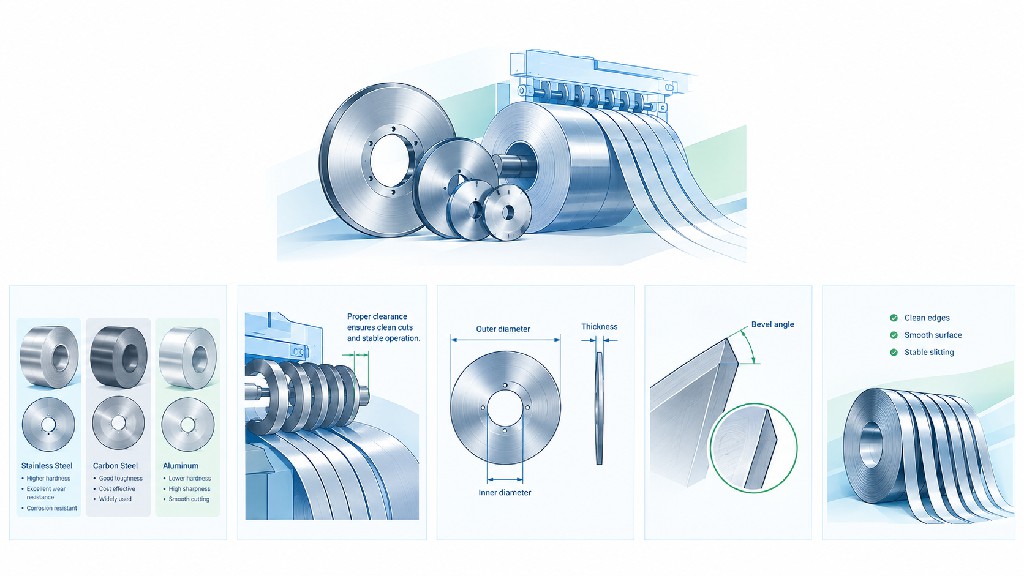
An industrial knife quotation is only as clear as its underlying requirements. Material specifications can support traceability, but they do not independently certify the entire finished tool. For a high-precision slitting application, the buyer may need inspection data showing OD, ID, thickness, parallelism, flatness, edge orientation and radial/axial runout against a drawing with well-defined datums.
For the steel grade itself, relevant published material references include ASTM A681 for wrought alloy tool steels and ASTM A600 for high-speed tool steels such as M2 and M42. These should not be misrepresented as generic certifications for every slitter knife, every heat treatment or every final geometric tolerance. If the supplier uses a JIS, EN, ISO or another recognized designation, list the exact accepted specification and proposed equivalent rather than assuming interchangeability.
For routine replacement knives, an agreed certificate of conformity and dimensional results may be enough. For critical coils or unfamiliar suppliers, request actual measured values, inspection equipment or methods, material traceability, relevant heat-treatment or hardness evidence and explicit treatment of any drawing deviations. If edge performance is important, agree on a functional sample test using customer material and define the inspection criteria before placing the production order.
Where a purchaser requests 100% inspection, specify exactly which characteristics are to be measured on every blade. “100% quality checked” without a checklist is not a verifiable requirement. Similarly, claims of flatness within a certain number of micrometers require a measurement setup, supported diameter, temperature condition and agreed reference surface. Precision is meaningful only when both parties can reproduce the inspection.
A complete procurement calculation includes how the knife will be maintained. Ask for allowable grinding geometry, the minimum permissible working diameter, relevant edge profiles and any dimensional change that affects the stack or overlap. Avoid assuming unlimited regrinds. A blade may reach its geometric limit, develop subsurface damage or become uneconomical to sharpen before the theoretical wear-resistant material is exhausted.
Maintain spare sets that match the slitter's actual operating pattern. A premium knife with long delivery time may justify a backup even if its average life is excellent. Store cleaned and protected blades in appropriate packaging, avoiding edge-to-edge contact and corrosion exposure. Incoming goods should be checked for handling damage before being released to production.
When comparing two suppliers or material grades, create a written trial plan. Otherwise the result can reflect differences in coil properties, machine setup, operator practices or inspection thresholds rather than knife performance. A scientifically perfect laboratory study is not necessary for a useful factory trial, but the basic comparisons must be controlled.
Ask the supplier to help distinguish manufacturing quality from process selection. A genuinely good new blade can fail on the wrong clearance; a mediocre blade can appear acceptable on a short, easy sample. Repeatability under meaningful production conditions is more persuasive than an isolated demonstration.
GUANG CHUAN's custom blade engineering service describes drawing-to-product work, sample-based replacement manufacturing and material selection support. The company's top and bottom slitter knife product page provides a starting point for discussing rotary knife sets, but a blade used on a heavy metal-coil shear still needs application-specific engineering review. Do not assume every paper-converting knife shown in a general catalog is directly interchangeable with a high-load steel slitter blade.
To obtain a useful quote, submit the following information as one technical package rather than scattering it through multiple messages:
If you cannot identify the original material or geometry, say so openly. Provide a usable sample, installed assembly photographs and the machine manual details. A responsible supplier can then identify which features are established and which remain subject to measurement or trial confirmation. This is especially important for nonstandard or discontinued equipment.
The goal is not to buy the largest number of knives at the lowest unit price. It is to establish a repeatable, correctly specified supply for metal slitting knives that meet the edge, machine and commercial requirements of your actual operation.
Not necessarily. A circular saw generally uses teeth to remove a kerf. Rotary shear slitting usually uses smooth circular upper and lower knife edges to separate metal by deformation and fracture. The two categories may look similar in product photographs, but geometry and mounting requirements differ. Search for metal coil rotary knives or circular shear slitter knives when that is the machine's actual cutting method.
There is no universal winner. A D2-type knife can be a practical baseline for a suitable annealed stainless application; M2, specialty steel or another grade may be considered if measured wear, strength condition or quality requirements justify it. Specify the actual temper, gauge, strength, bevel arrangement and burr acceptance standard before requesting a recommendation.
Sometimes a qualified knife design can serve several materials, but the best setup and expected maintenance interval may differ. Soft aluminum presents adhesion and deformation risks, while high-strength steel can create greater loading and chipping concerns. Reusing the same part number should be based on approved machine recipes and cut-edge qualification, not just the blade's dimensions.
Start with the slitter OEM's definitions and an approved process recipe for the exact grade, temper and gauge. Published sources show materially different reference values because their assumptions and strength classes differ. Define whether the number is a single cutting-plane gap or a combined allowance, then perform a controlled cut and inspect the resulting edge. An isolated percentage is not enough.
Some soft aluminum applications use relatively tight clearance to limit folding and smearing, but aluminum alloys and tempers differ. A work-hardened or high-strength aluminum product cannot automatically use the same recipe as soft 1xxx stock. Machine geometry and customer edge criteria also matter. Treat published ranges as trial guidance, never universal production instructions.
M42 can provide higher attainable hardness and improved hot-hardness characteristics, but that does not prove lower cost or longer acceptable cutting life on every coil line. The extra alloy and processing cost needs to solve a verified problem. Compare both grades using the same knife geometry, operating duty, regrind policy and defect endpoint.
Solid cemented-carbide designs are best considered as engineered options for suitable load conditions, not default upgrades for every metal slitter. They offer excellent abrasion resistance but can chip or fracture under undesirable contact or high localized impact. Ask for a defined carbide grade and have the machine and tooling supplier evaluate its suitability before a pilot.
Newness does not prove that the installed system is correct. Wrong horizontal clearance, unsuitable overlap, reversed bevel orientation, damaged spacer faces, arbor movement, strip tension and mismatched coil properties can all create burrs. Measure the cut edge and inspect the entire setup before concluding that the supplier delivered a blunt knife.
Remove it when it reaches an agreed defect threshold, has unsafe or unrepairable damage, or reaches its approved regrind limit. A dull but structurally sound knife may be sharpened to its specified profile; a severely chipped or cracked blade may require scrapping. Check the remaining diameter, edge geometry and the approved machine setup after every regrind.
At minimum: finished outside diameter, bore, thickness, bevel or edge profile, orientation, material specification and the tolerances necessary for the machine. Critical applications may also require flatness, parallelism, runout relative to datums, surface finish and hardness testing. Include mounting features and any maximum speed or balance requirement supplied by the machine builder.
Often yes, if the sample preserves enough usable geometry and the supplier also knows the machine and assembly details. However, a heavily worn or repeatedly reground knife may not reflect original dimensions. Sample-based replacement should include measurement, uncertainty review, approval of the proposed drawing and preferably a trial before large-scale supply.
Compare the complete finished blade specification and the trial/inspection plan, not only material labels and unit prices. Include tooling dimensions, grade traceability, bevel quality, runout, sharpening allowance, failure policy, delivery terms and actual accepted output. A low-cost blade may be attractive for short campaigns; a premium grade may be justified when it eliminates expensive extra changeovers.
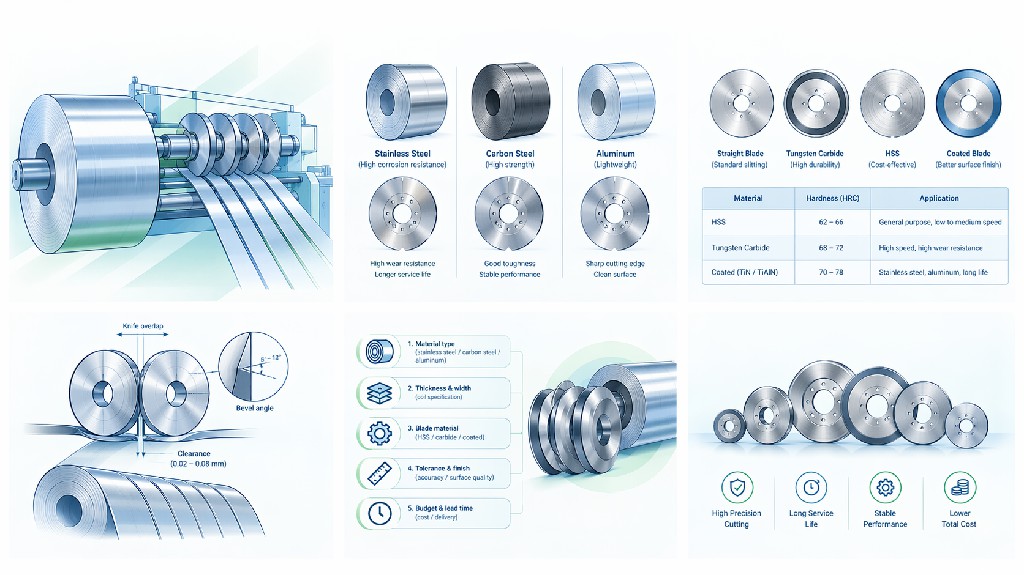
Select the material, not just the marketing category. Confirm actual coil grade, temper and strength. Define the customer-required slit edge and strip width. Review the upper and lower cutting arrangement, clearance definition, overlap, support rings and stack. Choose a tool-steel or HSS baseline with appropriate wear and toughness properties. Specify drawing datums and tolerances, document the finished-blade inspection, and trial the design against the same acceptance threshold. Only then compare procurement prices and expected service costs.
For ordinary carbon-steel duties, a correctly produced D2-type blade may already be the best business decision. For demanding stainless production, a carefully matched HSS or specialty grade may extend the accepted campaign when wear is the true limiting factor. For aluminum, blade-face finish and controlled shearing can be more decisive than maximum hardness. None of these conclusions removes the need for a qualified line setup.
Need replacement coil slitter knives for stainless steel, carbon steel or aluminum? GUANG CHUAN provides custom industrial knife manufacturing and can review drawings or representative samples. Share your coil specification, existing knife dimensions, cutting defects and planned trial criteria. The team can then discuss suitable knife material families, geometry, inspection requirements and a quotation for the intended duty.
Contact GUANG CHUAN for a technical quotation or review its OEM/ODM blade manufacturing services. A specific drawing and a description of the cutting problem produce a more actionable recommendation than asking for the “hardest” or “longest-lasting” blade.
Technical note: Published metallurgy and standards statements are linked at their point of use. Clearance percentages shown in the arithmetic table are illustrative calculations, not validated universal machine settings. Prices, cutting intervals, intervention expenses, quality yield and resulting cost savings in the worked example are explicitly hypothetical. Confirm the latest applicable standards, exact material condition, machine-OEM instructions and trial acceptance criteria before production approval.

Leave A Message
Scan to WhatsApp :

 English