



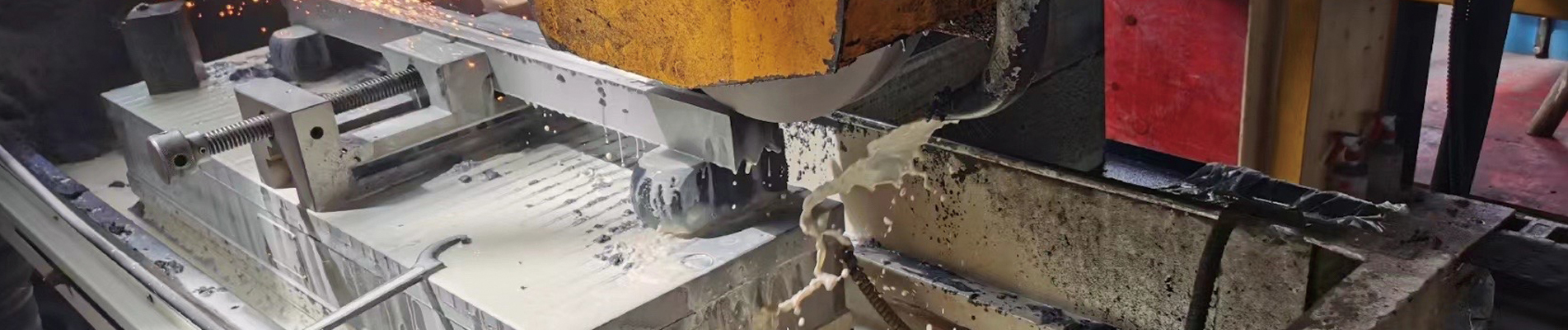

A packaging line can produce thousands of acceptable packs and then begin delivering ragged edges, hanging film tails, partly separated sachets, or excessive reject rates without an obvious change in the film. The cutting knife is often blamed first. Sometimes that is justified; sometimes the real problem is the opposing anvil, worn knife holder, changed laminate, misaligned sealing jaws, or an incorrect replacement part. Buying a harder blade without finding the mechanism can make the next failure more expensive.
This guide explains how to select packaging machine knives by cutting action, edge geometry, material grade, dimensions, inspection evidence, and total operating cost. It addresses the most common commercial questions: Should you buy serrated or straight packaging knives? When do D2, high-speed steel, stainless steel, or carbide make sense? Which measurements must accompany an OEM replacement order? What should a supplier demonstrate before a trial becomes a recurring purchase?
GUANG CHUAN manufactures custom industrial machine knives and lists a dedicated range of packaging machine toothed blades, including straight serrated knives, T-type vertical-packaging blades, and perimeter cutting dies. The supplier's company overview identifies packaging, film processing, and precision-grinding applications among its core activities. This article uses those published product categories as practical examples, while separating manufacturer descriptions from industry standards and from illustrative buying calculations.
The short answer: Choose the cutting system first, the blade profile second, the steel and heat treatment third, and the exact mounting geometry before placing an order. A blade is only commercially successful when it fits securely, gives a repeatable cut on the actual packaging material, and offers an acceptable cost per good package over its working life.
In this guide
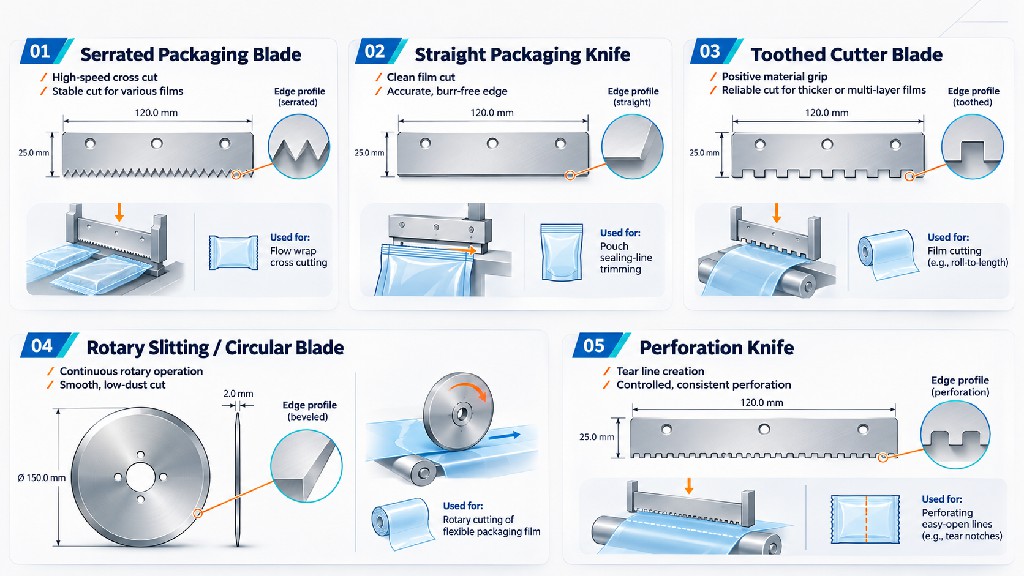
For a VFFS snack-pouch machine that cuts between transverse seals, start by identifying the existing jaw-mounted cutter, counter-surface, tooth pattern, and whether a zigzag pack edge is required. For a horizontal flow wrapper, confirm the rotary or reciprocating cutoff arrangement and the available space around the end-seal jaws. For film converting, distinguish continuous longitudinal slitting from transverse bag separation; a rotary shear knife and a toothed cross-cutting knife are not interchangeable. For a tray-sealing operation, a shaped perimeter die may be required rather than a straight strip.
If the machine already performs well with a validated original knife, the lowest-risk replacement usually duplicates the OEM's critical geometry and material performance, with any proposed changes documented and trialed. If the current part fails prematurely, first classify the failure: abrasive rounding, fractured teeth, adhesive pickup, corrosion, mounting movement, or tearing caused by the machine. Each points to a different solution.
The terms packaging machine blades, packaging knives, serrated packaging blades, toothed packaging blades, and packaging cutter blades overlap in supplier catalogs. They do not describe one standardized blade shape. The relevant details are the cutting direction, edge profile, mating component, physical fit, and product-contact environment.
A packaging machine knife separates or weakens packaging material at a specified position in the machine cycle. The action may be a straight cross-cut, a serrated cutoff, longitudinal slitting, a perforation, a controlled tear notch, or a shaped trim around a package. In each case the blade creates a local stress concentration in the material. The material then shears, fractures, or propagates a tear according to its structure and the machine's support and motion.
A clean cut is not determined by sharpness alone. Film can stretch ahead of the edge, especially if it is warm or inadequately supported. A laminated web may have a stiff outer layer and a ductile sealant layer; the first fractures while the second elongates. Coated paper may shed fibers. Thin foil may wrinkle before separation. These differences explain why two blades with identical outside dimensions can produce noticeably different package edges.
In many vertical and horizontal form-fill-seal machines, heated jaws create the transverse seals and a knife cuts the web in or near the sealed region. The knife does not itself generate the required seal temperature, pressure, dwell time, or polymer fusion. Some integrated jaw assemblies coordinate sealing and cutting in one cycle, so poor knife alignment can disturb the process; nevertheless, correcting a knife does not automatically fix an underheated or contaminated seal.
A cutoff knife aims to divide two adjacent packs. A perforating knife intentionally leaves bridges of material so that connected packs can be torn apart later. An easy-tear edge may be produced by serrating the final cutoff, or by a separate notch/perforation feature. Those requirements must be specified individually. A zigzag cut is not the same as a controlled perforation line, and a row of sharp teeth does not guarantee a specific opening force.
For quality testing, ASTM F88/F88M describes measurement of flexible-package seal strength, not knife sharpness. Package-integrity testing such as ASTM F2096 may help investigate gross leakage when that test is appropriate for the package. These are different measurements. A purchaser should therefore track both cut quality and the relevant package-seal acceptance criteria.
Consider a film roll that has changed supplier. Its thickness may be unchanged, but slip additives, layer balance, coating, orientation, or lamination adhesive can differ. A blade previously optimized for one web may now leave strings or residue. Likewise, the same knife may cut successfully at reduced speed but fail at full production rate because the web begins to move, the cutter reaches it off-center, or the knife seat deflects. In these cases the replacement knife must be evaluated as part of the system rather than as an isolated steel strip.
The practical diagnostic sequence is to check film identification, cut position, supporting surface, knife condition, mounting rigidity, machine timing, and environmental conditions. Only after those checks should the team decide whether a different material or tooth geometry is a justified engineering change.
The most useful classification is by cutting mechanism. Buyers can then add an edge-style description such as straight, toothed, scalloped, perforating, or micro-serrated. A particular packaging machine may use more than one knife type.
| Knife type | Typical machine or operation | Primary function | Critical buying checks |
|---|---|---|---|
| Straight reciprocating cutoff knife | Selected VFFS and bag-making units | Transverse separation with a continuous edge | Length, thickness, bevel, stroke, counterface, hole positions |
| Serrated or toothed cross-cut knife | Pillow packs, VFFS and HFFS cutoff stations | Positive initiation and a patterned cut edge | Tooth pitch, depth, tip condition, mating jaw, cut appearance |
| T-shaped or formed knife | Selected vertical bagging machines | Fits a shaped holder or specialized cutting zone | Overall form, offset, bends, orientation, support surfaces |
| Rotary cutoff knife | Some horizontal wrappers and intermittent web systems | Cuts with rotating motion | Diameter, bore, blade phase, runout, clearance, guarding |
| Circular slitter or razor blade | Film/paper converting and web trimming | Continuous longitudinal separation | Holder style, overlap or anvil, edge quality, web tension |
| Perforation or tear-feature knife | Connected packs, tear-open strips, selected bags | Leaves an intentionally weakened line | Cut-to-tie ratio, pitch, bridge strength, registration |
| Perimeter cutting die | Tray-seal trim and shaped flexible packs | Cuts around a specified outline | Die contour, mating support, depth, corner radii, ejection |
Table 1 is a functional classification, not a claim that every blade is compatible with every machine in the same category. Actual assembly drawings govern fit and safety.
These knives move into a stationary or supported web, usually as part of a timed mechanical, pneumatic, or servo-driven unit. They can produce a clean transverse edge when the film is held adequately and the edge remains even across its working length. Their benefits include a comparatively simple profile and straightforward inspection. However, moving the entire edge into the web at once can demand well-controlled machine force and alignment. An uneven support or locally worn anvil may give a partially uncut corner even with a sharp blade.
A straight-edge knife is a serious candidate when the final package needs a visually smooth edge, the substrate cuts cleanly without tooth penetration, and there is no required zigzag or easy-tear feature. Before specifying one, ask whether the current machine actually has a continuous cutting edge or a very fine tooth pattern that looks smooth to the naked eye. A photograph alone can be misleading; a magnified image with a scale is better.
Serrated knives use regularly shaped teeth or a defined variable pitch. Individual tooth tips can enter a supported film before the full edge engages, which may help initiate cutting of certain flexible substrates and produce a recognizable serrated bag edge. Performance depends strongly on tip sharpness, pitch, depth, rake, bevel, and the mating surface. Teeth that are too aggressive for a film can create excessive notches, dust, stretched bridges, or an unattractive edge.
GUANG CHUAN offers high-precision HSS serrated packaging machine blades for reciprocating cutting applications. Its published listing describes customizable tooth geometry and mounting features. That product example demonstrates why a quote should identify the actual serration drawing rather than simply say “serrated blade, high speed.” A supplier cannot infer the required tooth profile from the nominal steel grade or machine brand alone.
A T-type knife is identified by its mounting/body geometry rather than by a universal tooth pattern. On certain vertical form-fill-seal systems it provides an extended or shaped portion that fits the jaw assembly and reaches the cutting position. Its mounting width, stem, shoulders, working projection, and orientation matter just as much as the tooth edge. Altering a bend or shoulder can place the cutting tips in the wrong part of the machine stroke.
For an example of a machine-specific form, review GUANG CHUAN's T-type HSS vertical-packaging serrated blade. A buyer replacing a formed part should supply a flat-pattern drawing only if it is known to represent the finished geometry correctly. Otherwise, use a dimensioned drawing of the finished part or a safely removed sample accompanied by photos showing its installed orientation.
Rotary cutting arrangements use an edge moving through a defined path. In a rotary cutoff, correct phase relative to the web and opposing surface is central. For slitting, two common systems are a circular shear pair and razor cutting, but the proper choice depends on the web and machine. Radial runout, axial runout, blade thickness, arbor fit, and clearance can matter more than a marginal increase in hardness.
These knives should never be substituted for straight jaw-mounted toothed blades merely because both are called packaging machine blades. Buyers handling films such as BOPP, PET, PE, or laminates can consult GUANG CHUAN's film slitting blade selection guide when the job is longitudinal converting rather than bag cutoff.
Perforation requires a deliberate sequence of cuts and uncut ties. The bridges must remain strong enough for processing, shipment, or dispensing, yet weak enough to separate when intended. A drawing therefore needs the intended pitch, the length of each cut and tie, total perforation width, orientation relative to the film's machine direction, and an approved functional test. Merely writing “perforated serration” is not sufficient for repeatable reproduction.
If customers complain that connected sachets detach accidentally, the issue might be weak tie length or a film change, not excess knife hardness. If the packs cannot be separated by hand, the ties may be too wide, the penetration inadequate, or the pattern poorly positioned. These are geometry and process problems that should be diagnosed before changing the steel.
Some packaging lines trim around the perimeter of a sealed tray or formed pouch. Their cutting tool follows a contour and may contain corners, radii, locally reinforced sections, or interrupted tooth patterns. Unlike a straight cutoff knife, a perimeter die introduces alignment and penetration questions around the entire shape. If one corner is uncut, increasing pressure throughout the die may overload the rest of the edge.
GUANG CHUAN lists serrated perimeter packaging cutting dies for shaped trimming applications. A replacement request should include the complete contour, datum positions, mating support, installed height, allowed final package outline, and any product clearance zones. Do not assume the drawing of the final pack gives the exact knife geometry; allowances may be needed for the existing tooling arrangement.
The answer depends on the specified finished edge and the way the substrate behaves during the cut. A straight knife is often appropriate when a clean continuous edge is essential and the machine has stable web restraint. A serrated knife may help initiate separation in slippery or stretch-sensitive film and may create an easy-grip package edge, but it can also increase local stress or produce a rougher appearance. Neither geometry is automatically faster, safer, or longer-lived in every machine.
The correct comparison is an on-machine trial using the same film lot, web speed, jaw setup, and acceptance criteria. The test should collect not just anecdotal opinions about sharpness but specific observations: missed separations, whiskers, edge-to-seal distance, hanging tabs, dust, visible stretch, and change in performance over the trial interval.
A particularly important distinction is seal integrity. A serrated knife may reduce pulling at the cutoff point in one machine, indirectly helping the seal remain undisturbed. In another machine, aggressive teeth may cut too close to or into the seal. Therefore, improvement in seal performance should be demonstrated with the finished package and an appropriate seal test, not assumed from the serration alone. GUANG CHUAN's related article on serrated blades in packaging machines discusses the relationship between web movement, cutting, and seal consistency; the machine's sealing parameters still require independent validation.
Some applications benefit from a short region of fine serration adjacent to a smoother cutting section, or from changes in tooth distribution rather than a completely different material. Such modifications must not exceed the machine's permitted blade envelope or alter safety-critical engagement. A hybrid edge is an engineering trial, not a universal upgrade. Ask the supplier to submit a drawing of the proposed change, identify the expected failure mode it addresses, and explain how the resulting pack edge will be inspected.
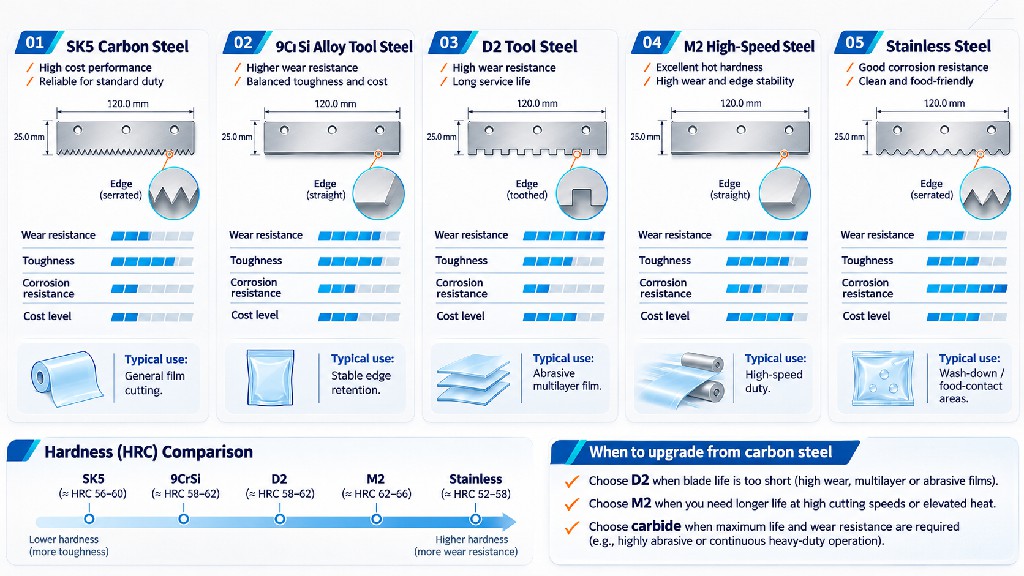
A blade material decision balances wear resistance, tooth toughness, achievable sharpness, heat-treatment stability, corrosion behavior, ease of grinding, supply cost, and the surrounding hygiene requirements. Maximum hardness is not the objective. Thin teeth may chip when a grade is too brittle for the impact and misalignment of the real machine. A softer but tougher edge that remains intact can have a lower cost per acceptable package.
The table below describes material families used across industrial packaging knives. It is a selection map, not a guarantee of interchangeability, obtainable hardness, or certification. Exact chemistry, heat-treatment route, hardness target, and approved application must be included in the purchased specification.
| Material family | Common buying rationale | Main limitation or check | Best starting situation |
|---|---|---|---|
| SK5 and comparable high-carbon steels | Economical, workable for selected simple thin knives | Corrosion control, heat-treatment consistency, achievable edge life | Proven standard replacement at moderate duty |
| 9CrSi and related alloy tool steels | Practical balance of hardenability and edge performance | Grade identity and equivalent designations must be verified | Routine toothed knives matched to an OEM specification |
| D2 / SKD11 family | High abrasive-wear resistance | Chipping under shock; not a stainless-grade substitute | Stable holders, abrasive laminates, high wear demand |
| M2 high-speed steel | Strong hot-hardness and wear capability for demanding cutting | Higher material cost; tooth toughness and grinding quality remain critical | Validated higher-cycle or wear-intensive applications |
| 420-series stainless steel | Corrosion resistance with moderate cutting performance | Hardness and wear behavior depend on exact variant and temper | Humid or frequent-cleaning environments |
| 440C stainless steel | Corrosion resistance with higher attainable hardness than many 420 conditions | Can chip in thin tooth sections; confirm cleaning-chemical compatibility | Corrosion-sensitive service needing stronger edge retention |
| Cemented tungsten carbide | Very high abrasion resistance in a supported rigid tool | Edge brittleness, impact sensitivity, mounting and total cost | Specific rigid high-wear stations after feasibility trials |
Table 2 shows broad material trade-offs, not measured head-to-head results. “D2/SKD11” denotes closely related standards families; procurement should verify the specified grade and certificate rather than assume all supplied heats are identical.
The GUANG CHUAN packaging blade category identifies SK5 and 9CrSi as materials in its broader product range. These can be commercially sensible where the machine geometry is well established, cutting demands are moderate, and predictable replacement cost is more important than maximum theoretical wear resistance. They are not automatically the right choices for aggressive washdown or unusually abrasive laminates.
Ask what actual grade is supplied, what standards or chemical-composition limits apply, what hardness range follows heat treatment, and whether a retained sample can be checked for repeatability. “Alloy steel” alone does not specify a blade. If a vendor proposes replacing a proven grade with a lower-cost one, require a side-by-side trial. A cheaper material that doubles unplanned stoppages has not saved money.
D2-type cold-work steel has a high chromium and carbon content that supports abrasion resistance. ASTM A681 covers alloy tool-steel material requirements; a product certificate should identify the relevant specification and grade. Uddeholm's Sverker 21 material page identifies its D2-type steel as wear-resistant while noting that applications requiring higher chipping resistance need careful evaluation.
That distinction is essential for packaging teeth. A D2 knife may remain sharp longer under controlled abrasive wear, but sharp thin tooth tips exposed to impact, imperfect anvil support, or lateral misalignment can break before they wear out. Do not upgrade from a proven tougher grade to D2 solely because “D2 is harder.” Instead identify whether the present failure is rounding, chipping, adhesive buildup, or corrosion; only the first strongly supports a wear-focused upgrade without additional changes.
M2 high-speed steel can provide strong wear and temperature resistance for demanding cutting operations. However, film is not being machined like a steel workpiece, and high-speed-machine labels do not automatically require HSS. In many packaging applications edge geometry, mechanical support, heat treatment, and film behavior dominate before hot hardness becomes relevant.
An HSS quote should state the exact grade, measured hardness range, tooth-forming method, and regrinding options. A high unit price may be justified if the trial demonstrates lower wear and fewer interventions. It is not justified by the designation “HSS” alone. Compare batch certificates, pack samples, and lifetime results against a current control knife.
When a knife sits in a humid area, is exposed to washdown, or is near food-contact zones, corrosion behavior becomes a high-priority requirement. Grade 420 and grade 440C are possible stainless options, but the words “stainless,” “food grade,” and “FDA approved” are not equivalent to documented application suitability. The material, finish, cleaning chemicals, corrosion exposure, potential fragments, and product-contact status must be evaluated together.
For US food operations, 21 CFR 117.40 addresses equipment construction, cleanability, maintenance, protection against contamination, and corrosion-resistant food-contact surfaces. In the EU, Regulation (EC) No 1935/2004 sets a framework for materials and articles intended to contact food. The applicable duties depend on whether the actual knife can contact food and on the end use. Buyers should request relevant material documentation and hygienic-design details rather than accept an unsupported blanket certification claim.
Tungsten carbide is worth considering in certain rigidly supported wear-intensive stations. It is generally less forgiving of impacts and bending than a suitably tough steel edge. A carbide insert that suffers one early corner fracture can cost more than several conventional knives. Evaluate the holder, impact condition, edge radius, and repair policy before selecting it.
Surface treatments may help where adhesion or abrasive wear is a dominant problem, but a coating cannot compensate for incorrect engagement. For an anti-stick coating, request the coating type, thickness range, adhesion performance, cleaning compatibility, and documented suitability for incidental or direct food contact where relevant. Coating buildup at a fine tooth tip can change geometry; chipping or flaking can introduce another contamination risk. Select coatings through controlled trials, not by color or marketing claims.
Hardness is commonly reported on the Rockwell C scale for appropriate hardened steels, but the number has meaning only with the grade, heat treatment, test location, and sample suitability. ASTM E18 is an established reference for Rockwell hardness testing of metallic materials. Very thin knife sections may not permit reliable direct HRC indentation in every location, so an agreed witness coupon or alternative validated method may be needed.
As a product-specific illustration—not an industry tolerance—GUANG CHUAN's HSS serrated knife listing publishes a working hardness range of 56–61 HRC and dimensional figures for that item. Those statements should not be copied into every RFQ without verifying whether they apply to the chosen material, blade thickness, and inspection method. A purchasing specification should state the required range after engineering review and the evidence that will be supplied with each production lot.
The term “serrated blade” conceals several independent geometric variables. Two knives can have the same length and number of teeth but behave differently because tooth depth, tip radius, flank angle, or bevel direction has changed. On a packaging line these differences affect the first point of penetration, the amount of film stretching, the visible package edge, and the likelihood of tooth damage.
Pitch is the center-to-center spacing between corresponding points of adjacent teeth along the defined reference direction. In a simple uniform pattern, the distance between the first and last tooth centers equals the number of intervals multiplied by the pitch. Do not use total blade length divided by total tooth count unless the drawing defines the end margins and measurement convention; end-tooth spacing can make that calculation wrong.
Fine pitch distributes engagement over many small teeth and can yield a finer-looking cut, but it also creates delicate tips and more detailed grinding requirements. Coarse pitch offers a larger tooth shape but can leave deeper notches and may require a different force profile. Neither is inherently more durable. Send a magnified image and a dimensioned pattern or a verified sample when requesting a replacement.
Deeper teeth tend to create stronger localized engagement but can be more intrusive at the seal edge. The included angle influences tip strength; a very sharp narrow tooth can penetrate easily yet be vulnerable to damage. The specified tip condition matters as much as nominal angle. Microscopic burrs, folded edges, or one chipped tip can create hanging film tails even when the bulk hardness is correct.
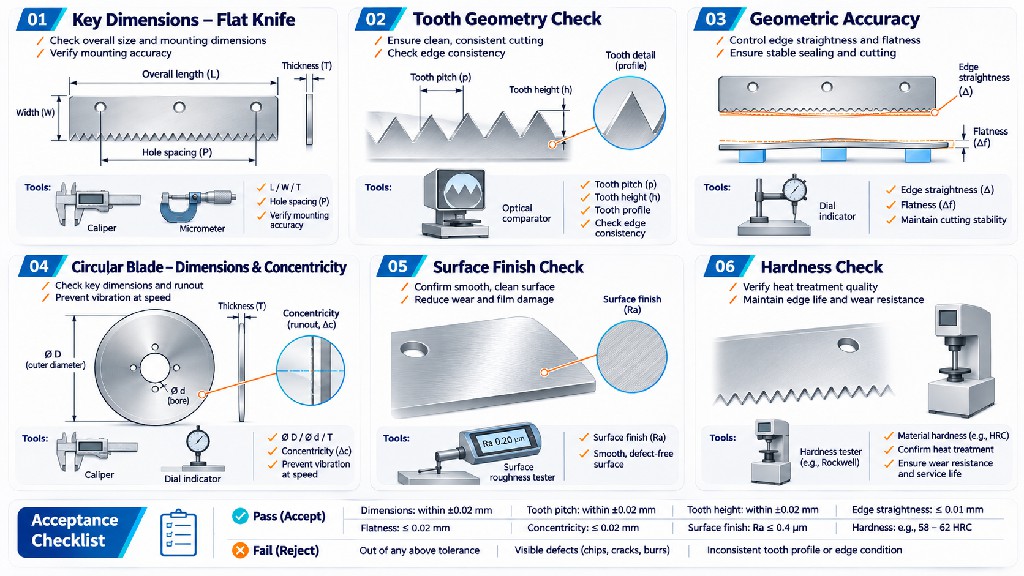
For practical inspection, use a profile projector, optical comparator, calibrated imaging system, or an agreed equivalent. Define the reference datum and measurement positions. On the order drawing, record not only pitch and depth but also whether the tooth tip should be pointed, truncated, radiused, or otherwise controlled. When the current knife has been heavily reground, it may no longer represent the original tooth profile.
A single-bevel tooth may approach the web differently when installed in the reverse orientation. Some knives are symmetrical; others rely on a specific active face. If the blade is mounted backward, the edge may push the film rather than sever it cleanly, even if the hole pattern fits. Mark the active face, cutting direction, and left/right orientation on the purchase drawing. For mirror-image parts, identify each separately.
When changing bevel angle or blade protrusion, verify the mating support and the machine's safety envelope. A new tooth pattern that looks excellent on a bench test may collide with the opposing jaw, cut into the seal, or overload the actuator in production. Modifications should be evaluated with the machine owner and, where required, the original equipment manufacturer.
A complete serrated cutoff creates two separate pack edges. A perforation intentionally leaves material bridges. A tear notch may be a localized cut at the package margin. Buyers often use these terms casually, but they lead to different drawings and inspections. Define the intended outcome in observable terms: full separation, connected chain of packs, finger-tear initiation, or a visually consistent sawtooth edge.
For a proposed easy-open design, test actual consumer opening behavior on conditioned finished packages. Film orientation, laminate structure, seal width, and product contamination can alter tear propagation. The right acceptance criterion might include allowable opening-force variation or the percentage of packs opening in the intended direction, but the values must come from the brand owner's product requirements. No generic packaging knife standard establishes one universal easy-tear force.
“Plastic film” is not a complete specification. Thin packaging webs are engineered structures with different stiffness, elongation, coatings, surface treatments, sealant layers, and friction properties. A knife selected for a paper wrapper may behave poorly on a ductile PE bag; a cutter optimized for an unprinted film may collect adhesive or coating residue when it encounters a new laminate. Procurement teams should therefore request the actual structure of the packaging web or as much of it as the brand owner can disclose.
| Packaging material or structure | Likely cutting challenge | What to examine in a blade trial |
|---|---|---|
| BOPP or oriented PP film | Stiffer orientation response, potential edge splitting or variable tear direction | Consistent cut initiation, film dust, tear direction, edge appearance |
| PE films and PE-rich sealant layers | Stretching, drawdown, strings, or heat-related sticking | Web restraint, tooth entry, unsupported tails, residue on the blade |
| PET-containing flexible laminate | Layer-to-layer differences in stiffness and fracture | Complete separation through all layers, fraying, delamination |
| Metallized or aluminum-foil laminate | Wrinkling, local tearing, possible abrasive or coating effects | Smooth edge, pinhole damage near cut, layer integrity |
| Paper or paper-plastic laminate | Fibers, dust, coating buildup, mixed fracture response | Fiber pull-out, edge cleanliness, residue, effective tooth profile |
| Nonwoven or porous packaging web | Fibers may bridge between cuts or entangle around teeth | Complete fiber severing, lint, repeatability, process cleanliness |
| Adhesive tape or coated web | Adhesive deposits, drag, reattachment of the cut edge | Surface finish, cleaning interval, adhesive transfer, film support |
Table 3 is a troubleshooting starting point. Resin labels alone do not predict performance; supplier datasheets, actual production rolls, and machine trials control the final decision.
BOPP and PET-based structures can have relatively directional mechanical behavior. Their cutting response depends on orientation, film thickness, additives, print and coating layers, and how the web is supported. A blade that leaves one edge satisfactory and another edge split may be interacting with web direction or a tension difference, not just a steel problem. Record whether the cut is parallel or transverse to the machine direction and whether the test film is conditioned consistently.
PE-rich layers are often chosen for sealing and flexibility. Under some conditions they stretch before the knife completes the cut. The operator may describe this as a dull blade, but the cause may also be an unsupported length of film, an incorrect angle of attack, or a knife that contacts one side before the other. Inspect the severed edge under magnification: a clean fracture or shear looks different from a drawn strand. If the web has recently changed to a softer sealant formulation, retest rather than blindly sharpening every blade.
Multilayer film combines unlike mechanical responses. One layer may split abruptly, another elongate, and a printed or laminated interface may expose adhesive at the cut. Evaluate whether cutting causes delamination or leaves a rough outer layer that affects appearance. In foil laminates, inspect for wrinkling and local damage beyond the nominal edge. If an unusual deposit appears on the knife, identify it before selecting an anti-stick coating. It could be adhesive, polymer residue, lubricant, environmental dirt, or material transferred from a worn counterface.
Paperboard, paper-plastic composites, and nonwovens can introduce fiber and dust control concerns. A tooth that tears fibers instead of severing them may create loose particles. For healthcare or sterile-barrier applications, the package specification and validated process requirements take precedence over generic knife marketing. The supplier should understand cleanliness, traceability, material compatibility, and the verification procedure appropriate to that process. No broad statement that a knife “works for medical packaging” substitutes for product-specific validation.
An accurately heat-treated knife will still fail if it cannot be located repeatably in the holder. Mechanical fit controls the position of the active edge relative to the web, sealing jaws, backup surface, and machine stroke. For an OEM replacement, the priority is reproducing the validated contact geometry; a beautiful new edge with an altered working projection can introduce collision risk or inconsistent cuts.
Record overall length and width, finished thickness, working-edge length, hole and slot diameters, hole-to-hole distances, hole-to-edge distances, countersink or counterbore dimensions, corner radii, and installed orientation. For formed or T-type parts, include finished offsets, angles, shoulders, and flatness or perpendicularity where needed. For rotary knives, add bore, outside diameter, face width, concentricity or runout criteria, keyways, and mating components. For serrated parts, state pitch, depth, included angle, tip condition, and placement relative to the mounting datums.
A drawing should use a clear datum system. Do not dimension several critical holes from independent, unverified edges when the machine actually locates the knife from one precision shoulder or bore. Specify critical dimensions according to the real functional interface and agree on the inspection method. The goal is repeatable interchangeability, not the largest possible number of tight tolerances.
An original unmodified blade is often the most useful starting reference. A used blade can reveal holder engagement and old tooth pattern, but wear, regrinding, corrosion, and accidental bending can distort the geometry. If several used samples are available, compare them. Mark the installed cutting direction and photograph the original assembly before removal under the machine's approved safe procedure.
A machinist should not assume a worn edge is a design reference. Ask for the OEM drawing, a new reference blade, or verified measurements from the assembly whenever possible. If only one damaged knife exists, identify the dimensions that are certain and those that need a prototype fit check. State the risk explicitly in the purchase process.
There is no industry-wide universal mounting-hole tolerance for packaging knives. A critical locating feature may need a close tolerance; a clearance hole may not. Imposing the same microscopic tolerance on every edge and hole can increase cost without improving the cut. Conversely, a loose locating feature may allow the knife to shift during every stroke. Set tolerances based on the holder, actual load path, measuring capability, and approved machine drawing.
GUANG CHUAN's published precision serrated blade product description includes specific figures for tooth pitch, hole position, and flatness. They are examples of product-specific claimed capability—not blanket commitments for all materials and blade shapes. For a new order, confirm the exact inspection points, lot sampling plan, acceptance criteria, and any manufacturing feasibility limitations in writing. The finished-knife inspection record should be understandable without reading a marketing page.
A knife engages another component, even if that component is simply a designed backing or cutting pad. Identify whether the mechanism is shear cutting, compression against an anvil, penetrating into a groove, or another OEM arrangement. The counterface's wear, position, resilience, hardness, and alignment can determine whether the knife cuts completely. If a new blade fails immediately across the same corner as the old one, measure the support and holder before ordering another grade.
Never specify a generic gap or a new blade penetration depth without the machine manufacturer's setup requirements. Excessive penetration can damage the knife, opposing component, heating jaw, or surrounding guards. Insufficient engagement creates incomplete cuts and strings. Refer to the machine manual or controlled engineering drawing for the safe permissible relationship.
A supplier's material name and glossy photograph are insufficient purchasing evidence. A commercial order should define what constitutes an acceptable knife, how that will be checked, and what records the buyer can obtain when a shipment differs from the approved sample. Strong suppliers can explain the complete manufacturing sequence and the inspection points that control the finished edge.
Ask for a stated material grade, applicable material specification, and lot or heat traceability appropriate to the order. Confirm whether the material is supplied as annealed stock and heat treated after shaping, or as another documented condition. Where substitutions are allowed, list the permitted alternatives. If a quote says “D2 equivalent,” request the actual chemistry standard, not simply a translation of the trade name.
Heat treatment influences hardness distribution, residual stress, dimensional stability, and toughness. The buyer should specify the required final hardness range and agreed verification method. Where useful, ask about distortion control, surface decarburization, and whether edge grinding occurs after heat treatment. A polished face alone cannot establish that tooth tips are free of thermal damage or microscopic cracks.
Inspect the functional edge for burrs, chipped tips, inconsistent tooth height, and local overheating marks. A sharp-looking knife can still have a weak tooth line that fails early. For repeated orders, it is practical to approve a representative first article or golden sample and retain its drawing revision and acceptance results.
A first-article report may include overall dimensions, locating features, critical serration characteristics, flatness, blade thickness, and active-edge position. Record the measuring equipment and method, especially for small tooth tips and radiused surfaces. A toleranced number without a defined datum or measurement direction is not actionable. Require units on all drawings and inspection records.
For high-volume orders, agree on sampling frequency, nonconformance handling, packaging protection, and traceability before mass production. First articles should not be treated as automatic approval for future substitutions. If the steel grade, process, heat treatment, tooth grinding method, or critical dimensions change, the buyer may need a new qualification trial.
The cutting edge can be damaged during shipping even when the part leaves the factory correctly. Request individual edge protection, corrosion prevention appropriate to the steel and destination, clear part identification, and separation of similar-looking left/right or revised parts. A shipment of precision knives piled together may arrive with damaged teeth, making the original inspection irrelevant. On receipt, check packaging integrity and perform the agreed incoming inspection before moving stock into production.
For custom production and inspection options, GUANG CHUAN describes its capabilities on the custom industrial blade service page. Buyers should ask for an offer-specific inspection and documentation package rather than assume every possible process applies to every SKU.
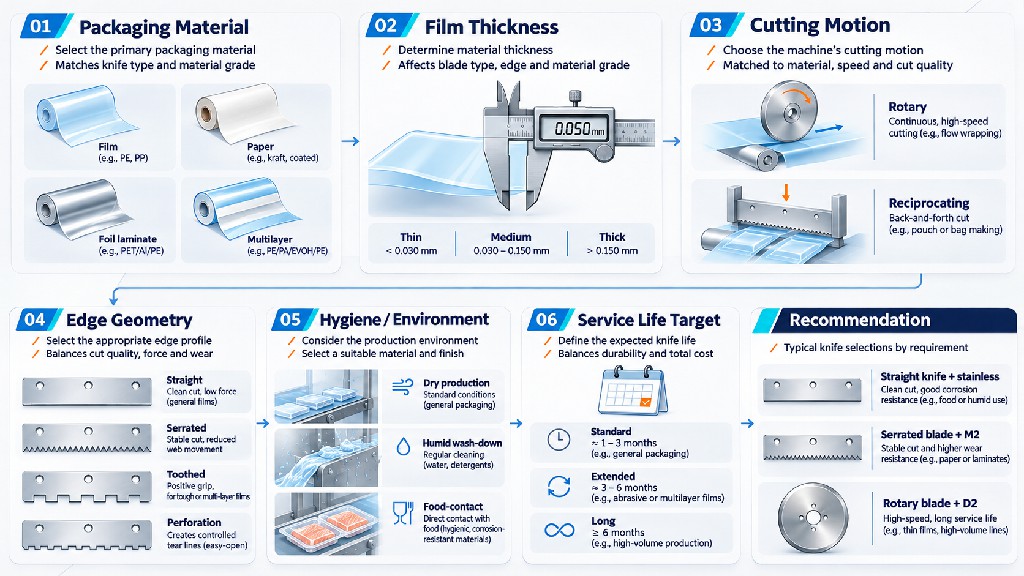
A useful selection workflow moves from the finished package backward to the machine and then to the knife. It prevents procurement from choosing an expensive grade before understanding the cut problem.
Define whether the package must separate completely, retain a controlled tear bridge, carry a serrated edge, or open with a validated tear feature. State the allowed defects in plain language: no hanging tails, no visible split toward the seal, no loose fibers, or no incomplete cuts in the agreed inspection sample. If there are brand-owner appearance requirements, include representative accepted and rejected packages.
Provide film supplier, film or laminate structure where available, total thickness and permitted variation, coatings, adhesive system if known, web orientation, and product contamination conditions. Send representative material rolls or samples from normal production, not just a catalog image. An approved trial on one structure does not necessarily qualify every alternative film supplier.
Record machine manufacturer, model, year or revision if available, cutting unit type, normal and maximum speed, stroke or rotation arrangement, counterface type, available clearance, and whether the cutter is integrated into sealing jaws. Include current blade part number and photos with scale. Do not omit these details when buying a supposedly standard replacement; OEMs may revise holder designs without changing the general model name.
Is the knife simply worn at the normal maintenance interval? Does it fracture after a few hours? Does it produce different defects only at higher speed? Does it accumulate deposits after a film change? Is the problem confined to one side? Photographs and defect samples are more useful than “bad quality.” Measure actual service life and the frequency of unexpected interventions.
Treat confirmed holder dimensions and safety-critical clearance as non-negotiable unless a machine modification is separately approved. Compare straight and toothed profiles using the required pack result. Select material grade and heat-treatment range according to the failure mode. If a coating is proposed, add separate approval requirements for thickness, condition, and environment.
Use a known-good baseline knife, one proposed alternative, the same film lot if possible, and the same machine conditions. Record packs made, actual line speed, operating minutes, rejected cuts, reason codes, stoppages, tool inspections, and any change to sealing quality. Ideally repeat over more than one shift or film roll when variability is expected. Do not interpret a short “it cuts” demonstration as proven long-life performance.
Finalize the drawing revision, material, heat treatment, edge profile, surface condition, quantity, inspection plan, packaging method, and change-notification requirements. Store accepted trial samples and documentation so that a future purchaser is not forced to reconstruct the original selection. If the purchase involves a distributor, require preservation of the manufacturer traceability and drawing revision across the supply chain.
Purchasing managers should compare not just blade price but the cost of keeping the cutting station producing good packs. A cheaper knife can be the correct choice when changeovers are fast and predictable; a premium knife may be better when a stoppage disrupts an entire high-output line. The economic result depends on the actual service interval, replacement labor, downtime value, rejected packages, sharpening costs, and any extra quality or cleaning work.
A practical simplified model is:
Cost per 1,000 successful cuts = 1,000 × (blade purchase cost + changeover cost + attributable lost production cost + incremental scrap/rework cost) ÷ successful cuts between changes.
Keep units consistent and do not count the same lost production twice under both changeover and downtime. When the machine produces more than one pack per cutting stroke, convert strokes to actual good packages before comparing product-level economics. If two candidate knives create different reject rates, use the number of accepted packages as the denominator.
Suppose the following are hypothetical trial assumptions for one station: Blade A costs US$40 and produces 200,000 acceptable cuts between changes; Blade B costs US$70 and produces 400,000 acceptable cuts. Both require one 12-minute line stop per change. The production stop is valued at US$180 per hour, and scrap/rework attributable to each blade change averages US$5. Assume no additional labor charge beyond the chosen stop valuation, and no difference in cleaning or other operating costs.
Blade A's per-change cost is $40 + (12/60 × $180) + $5 = $81. Over 200,000 acceptable cuts, that is $0.405 per 1,000 acceptable cuts. Blade B's per-change cost is $70 + $36 + $5 = $111. Over 400,000 acceptable cuts, that is $0.2775 per 1,000 acceptable cuts. Under these assumptions, B saves $0.1275 per 1,000 acceptable cuts, or $127.50 per million acceptable cuts.
These figures are illustrative arithmetic, not GUANG CHUAN testing data, supplier quotations, or a promised blade life. If B chips early, creates more rejects, or requires additional setup, the conclusion may reverse. Use your recorded production numbers and compare at least one complete representative service interval before approving an upgrade.
For a high-value printed laminate, scrap and customer complaints may dominate knife price. For a low-cost, fast-change station with redundant capacity, unit cost and supply availability may matter more. For an integrated sealing-and-cutting jaw, an incorrect replacement may damage expensive mating hardware. Weight the purchasing decision according to the actual risk profile of the line and document the decision with data a maintenance manager can reproduce.
A low unit price is not automatically good value if parts arrive with inconsistent hole locations or if only some knives from a batch match the approved tooth profile. Hidden costs include setup adjustment, emergency freight, extra inspection, damaged seals, and longer procurement lead time. A transparent quote should separately identify the blade material, custom tooling or setup costs, minimum order quantity, first-article charge, inspection documents, export packing, delivery terms, and the policy for nonconforming parts.
Knife failure should be described by its visible evidence and operating conditions. The following troubleshooting logic helps distinguish an edge-quality problem from a machine or substrate problem. All inspection and replacement work must follow the site's approved machine isolation and safety procedure.
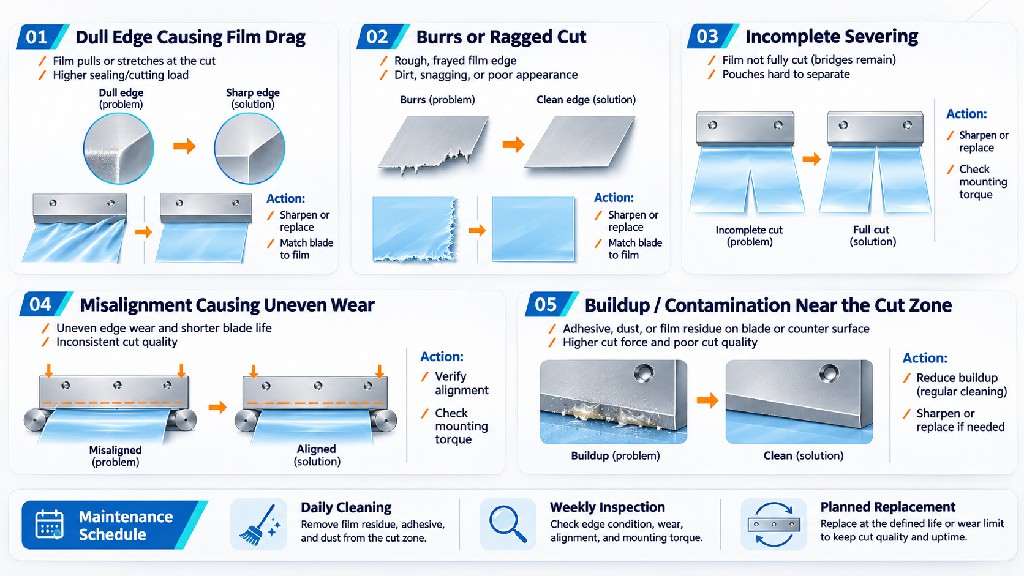
When a thin strand remains between adjacent packs, inspect where the strand appears. A repeated defect at the same location suggests local blade damage, anvil wear, blade bow, uneven penetration, or a fixed support problem. Random defects that rise at higher speeds suggest web movement, timing, or inconsistent tension. If a new blade works briefly but quickly develops tails, check whether the opposing surface or cutting depth is damaging it. Changing steel before inspecting alignment can make failures recur.
Uneven teeth, chipped tips, aggressive penetration, or a mismatch between tooth geometry and substrate can produce torn edges and particles. Compare a magnified edge with the drawing and an accepted reference. If the problem began after regrinding, inspect whether the original tooth profile was preserved. For paper and nonwoven webs, distinguish unavoidable process fibers from unacceptable loose debris using an agreed cleanliness test.
Chipping may result from excessive hardness for the duty, poor heat treatment, side loading, counterface contact, poor seating, or impact from foreign material. Inspect the fracture location and whether damage clusters at one corner. Verify mounting torque and support according to the machine manufacturer's instructions, and check for contact marks on nearby components. A tougher grade or modified tooth tip may be appropriate only after the mechanical source of shock has been considered.
Residue increases friction and can drag film instead of cutting it cleanly. Determine whether the deposit comes from hot-melt adhesive, sealant layers, coatings, cleaning chemicals, or transfer from another component. Correct temperature and web-handling problems before requesting a non-stick treatment. Cleaning frequency is a useful trial metric; a coating is successful only if it reduces deposit-related problems without creating unacceptable wear, flaking, or cleaning restrictions.
Rust spots and pitting can change the cutting edge and increase the risk of contamination. Investigate washdown conditions, condensation, storage, chemical exposure, and the actual steel grade. A stainless alternative may be sensible, but no stainless steel is immune to every cleaning chemical. Confirm chemical compatibility and drying/storage practices. Do not assume visible discoloration is always ordinary corrosion; heat effects, transferred material, or surface treatment damage can look similar.
Possible causes include incorrect tooth pitch, reversed bevel, altered protrusion, different heat treatment, oversize or poorly located holes, or a manufacturing drawing that copied an already worn sample. Compare the new and old parts dimensionally, then inspect the assembly and the cut. An inexpensive fit-check sample before a bulk purchase can prevent a large inventory of incompatible knives.
Do not treat the cutter as the sole cause. Verify seal temperature, dwell time, pressure, film structure, contamination in the seal area, jaw condition, and registration. Examine whether the knife is cutting into the sealed band or pulling on it. Test finished packs against the product's seal and integrity requirements. The blade may be part of the failure mechanism, but a cutter replacement cannot substitute for sealing-process control.
Replacement work involves sharp edges, moving equipment, and sometimes stored pneumatic, electrical, hydraulic, or thermal energy. Site procedures and the OEM instructions must govern. In the United States, OSHA 29 CFR 1910.147 addresses hazardous-energy control during servicing, while 29 CFR 1910.212 describes machine-guarding requirements. No instruction in a supplier article is a substitute for trained maintenance personnel or the site's safety program.
Before installing a replacement, confirm the part number, drawing revision, cutting direction, mounting surfaces, and condition of the mating component. Protect personnel from blade edges and verify that fasteners, spacers, and locating features are correct. Follow the OEM's tightening sequence and torque requirements; do not invent a universal torque for an unknown machine. After the approved setup and guarding checks, conduct a controlled test and inspect the first packs at the validated operating conditions.
For routine care, record pack count or cycles at each knife change. Inspect for chipped teeth and buildup at defined intervals; maintain only when the machine is in a safe state under the prescribed procedure. Clean with chemicals and tools approved for the blade material and surrounding hygienic environment. Avoid uncontrolled scraping or abrasive treatment that changes tooth geometry. Store spare knives with protected edges in dry, labeled packaging and segregate different revisions.
Sharpening may be possible for certain straight or toothed knives, but the allowable stock removal depends on original geometry, minimum blade dimensions, heat-treated depth, and mounting position. Regrinding a serrated knife without controlled tooth restoration can change pitch, depth, and tip profile. Establish a discard limit and an inspection requirement before treating sharpening as a cost-saving measure. In many thin or highly customized knives, replacement may be more reliable than repeated regrinding.
A capable supplier should be able to discuss the machine, the material being cut, the current defect, and the drawing—not simply quote a steel grade. The quality of a technical response is itself a useful sourcing signal. Procurement can reduce risk by asking a few precise questions before requesting bulk production.
First, does the supplier distinguish a complete cutoff from perforation, and understand where the blade is positioned relative to the seal? Second, can it explain the selected material and heat treatment in terms of actual failure modes? Third, can it measure serrations and critical locating features, and provide a first-article report? Fourth, can it reproduce the approved part across lots and notify the buyer before changing materials or processes? Fifth, can it protect edges during shipment and support traceable replacement orders?
A good quote does not need to promise a dramatic percentage increase in blade life. It should define the proposed part, key assumptions, documentation, lead time, and a test plan. If the supplier recommends a premium grade, request the technical reason and what trial evidence would confirm its value. For an unproven shape, a prototype or small pilot order often costs less than an unsupported production run.
GUANG CHUAN presents custom packaging toothed knives among its product categories, alongside HSS serrated knives, T-type VFFS cutters, and shaped perimeter dies. Its customization and service information describes material selection, heat treatment, surface treatment, and inspection services. A buyer can request an application review based on drawings or samples, while confirming which materials, dimensions, tolerances, documentation, and delivery terms are feasible for the specific job.
For procurement discussions, reference the relevant packaging machine toothed blades category, rather than asking for an unspecified “packaging blade.” The category contains examples that help identify whether the required part is a straight-tooth cutter, precision HSS blade, T-type part, or perimeter die.
An effective RFQ lets multiple suppliers price the same technical scope. Without consistent data, one quote may include the correct heat-treated custom blade and inspection report, while another silently assumes a standard economy grade. The lowest number then reflects a different product rather than a better offer.
Machine and process: Equipment manufacturer and model; cutting-unit type; whether VFFS, HFFS, tray seal, bag making, or converting; normal and maximum running conditions; and whether the knife participates in a jaw assembly.
Material being cut: Film or laminate description, thickness range, orientation, coatings, product-contact or washdown conditions, and representative samples where permitted.
Knife definition: OEM part number, dimensioned drawing with revision and datums, photographs with scale, installed cutting direction, tooth geometry, bevel, material grade, and required final condition. Identify the mating knife or anvil when applicable.
Quality and acceptance: Hardness requirement and test method; critical dimensional tolerances; burr/chip criteria; first-article report; sampling plan; material traceability; and the finished-package performance trial.
Commercial terms: Trial quantity and annual usage, order quantity, required delivery date, destination, Incoterms where relevant, packaging, payment terms, and whether a recurring supply agreement is desired.
Current pain point: Typical blade life measured in cycles or acceptable packs, cutting defects with photographs, stoppage frequency, existing scrap rate, cleaning interval, and what improvement would justify a higher unit price.
The RFQ can also request an explicitly labeled alternative. For example, ask for one price that reproduces the current geometry and another that proposes improved wear resistance, with technical differences highlighted. That approach preserves an OEM-equivalent baseline while allowing a controlled upgrade trial. Avoid mixing several changes at once—new steel, new tooth pitch, and new coating—unless the experiment is structured to identify which change helped.
In everyday purchasing language, usually yes: suppliers use the terms for the replaceable cutting components installed on packaging equipment. However, neither term defines the cutting action or physical geometry. A blade can be a straight strip, toothed insert, rotary disk, perforator, shaped die, or another machine-specific tool. Always specify the actual component and how it interacts with the film and counter-surface.
There is no universally best material. A conventional high-carbon or alloy steel can be economical for stable-duty service. D2-type tool steel can be attractive when abrasive wear dominates and the holder is mechanically sound. M2 HSS may justify its cost in demanding wear situations. Stainless steel becomes important when corrosion and cleaning conditions require it. Cemented carbide may suit selected rigid high-wear applications. The best choice must be validated on the machine and evaluated by cost per acceptable package.
Not necessarily. Serrations change the way the edge contacts the material, but life depends on tip strength, steel grade, heat treatment, cutting load, counterface, substrate, and setup. Fine teeth may chip sooner than a well-supported straight edge in one application; in another, a suitably designed serration may reduce stretching and lower the number of missed cuts. Compare controlled trial data, not appearance or an unsupported “long-life” claim.
Only after confirming its dimensions, mechanical duty, fracture risk, and heat-treatment requirements. D2 and M2 have different property trade-offs, and a grade substitution can change tooth toughness even when nominal hardness looks similar. Ask the supplier for a documented alternative and evaluate sample knives on the actual web. Do not assume a one-to-one substitution based on hardness alone.
Use the original drawing or an appropriately calibrated optical measurement method. Pitch is measured between corresponding positions on adjacent teeth according to the defined reference direction. Measure several intervals to detect cumulative errors and confirm end margins separately. A ruler against a worn or damaged blade is not reliable for a tight-tolerance serration. Include tooth depth, tip geometry, bevel, and pattern position in the specification.
No general interchangeability rule exists. Both processes can use transverse cutoffs, but the jaw layout, motion, mounting, length, projection, and mating surfaces may differ. Some VFFS machines use T-type or formed blades; some HFFS systems use rotary arrangements. The machine's exact cutter assembly and drawing determine compatibility, not the broad machine category.
Only indirectly, and only if knife action was disturbing the sealing process. Seal strength primarily depends on film structure, sealing temperature, pressure, dwell time, contamination, and jaw condition. A correctly positioned knife can avoid pulling or cutting into the sealed area, but seal-strength verification remains a separate task. Use the brand owner's acceptance plan and a relevant method such as ASTM F88/F88M when appropriate.
The company's published OEM/customization information states that it accepts technical drawings and physical samples for bespoke blade work. A good sample enables an initial fit study, but a worn sample may not contain the original tooth shape or critical dimensions. Supply the machine model, installation photographs, material details, and expected cut result to improve the chance of a correct first article. Confirm feasibility and quotation details directly for the exact part.
Use the machine drawing and functional locating system. A precision locating hole may require tighter control than a clearance fastener hole, and a tolerance meaningful for one blade design can be inappropriate for another. Specify datums, nominal size, position, and measurement method. Avoid copying a tolerance from a supplier's unrelated product listing into a new drawing without engineering review.
Replace according to monitored performance and an agreed safe maintenance limit, not an arbitrary universal number of days or packs. Track good cuts, defect rate, edge damage, stop duration, and any rising load or contamination. If the operator consistently observes a defect trend before failure, schedule replacement earlier and review whether the cause can be corrected. Do not continue using chipped or unsafe blades merely to meet a cycle target.
No. Stainless grade is one consideration, but suitable material documentation, finish, hygienic design, cleaning compatibility, contamination prevention, and actual food-contact status also matter. A food packaging line can contain components that never contact food and components that may contact it directly. Confirm the required regulatory and customer specifications for the real use, rather than relying on an unqualified “food grade” label.
If the existing knife delivers reliable package quality and acceptable cost, reproducing the approved geometry is usually the lower-risk purchasing path. Redesign makes sense when you can define a repeatable problem and test a plausible improvement. Preserve the current knife as a control sample, approve a revised drawing, run a structured trial, and keep the revisions separate in inventory.
Select packaging machine knives as precision components of a cutting system rather than interchangeable consumables. Start with the required finished package; verify whether the machine needs a smooth cutoff, serrated separation, perforation, rotary slitting, or shaped perimeter cut. Then confirm the mounting geometry, evaluate tooth profile and blade material against the real substrate, and use documented quality checks to support repeat purchasing.
For commercial decisions, compare accepted packs between changes, defect-related waste, cleaning stops, changeover cost, and lead-time risk—not only the purchase price of individual packaging machine blades. Request evidence of material grade, heat treatment, dimensional inspection, and trial performance. Where a knife appears to damage a seal, investigate the complete cutting-and-sealing process instead of assuming the edge alone controls package integrity.
GUANG CHUAN offers toothed packaging knives and custom cutter designs for relevant machine configurations. To discuss an OEM replacement or tailored packaging cutter blade, send the current drawing or measured sample, machine model, film specification, cut-quality target, and current failure description through the GUANG CHUAN contact page. A clearly defined application gives both buyer and manufacturer a stronger basis for quoting, testing, and building a dependable long-term supply arrangement.

Leave A Message
Scan to WhatsApp :

 English