



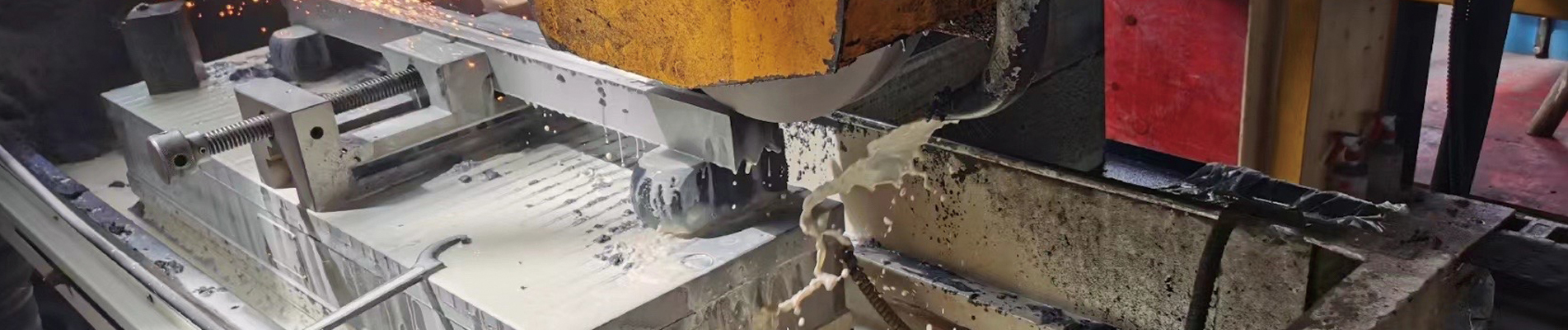

A plastic crusher does not necessarily have an electrical problem when its motor starts drawing more current. Very often, the motor is doing exactly what the cutting chamber demands: delivering more torque because plastic is being squeezed, bent, rubbed, or repeatedly recut rather than sheared cleanly. The difference can be a worn rotor knife, a damaged fixed bed knife, an incorrect cutting gap, or a screen that is preventing material from escaping. These faults increase the work required to make each kilogram of acceptable regrind. Before replacing an expensive motor, investigate the blades and their operating conditions.
Quick answer: When investigating plastic crusher high power consumption, compare the machine against a repeatable, safe operating baseline; record actual three-phase input power, throughput, and product quality; then inspect the rotor and stationary knives, their clearances, the screen and discharge, and the incoming feed. Dull crusher blades and badly adjusted knife pairs are common causes of excess cutting resistance, but a granulator high motor load can also come from overfeeding, foreign objects, bearings, belts, poor voltage, or an undersized machine. Confirm the cause before purchasing parts.
Safety comes first. Never open, reach into, adjust, or manually clear a cutting chamber while the machine can start or the rotor can move unexpectedly. Only authorized personnel should isolate hazardous energy, restrain stored mechanical motion, perform knife service, and restore guards. Follow the exact machine maker's instructions and your jurisdiction's requirements. The U.S. Occupational Safety and Health Administration's hazardous-energy control standard, 29 CFR 1910.147, explains the need for documented procedures, energy isolation, and verification before covered servicing activities.
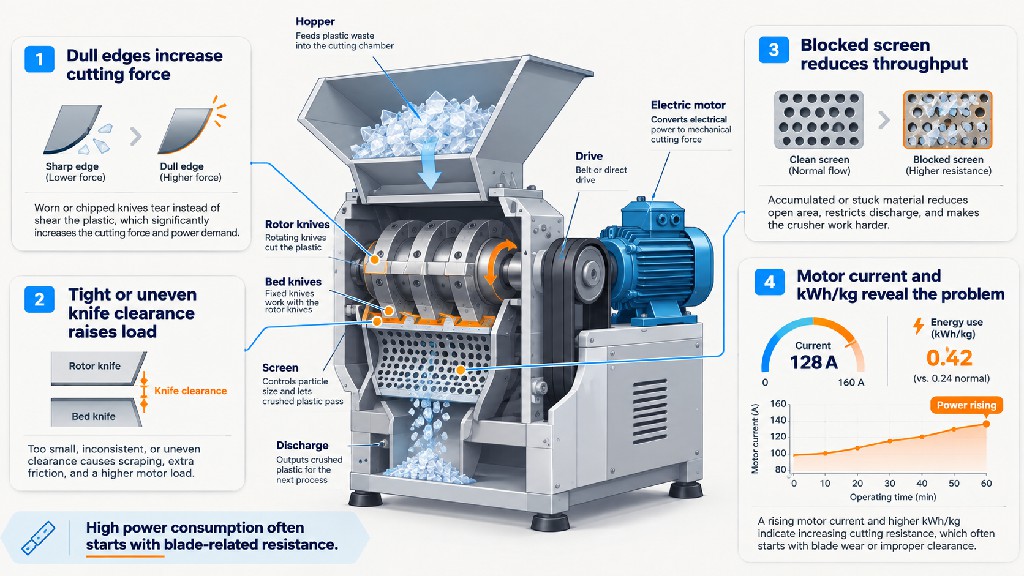
Plant teams use several expressions for the same complaint: the electricity bill went up, the motor is running hot, an overload relay trips, or the machine produces less material than before. These are not identical diagnoses. A higher bill might result from longer working hours, a tariff change, a new downstream conveyor, or lower production volume. An overload trip might be a short current spike or a persistent mechanical overload. A lower throughput can make the cost per kilogram rise even when the motor's instantaneous power barely changes.
Three different measurements should be separated at the start. Current is measured in amperes and describes electrical current flowing to the motor. Real power is measured in kilowatts (kW), the instantaneous rate of electrical energy use. Energy is measured in kilowatt-hours (kWh), the accumulated consumption over time. For production decisions, add specific energy consumption, normally stated as kWh per kilogram or kWh per tonne of acceptable output. This final metric tells a purchaser what the size-reduction stage costs to run per unit actually delivered.
The U.S. Department of Energy's Premium Efficiency Motor Selection and Application Guide explains why direct power measurement is preferable when assessing a motor's load. Current alone is affected by voltage, power factor, and partial-load behavior. The guide also stresses that trained electrical personnel must carry out appropriate measurements. A panel display labeled "amps" is useful for trending but is not a substitute for a true power measurement when calculating an energy-saving business case.
Consider two production shifts. During the first, a granulator averages 19 kW and makes 350 kg of acceptable regrind each hour. During the second, it averages 19 kW but makes only 250 kg per hour because material circulates in the chamber. The real-power reading has not increased. Nevertheless, specific energy consumption has climbed from 0.0543 to 0.0760 kWh/kg, approximately 40% more electricity per kilogram. This is an illustrative calculation, not a test result from GUANG CHUAN or a claimed industry benchmark. It demonstrates why measuring throughput matters as much as observing the motor.
A properly designed baseline records the motor and drive configuration, actual speed, feedstock type, feed form, feed rate, screen opening, blade installation condition, three-phase electrical data, average and peak real power, run time, accepted production weight, and product defects. It also records relevant ancillary loads if the energy meter includes them. Comparing unlike operations may create a false explanation: processing rigid PET preforms is not the same duty as loose polyethylene film, and a smaller screen can alter residence time even if the knives remain sharp.
For an existing line, the most valuable reference is a stable production period immediately after a correctly performed knife service, when the process was producing acceptable regrind. Record that result and repeat the same measurement method at later intervals. A single dramatic current spike during a large feed piece is not the same as a progressive increase in average loading. Measurements should cover enough operating cycles to represent normal production, not just a convenient instant.
A screened plastic granulator typically has rotating knives on a rotor, stationary bed knives on the housing, and a screen through which adequately reduced fragments exit. The knives are intended to work as a coordinated shearing system. Each passing rotor edge should separate material efficiently against the stationary edge. If a moving edge is rounded or its partner is damaged, the material can deform before it fractures. More rubbing and repeated cutting attempts then become necessary to achieve the same screened size.
This mechanism is described in Conair's plastics granulator maintenance guidance, which associates poor cutting conditions with rising heat and motor power draw and emphasizes sharp knives, correct adjustment, and serviceable screens. It is useful industry evidence of the failure mechanism, not a claim that every rise in electrical demand has the same cause.
For buyers unfamiliar with the distinction between blade names, GUANG CHUAN's crusher blades versus granulator knives guide explains why a screened high-speed plastic crusher may be marketed as a granulator while a heavy primary shredder can have a fundamentally different cutting system. The correct troubleshooting method depends on which machine is installed. Do not apply a rotor-and-bed-knife adjustment procedure to an intermeshing dual-shaft shredder.
Wear gradually increases the cutting-edge radius. The operator may see material bridging across the shear zone, long strips, torn edges, or an increased fraction of fines. A sharp edge needs less material displacement before fracture, whereas a rounded edge pushes and flexes more material. Under otherwise comparable conditions this can increase resistance to cutting, dwell time inside the chamber, and heat generated by friction. Motor-current patterns may become less stable as pieces bounce and are caught repeatedly.
However, rounded edges do not always make the motor's current increase in a simple straight line. A dull machine may stop accepting material, partially starve itself, or trip before a stable higher loading can be measured. Some materials deform without breaking; other materials fracture suddenly. The key is the combination of blade inspection, production rate, particle appearance, and matched electrical records. Edge condition is a causal hypothesis until a controlled test supports it.
A rotor knife experiences repeated engagement and cyclic forces as it moves past the bed knife. Localized impacts, contamination, incorrect projection, loose mounting, or poor seating can damage its edge. The bed knife provides the reaction surface: a chipped or bowed stationary edge may leave parts of the rotor width cutting poorly even if the rotating knives look bright. Correctly sharpening only one side of a badly worn pair can therefore produce disappointing results.
A maintenance log should identify the blade position rather than merely writing "crusher knife replaced." GUANG CHUAN's rotor knives versus fixed bed knives technical guide explains this relationship and why their mounting details and replacement quantities differ. A purchasing order should describe each position separately, with the original part numbers or controlled drawings where available.
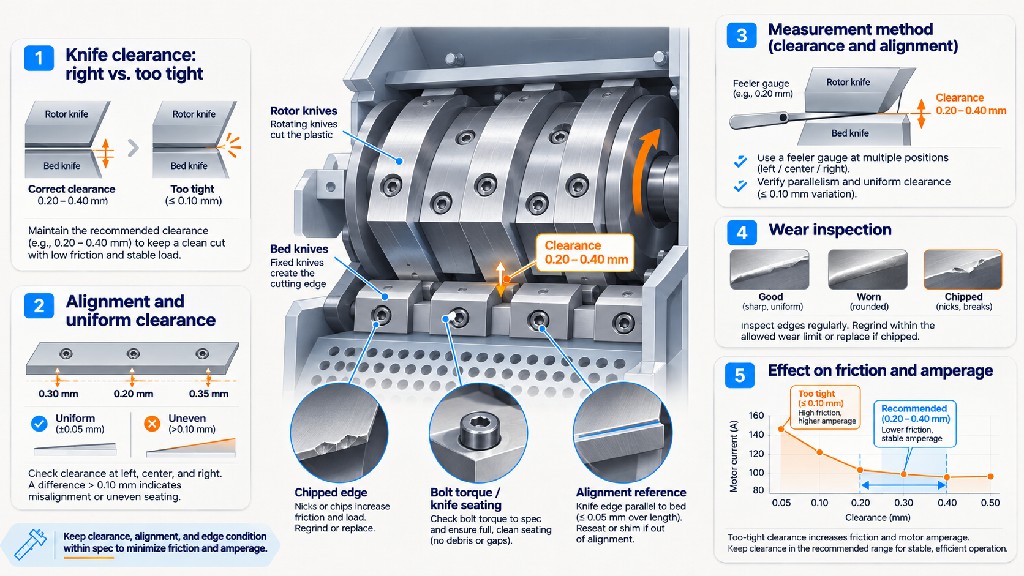
The clearance between the closest passing rotor and bed knife edges is one of the most important machine-specific settings. Excessive gap can let thin or flexible material fold and escape the first cut. Extremely small clearance, incorrect knife projection, or mechanical deflection can create rubbing or actual knife contact. Either condition may elevate energy use, though the symptom pattern and severity differ. If knives touch, stop and correct the mechanical danger rather than trying to continue until the edges "wear in."
There is no universal safe knife gap for every crusher. A Conair granulator maintenance discussion instructs owners to adjust the moving-to-fixed-knife gap according to manufacturer recommendations. Different machine manuals give different settings and procedures. A number published for one rotor diameter or series must never be copied blindly into another machine. It is the OEM drawing and maintenance manual, not a supplier's generic blog range, that controls installation acceptance.
An experienced technician can narrow down a fault using operating records and observations made from a safe location. The diagnosis becomes faster when symptoms are divided by time and operating state: what happens at no-load, at start-up, under stable feed, as the screen fills, and after a product or screen change? In particular, note whether the plastic granulator current increase occurs gradually over days, suddenly after maintenance, or only when a specific material enters the machine.
| Observation during operation | Plausible causes to investigate | Useful next evidence |
|---|---|---|
| Loaded power rises gradually and acceptable throughput falls | Edge rounding, wider cutting gap, screen restriction, feed changes | Blade service history, output weight, screen condition, product samples |
| No-load power rises significantly after service | Interference, bearing drag, belt or drive issue, changed operating speed | Safe mechanical inspection and qualified electrical measurements |
| Short current peaks accompany loud impacts | Large rigid pieces, contamination, intermittent feed, loose components | Feed audit, metal detection, impact history, event log |
| Output grows hotter; film smears or wraps | Dull edges, friction, poor discharge, unsuitable feed presentation | Regrind temperature, blade condition, screen airflow, material form |
| Current differs considerably across motor phases | Supply imbalance, wiring or motor issue, plus possible load effects | Qualified three-phase voltage and current measurements |
| High kWh/kg despite unchanged kW | Lower accepted throughput, more recutting, excessive idle operation | Production mass and energy logged over the same interval |
Diagnostic matrix: symptoms are indicators, not proof. Stop the machine under its approved procedure when vibration, suspected knife contact, guard problems, or abnormal heat creates a safety concern.
A motor that operates normally without feed but struggles during cutting points toward the process or load-dependent parts of the drivetrain. First verify whether the feed has changed. The same nominal polymer can have different wall thickness, fillers, moisture, contamination, or bulk density. Next inspect product samples: long tails, bent fragments, irregular oversized particles, or increased dust may support a cutting or screen problem. A representative sample is more informative than a vague complaint that material looks "rough."
If the problem appears only on one material stream, retain a clean control sample from the previously acceptable process. Review whether a small screen has been installed, whether material arrives in large compacted lumps, and whether the upstream conveyor delivers surges. If all of these are unchanged, a blade inspection becomes especially valuable. A sharpness diagnosis is more convincing when both electrical loading and cutting quality move in the same direction.
High no-load power demands a different starting point. Possible causes include tight or contacting knife assemblies, damaged rotor bearings, misalignment, dragging seals, belt tension, or another driven accessory. Electrical disturbances can also affect current readings. A blade set that was installed incorrectly may generate a high mechanical load without processing any plastic, but ordinary edge dullness alone is a less persuasive explanation for a sudden idle-load increase. Do not feed the machine to "test whether it clears itself" when interference is suspected.
Record the speed, drive status and operating temperature after a properly guarded, OEM-approved test. A qualified electrician can check motor voltages and true power; maintenance specialists can inspect the isolated machine for rotating resistance, seat damage, bearing play, and approved clearances. Record any changes made, since resetting several variables at once makes the original cause hard to prove.
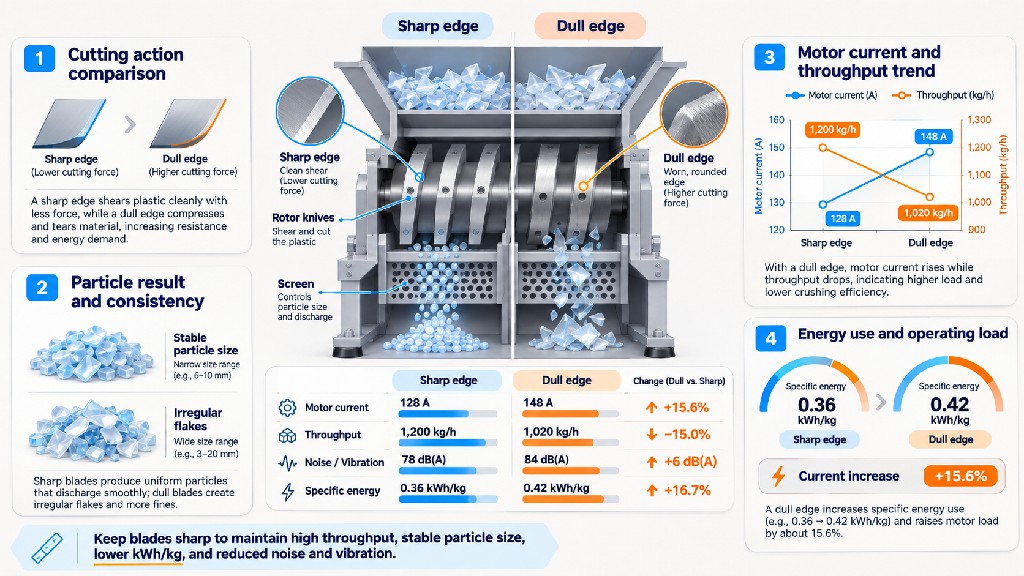
Crusher machine power consumption can be reported at the electrical panel, motor terminals, variable-frequency drive, or entire recycling line. Each location measures a different boundary. A motor-only measurement may exclude a vacuum blower, conveyor, dust extractor, or hydraulic feeder. A plant-submeter measurement may include all of them. Both figures are useful if the chosen boundary is clearly documented and remains unchanged in the before-and-after comparison.
For a reasonably balanced, sinusoidal three-phase supply, real input power is represented by P (kW) = √3 × V(line-to-line) × I(line) × PF / 1,000, where PF is the actual power factor. This formula appears in the U.S. DOE motor guide. It is not permission to estimate power from current alone, nor is this simple calculation appropriate without considering waveform distortion, unbalance, or the measurement point on a variable-frequency-drive system. Use a suitable true-power analyzer or trusted metering with the correct instrument configuration; leave electrical access and tests to qualified people.
For example, 400 V, 32 A, and power factor 0.82 imply about 18.2 kW for a balanced three-phase case. At the same voltage and current, power factor 0.72 implies about 16.0 kW. These illustrative electrical calculations show why identical amperes do not guarantee identical kW. They do not represent measured performance of a specific granulator. If a plant records only the amperage, it can detect a trend but cannot defend an exact annual savings claim.
The calculation is straightforward: Specific energy (kWh/kg) = measured energy over a production interval (kWh) ÷ accepted output mass in that same interval (kg). An equivalent steady-state calculation uses measured average real power divided by accepted output rate in kg/hour. To convert to kWh per tonne, multiply kWh/kg by 1,000. If only 85% of the material produced is accepted, count the accepted portion when evaluating the actual product cost. If the customer wants energy per tonne of incoming feed instead, calculate that separately and label it clearly.
One carefully described academic case illustrates why machine design can matter. A 2018 KTH master's thesis on a polyethylene-recycling granulator reported specific energy falling from 256.485 to 208.122 kJ/kg after installation of a redesigned rotor: a reduction of 48.363 kJ/kg, or approximately 18.9%. Converted to electrical-energy units, those levels are about 0.07125 and 0.05781 kWh/kg. This was a particular rotor replacement case study, not an experiment proving that sharpening knives alone saves 18.9%, and not an industry-wide forecast. Its practical lesson is to measure energy relative to useful production under comparable operating conditions.
Use the same polymer stream, equivalent incoming piece size and contamination, screen and discharge setup, motor speed, measurement boundary, weighing method, and acceptance standard. Document the blade edge condition and the gap before and after service. If the machine was simultaneously given new bearings, a bigger screen, and a redesigned feeder, the resulting energy improvement cannot fairly be attributed entirely to the new knives. A properly planned trial isolates one primary change or discloses every change that matters.
Start and stop conditions also matter. A short batch may consume a substantial fraction of its metered energy while warming up, clearing material, or idling. For a line running intermittently, include those stages if they are part of normal production. For steady continuous operation, log a stable representative period after normal running conditions are reached. If comparing whole-shift economics, use a whole-shift boundary for both periods. The measurement method should reflect the decision being made.
The fastest troubleshooting process is not to dismantle everything at once. It is to identify the operating pattern, rank the likely causes, make a safe inspection, correct a verified defect, and retest against the original baseline. The following sequence is meant as a planning framework for trained plant personnel; it does not replace the granulator manufacturer's procedure or authorize live inspection of guarded machinery.
Ask the operator when the rise started and whether it correlates with a new resin, a screen change, a replacement blade set, a motor repair, or an upstream feeder adjustment. Record the machine model, nameplate motor power, typical loading, and any recent protection trips. If a trend display is available, distinguish steady load from peaks and record whether its scaling or sensor has changed. Ask whether the electricity complaint concerns one machine's metered consumption, an entire plant's bill, or an unexpected increase in demand charges.
Examine production documents for the last known good run. How many kilograms of acceptable material were produced per hour? Was the machine cleanly cutting, or did it require frequent stops and clearing? Were there new contaminants, hotter parts, or abnormal noise? Write down hypotheses before dismantling the cutter. A clear timeline often identifies the first check without guessing.
With all guards in place and the machine operated according to its normal procedure, have qualified personnel record real power, phase conditions, running speed, material mass, and elapsed time. Use representative production and a defined metering boundary. Record material grade and form, estimated contamination, screen size, and whether the machine is being starved or overfed. Where available, note peak load and the frequency of overload warnings, but do not deliberately induce dangerous stalls to create data.
If a variable-frequency drive is fitted, log commanded speed, actual operating speed, power and warning history using parameters whose meaning is confirmed from the drive manual. Drive output current and calculated torque may be useful trends; they are not automatically the same as incoming electrical kW. If the existing electrical configuration is uncertain, involve the motor or controls supplier rather than treating a drive percentage display as a calibrated energy meter.
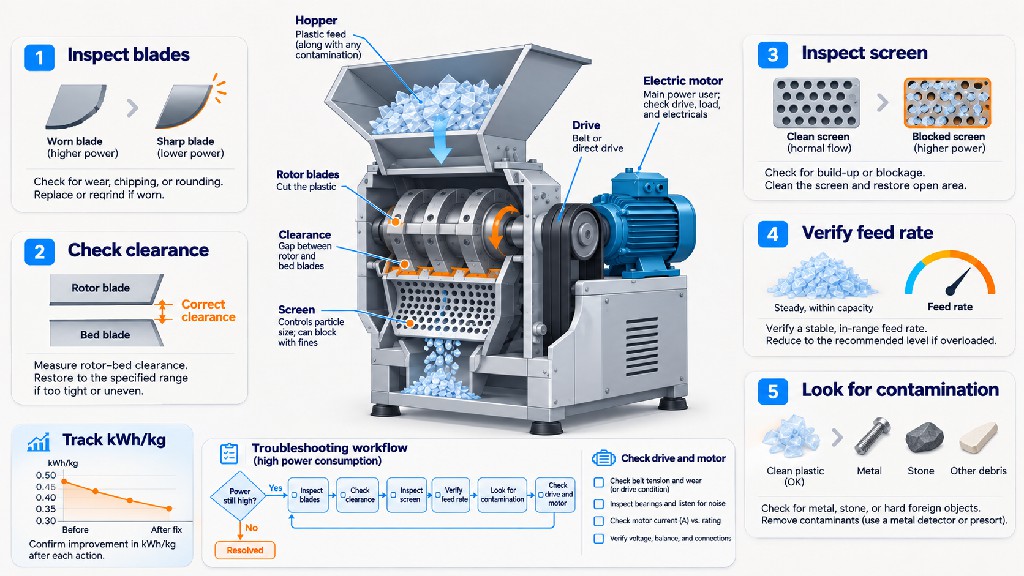
Once the machine is safely shut down, isolated, verified de-energized, and mechanically secured under approved procedures, inspect the moving and stationary knives. Look for edge rounding, discrete chips, fractures, broken corners, abnormal polishing, plastic deposits, heat discoloration, mounting-seat debris, damaged bolts, or uneven edge projection. Record locations and photographs so that a supplier can distinguish generalized wear from a localized impact problem. Keep hands away from edges and use the prescribed lifting and handling equipment.
Check whether previous sharpening has changed a blade's height, datum surface, bevel, or adjustment range. Verify actual clearance at every OEM-specified location, including both ends and all knife positions where required. Verify the condition of seating faces and fasteners before assuming the gap can simply be readjusted. If clearance changes after bolts are torqued, the setup is not complete. If there is unexplained rotor movement or bearing looseness, do not attempt to correct the problem merely by moving the stationary knife closer.
A granulator's screen is not merely a product-size accessory. It controls when material can leave the cutting chamber. Blocked perforations or poor extraction can increase residence time, causing pieces to be hit repeatedly before they exit. A broken or elongated screen can change regrind quality and may create separate equipment hazards. Inspect the mounting, perforations, accumulated fines, conveyor, suction or collection bin, and any airflow connections using the machine's safe maintenance procedure.
Conair's screen-maintenance guide identifies reduced throughput, excess fines, blocked openings, and unusual noise as warning signs. Screen cleaning or replacement may restore capacity, but choosing a larger perforation simply to reduce load is not acceptable if the customer requires a smaller product size. Match the screen to the product specification and the machine's design. A screen-related gain is a process correction, not evidence that a premium blade alloy caused it.
Inspect a sample of the incoming waste. Are there bolts, stones, labels, adhesives, glass fibers, mineral fillers, trapped metal inserts, moisture, or unusually thick solid sections? Does the equipment receive rigid housings, thin film, long straps, compacted lumps, or a mixture? These details change the cutting duty. A metal fragment may chip a good knife in seconds; dirty post-consumer material may wear an otherwise suitable edge rapidly; soft film can wrap and rub if the rotor and feeding system are wrong for the form.
If the current problem began when the material supply changed, a short approved trial with a clean known material may help isolate the difference. Do not use a potentially unsafe test feed and do not exceed equipment limits. Document every feed change so the results are comparable. In a commercial discussion, the supplier should ask about the actual material, not only whether the buyer calls it "PET," "PP," or "PVC."
When blade geometry and process conditions have been checked, inspect bearings, couplings, belts, seals, rotor supports, motor cooling, electrical connections, and drive alarms. A loose or slipping belt can reduce productive cutting; overtensioned belts may add bearing loads; a damaged bearing can raise vibration and mechanical losses. Three-phase voltage imbalance or a deteriorating motor may produce abnormal current or heating unrelated to edge wear. A plant should not continue grinding through an electrical protection fault just because it suspects the knife is dull.
The DOE motor guide notes that motor current can change with shaft load but also with supply voltage and other conditions. It supports checking voltage and current balance rather than assuming every ampere increase is mechanical. Only qualified electrical personnel should test wiring, energized circuits, protection settings, or insulation. If the motor runs abnormally at idle, solving the mechanical or electrical issue takes priority over ordering another set of knives.
After an approved repair or reconditioning operation, reassemble using the OEM sequence, hardware, torque, clearances, guards, interlocks, and restart requirements. Recheck critical gap measurements after clamping. Have authorized personnel perform any required hand-rotation or clearance verification using the machine's approved safe method, not an improvised powered test with guards removed. Return to a comparable production batch and measure actual kW, kg/hour, kWh/kg, product temperature, and accepted particle quality.
A credible outcome is one that survives a repeat run and does not create a new defect. The motor may draw less power but produce excessive fines; the throughput may increase but the product may no longer pass the downstream sieve requirement. Those are not unqualified successes. The aim is safe, stable production of acceptable material at a lower total cost, not the lowest possible current display.
Blade inspection should happen early, but it should not happen in isolation. The cutting chamber receives material from an upstream process and must release it to a downstream collection system. A sharp knife cannot deliver rated capacity if the hopper bridges, the feed is delivered in uncontrolled surges, or the discharge route is blocked. Conversely, excessive feeding can hide the benefit of otherwise good knives by pushing the motor into repeated overload and recovery cycles.
A smaller screen opening usually means more reduction is needed before fragments can exit. That can increase cutting events and residence time, depending on material, rotor design, screen open area, and extraction. Therefore, a site that has changed from a coarse to a finer screen should not judge blade deterioration by comparing total kWh/kg without accounting for the change in product specification. Screen perforation geometry, blocked area, and wear can matter even where the nominal hole diameter has not changed.
A useful screen trial compares the current screen against a properly cleaned or approved replacement of the same specified opening, while keeping feed and blade condition stable. If power and throughput improve, that supports a restriction problem. Changing to a much larger screen might also lower load, but would prove something different and may create unacceptable coarse particles. Never remove a screen or bypass an interlock to force a favorable measurement.
Continuous operation at an excessively low feed rate may produce poor kWh/kg because the motor, rotor, extraction and other equipment consume energy even while little product is being made. Overfeeding can overload the cutting zone, cause blockages and heating, and raise stoppage rates. The efficient operating point is somewhere between these extremes and must be established for the installed machine and feed. This is why real throughput matters as much as the motor's nominal kW rating.
A controlled feed system may reduce surges, but the benefit should be demonstrated with logged mass flow, drive power, and output acceptance. Record whether material is being weighed before feeding or estimated from a conveyor setting; inaccurate feed data can undermine the energy calculation. It is also worth looking at upstream cutting or pre-shredding. Large lumps that exceed a granulator's intended duty may be better handled by an engineered preceding stage rather than by forcing the installed machine harder.
A rotor's knife arrangement, cutting sweep, inertia, feed engagement, available shear length, and balance all affect its operating behavior. A redesign can improve performance in one duty and fail in another. The KTH rotor-change case study discussed earlier shows that hardware design can materially influence specific energy in a particular installation. It does not mean every recycler should replace its rotor or expect the same reduction. Start with serviceable knives and appropriate settings before proposing an expensive rebuild.
An OEM may offer open, staggered, chevron, stepped, or specialized cutting geometries. These arrangements differ in how the material is presented to cutting edges and how load is distributed across a rotor revolution. Some modifications can spread the cutting load more evenly, but they must be validated for strength, balance, machine clearances, feedstock, and product requirements. Copying a different machine's knife profile without engineering approval creates more risk than it solves.
The broad phrase "plastic waste" conceals large differences in cutting resistance and wear. A clean bottle-wall stream may demand little impact resistance compared with dense injection-molding purges, while an abrasive mineral-filled stream can destroy edge retention faster than an unfilled one. Long film or straps may wrap around a rotor rather than feed consistently through a conventional cutter. The correct knife geometry and handling equipment should reflect the real material form.
PET bottles and trays. Hollow PET bottles can collapse readily, but thick necks, preforms, label contamination, and grit produce uneven cutting loads. A knife that worked well on clean in-house PET scrap may wear rapidly on dirty post-consumer material. Check contamination and the feed configuration first. A harder grade may extend edge life when abrasion dominates, while a better supported edge or different upstream handling may be necessary when impacts dominate.
HDPE drums, pipe, and containers. Ductile walls may flex around an insufficiently sharp edge, producing strips or long tails. Thick pipe sections and solid shapes place different demands on the blade than thin containers. Watch for persistent wrapping or deformed pieces and compare the feed dimensions against the machine rating. Improving the shear interface may reduce repeated cutting, but excessive incoming section size should not be solved by unauthorized torque or speed increases.
PP rigid scrap and flexible film. Rigid PP sprues, crates, and housings can be quite different from woven sacks or flexible film. Film may need specialized rotor geometry, feed control, or downstream extraction to avoid wrapping. Filler-rich PP may wear an edge through abrasive contact. A generic "PP knife" is not enough information for an OEM-compatible order. Provide pictures, wall thickness, and filler or glass content whenever available.
PVC profiles and formulated scrap. PVC products vary in filler level, plasticizer content, reinforcement, and geometry. Mineral-filled profiles increase abrasion, while frictional heating and poor discharge can raise processing and quality concerns. Evaluate dust management and temperature as well as knife life. The machine must be suitable for the exact PVC stream; some processes require dedicated safety and ventilation controls that cannot be replaced with a more expensive knife.
ABS housings and engineering plastics. Unfilled ABS, thick brittle components, glass-filled variants, and assemblies containing inserts present different cutting hazards. Unexpected metal parts can chip an edge and contribute to sudden motor-load peaks. Material sorting and metal detection often offer more dependable protection than selecting the hardest available blade. If a new blade chips immediately on the first day, document the failure before assuming its steel is defective.
GUANG CHUAN's material-specific blade selection guide for PET, HDPE, PP, PVC, and ABS provides further practical screening questions. Material name, cutter geometry, contamination, heat treatment, and installation should be reviewed together. The goal is not to advertise one alloy as best for every polymer but to identify the dominant wear and failure mechanisms and select accordingly.
A worn knife does not automatically belong in the scrap bin. Proper regrinding can restore a sound blade if sufficient material remains, the approved edge geometry can be reproduced, the mounting datums remain correct, and the OEM permits further sharpening. Regrinding consumes material; excessive or uneven removal can move the edge beyond its adjustment range or alter the rotor's balance. This is especially important when several knives operate as a coordinated assembly.
Sharpening should follow a documented drawing and qualified grinding procedure. Avoid overheating the edge, changing a bevel by guesswork, grinding an unapproved seat, or removing material from a datum required for accurate mounting. The same knife may be fully reusable after light uniform wear but unsafe after a crack or deep chip. The appearance of a shiny new edge is not proof that the finished part is within tolerance.
Replace rather than resharpen when there are cracks, unacceptable structural chips, distortion, damaged mounting holes or slots, severe heat damage, inadequate remaining thickness or height, or an inability to restore the required geometry. Inspect fasteners and holders so the new component does not inherit the old failure. Rotor knives may have to be reground together or matched in weight or projection, as required by their machine; do not assume that one heavily reground part can be mixed with unmodified parts.
For the full distinction, see GUANG CHUAN's knife-sharpening procedure and its sharpen-or-replace article collection. The latter is a topic page rather than a machine-specific service manual. Always obtain the OEM's minimum dimensions and instructions before authorizing rework.
There is no reliable universal sharpening interval stated in operating hours for every plastic crusher. A line processing clean injection-molding runners may retain an edge much longer than one processing gritty, glass-filled, or metal-contaminated scrap. Instead of adopting a supplier's unsupported number of hours, track acceptable tonnes produced since service, average real power, energy per kilogram, product size distribution, temperature, and edge appearance. Inspect more frequently when the process changes or early warning signs are present.
Choose the interval at which gradual deterioration becomes commercially meaningful, while keeping planned shutdowns and safe access practical. If deterioration appears suddenly, the right response may be an immediate investigation rather than waiting for the next calendar inspection. Conair's maintenance guidance notes that different users follow different cleaning and knife-service frequencies depending on their duty; it does not prescribe one interval for every installed granulator.
Once the mechanical cause is confirmed, purchasing decisions should focus on fit, edge stability, predictable maintenance, and quality of output. A more expensive alloy does not inherently consume less electricity. If an incorrectly fitted knife rubs, even a premium grade will perform poorly. A properly selected wear-resistant material can keep an effective edge longer in abrasive service, which may help preserve cutting efficiency between maintenance stops. A tougher geometry can reduce chipping in a shock-prone application. These are different commercial objectives.
The manufacturer should begin with the machine identity: OEM, model, serial or revision where relevant, rotor and bed knife positions, part numbers, and the existing drawing. Follow with the actual material stream, contamination, installed screen, accepted particle size, production rate, current blade grade and service record. An inquiry that provides only "D2 granulator blade, 300 mm" may be impossible to manufacture accurately and safely. Two rectangular blades can have the same overall dimensions but different mounting, projection, bevel, and reference surfaces.
AISI D2 / EN 1.2379 and closely related commercial cold-work steels are established abrasion-resistant choices for some crusher and granulator applications. Cr12MoV is another tool-steel option in relevant industrial knife products. Other grades, including selected high-speed steels, may be considered when the application justifies them. Material labels alone do not establish performance: heat treatment, edge support, dimensional accuracy, grinding quality, machine compatibility, and feed conditions all contribute.
A very hard, thin edge can be unsuitable where frequent impact or contamination produces fractures. Conversely, an overly soft edge might round quickly on abrasive filled material, increasing maintenance frequency. The useful inquiry is: What actually ended the last knife's service life—uniform wear, abrasion, chipping, thermal damage, or a mounting failure? An evidence-based answer leads to a better quotation than demanding the maximum advertised hardness.
| Purchasing decision | What must be verified | Performance or cost question |
|---|---|---|
| Regrind existing sound knives | OEM minimum size, permitted surfaces, edge angle, cracking, matching requirements | Can cutting efficiency be restored safely at lower total cost? |
| Order equivalent OEM-compatible knives | Drawing, holes, seats, projection, blade function, material specification | Will the machine return to its proven baseline without a redesign? |
| Trial a more wear-resistant grade | Abrasive contamination, certified steel, heat treatment, comparative life | Does longer stable edge life justify the price and regrinding cost? |
| Trial a tougher edge design | Impact and chipping record, supported geometry, OEM approval | Does it reduce unplanned stoppages without raising cutting energy excessively? |
| Modify the wider cutting system | Rotor, screen, feed, discharge, balance, safety and structural review | Is a system change justified by reproducible operational data? |
Purchasing matrix: each recommendation requires machine-specific technical verification. No row promises a fixed energy-saving percentage or knife lifetime.
The minimum practical request should identify finished length, width, thickness, allowable tolerances, hole or slot pitch and dimensions, seats and countersinks, datum faces, working edge, bevel orientation, steel designation, heat-treatment requirement, hardness acceptance, and quantity by position. Ask how the supplier verifies edge straightness, flatness, mounting details, and final inspection. For heavily reground samples, supply the original drawing as well; the worn sample alone may no longer represent the new-part geometry.
GUANG CHUAN describes custom industrial knives, CNC manufacturing, heat treatment, and OEM/ODM capability in its company profile. Its crusher blade product category includes replacement knives for plastic size reduction, including slotted and rectangular designs. Product listings provide sourcing starting points; they do not remove the need to verify exact fitment and service suitability with the buyer's machine information.
Electricity savings matter, but their value needs to be calculated transparently. A blade program also affects stoppages, grinding costs, rejected regrind, and production capacity. Present those components separately rather than claiming that the entire difference between two production runs is an energy saving. The first task is to measure energy under comparable operation; the second is to translate the difference into a relevant annual production volume and tariff.
Suppose a granulator processing a consistent rigid-plastic stream averages 20.1 kW while delivering 270 kg of acceptable material per hour. After qualified maintenance corrects worn knives and restores the approved clearance, it averages 16.8 kW while delivering 320 kg/hour under otherwise comparable operating conditions. The former specific energy is 20.1 ÷ 270 = 0.0744 kWh/kg. The latter is 16.8 ÷ 320 = 0.0525 kWh/kg. The difference is approximately 0.0219 kWh per accepted kilogram, or about 29.5% of the original energy per kilogram.
At an annual production volume of 1,000 tonnes of accepted product, this hypothetical improvement corresponds to roughly 21,900 kWh of energy avoided for the measured machine boundary. At an illustrative electricity-only price of US$0.12/kWh, the value is about US$2,630 annually. The arithmetic assumes future operating conditions match the trial. Neither the inputs nor the calculated reduction are a GUANG CHUAN field test or a promised knife-saving rate. Production mix, local energy tariffs, demand charges, idle energy, and process losses can materially change the result.
An increase from 270 to 320 kg/hour also has potential operational value, but do not simply add an assumed sales margin without confirming the line can use the extra output. A downstream extruder may already be the bottleneck. A plant may instead gain by running fewer hours to make the same quantity, by avoiding overtime, or by reducing overtime-related machine wear. These are different benefit pathways, and a defensible procurement case should use only those that can actually be realized.
Suppose two blade options are quoted at different purchase prices. The lowest-cost option may require more frequent removal and grinding, while a more stable edge may deliver longer runs before output quality or energy reaches the maintenance threshold. Compare purchase cost per accepted tonne, regrinding and transport cost, safe knife-change labor, verified electricity cost, rejected material, and documented downtime. Also count the cost of a catastrophic chipped knife or damaged rotor when that risk is relevant to the existing material stream.
A sensible trial purchases a controlled sample of the proposed knife design, measures its finished dimensions and hardness against the approved specification, then tracks actual results. Record the production tonnes until a defined service threshold, not only the number of weeks a blade remained installed. A line running two shifts processes much more material than one operating only occasionally. The commercial objective is reliable accepted output with predictable service, rather than the largest marketing claim about hardness or life.
During the first week, establish a safe measurement baseline, audit the feed and screen, and review existing maintenance and protection records. Identify whether the complaint is high running power, high energy per tonne, repeated overload, or reduced throughput. Involve both production and electrical maintenance so that a mechanical interpretation is not built on an unreliable amperage reading. Record a clear problem statement with measurable acceptance criteria.
During the second week, conduct the approved outage inspection. Document the rotor and bed knife condition, clearance measurements, screen state, bearing condition, and any mounting or contamination issues. Sharpen, replace, or repair only after confirming the machine's specifications and service limits. If a replacement must be sourced, issue a complete drawing-based RFQ instead of relying on a photograph and generic material name.
During the third week, carry out a repeatable production trial. Keep feedstock and screen requirements comparable to the baseline. Measure input energy, accepted output mass, motor loading, noise observations, product temperature, particle quality, and trips. Do not treat a short successful run as proof of long blade life; it demonstrates only the immediate effect of the service under the observed conditions.
During the fourth week, review the results and decide whether to adopt an inspection threshold, order a spare set, test an alternative steel, investigate a drive issue, or plan an engineered system improvement. Assign responsibility for logging energy and throughput. If there is no meaningful improvement after cutting components are restored, revisit the screen, feed pattern, drivetrain, and electrical diagnosis. A responsible blade supplier should be willing to say when the fault is not primarily a blade problem.
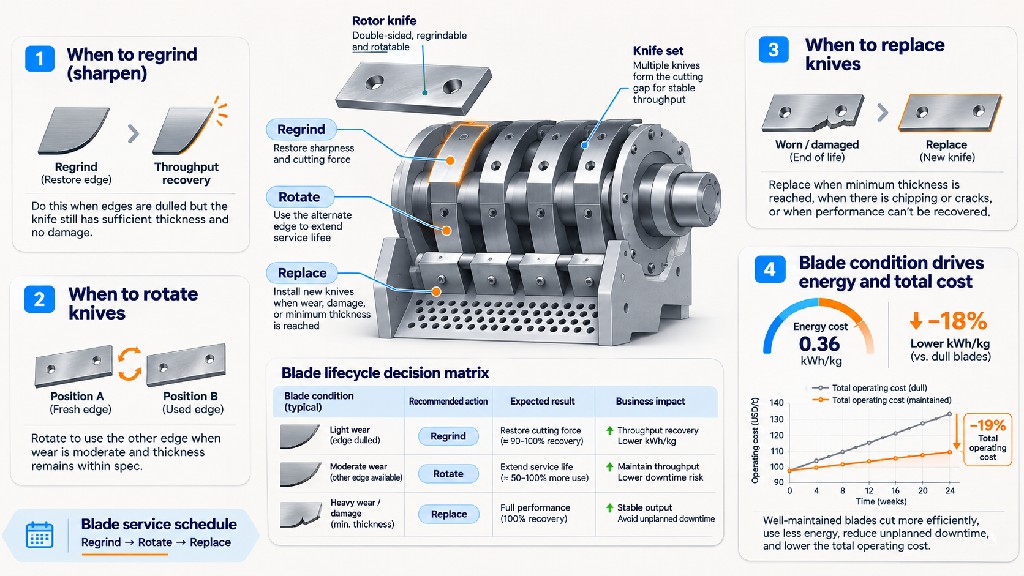
Yes, they can. Rounded edges may require more deformation and repeated cutting, and poor cutting increases heat and may lower acceptable throughput. Conair identifies increased heat and power draw among the symptoms associated with knife and screen problems. However, the magnitude varies by material, feed rate, machine, and maintenance state. Measure kWh/kg before and after verified service to establish the actual effect on your production line rather than adopting a generic saving percentage.
A sudden post-installation rise may indicate knife interference, incorrect gap, projection or seating, damaged or mismatched parts, incorrect hardware or clamping, changed rotor load, or a simultaneous electrical problem. Stop if there is abnormal noise, vibration, contact, overheating, or a safety fault. Follow isolation procedures and have trained personnel verify fitment, clearance at all specified locations, fastening and mechanical condition. A new cutting edge is not automatically a correctly installed one.
No. Current is influenced by electrical conditions and motor loading. Real input power depends on voltage, current, and power factor, while accumulated energy also depends on time. A process can use similar kW but have substantially worse kWh/kg if throughput falls. Use qualified three-phase real-power measurement and weigh accepted output over the same interval to determine whether energy efficiency has truly deteriorated.
There is no universal number. Clearance depends on the specific OEM model, rotor arrangement, blade geometry, machine condition, and sometimes the application. Published manuals differ. Use the installed machine's approved service manual or written OEM instructions, and verify at all required positions after the fasteners are secured. Never choose a gap solely from a website, and never attempt adjustment in an energized or unsecured cutting chamber.
Not necessarily. A larger motor may transfer greater torque into a rotor, transmission, bearings, bolts, or cutting chamber not designed for it, and the electrical system may not be suitable. Determine whether trips are caused by bad cutting, feed surges, a blockage, mechanical drag, electrical supply issues, or genuinely insufficient equipment capacity. Any power-system upgrade needs an OEM-led engineering assessment and appropriate protection; a motor change is not a substitute for root-cause analysis.
None can be declared universally best from the grade label. Energy depends primarily on the assembled cutting action and operating process. Wear-resistant material can help preserve edge sharpness between maintenance intervals, and tougher designs can help resist chipping in impact duty. The best buying decision starts with confirmed dimensions, an OEM-compatible profile, a known failure mechanism, verified heat treatment, and a controlled comparison under real feed conditions.
Compare operating symptoms and inspect both components under lockout. A blocked screen can retain material, cause repeated impacts, lower output, and produce fines. Dull or misaligned knives can tear or deform material instead of cutting it. The problems often coexist. Restore the specified screen condition and verify the knife pair independently, then run a controlled test. A single symptom such as noise or dust is insufficient to distinguish them with certainty.
Follow the machine maker's instructions and the condition of each mating component. Some rotors require matched grinding or replacement to keep blade projection, rotor balance, and cutting geometry consistent. Replacing one visibly damaged edge while leaving a severely worn bed knife can fail to restore performance. Specify quantities separately for rotor positions and fixed positions, and identify part revision, attachment details, and acceptable dimensions on the purchase order.
Provide the machine brand and model; rotor and bed knife drawings or part numbers; photographs of the mounted and removed knives; precise length, width, thickness, hole or slot details, bevels and datum faces; knife quantities; steel and hardness if known; and the plastic type, feed form, filler and contamination conditions. Add recent current or kW trends, output rate, edge damage photographs, sharpening history, and the problem you want to solve. This helps the engineering team assess a compatible replacement or a controlled material-and-edge trial.
GUANG CHUAN manufactures industrial cutting knives and custom machine blades for applications including plastic recycling and size reduction. If your plant is experiencing rising electrical consumption, unstable granulator motor load, poor regrind quality, or repeated blade service, begin by documenting the symptoms and checking the machine as described above. If inspection confirms blade wear, damage, or a compatibility problem, the next step is to select a safe replacement specification—not to guess at a new grade or install a similar-looking knife.
Explore the company's crusher blades and plastic granulator replacement options, then contact GUANG CHUAN with your drawings, machine model, material stream, and maintenance evidence. Ask for dimensional confirmation, suitable material and heat-treatment options, and a quotation covering the correct number of rotor and bed knives. The strongest purchasing result is a part that fits correctly, sustains an effective cutting edge, and can be evaluated against measurable production and energy outcomes.
Final takeaway: Check the blades early because poor shearing is a credible and often repairable cause of high crusher load. But prove the diagnosis through safe inspection, accurate power measurement, accepted-throughput data, and a repeatable test. Good troubleshooting protects equipment; good documentation protects the purchasing decision; and the right blade is only one component of an efficient, reliable granulation system.

Leave A Message
Scan to WhatsApp :

 English