



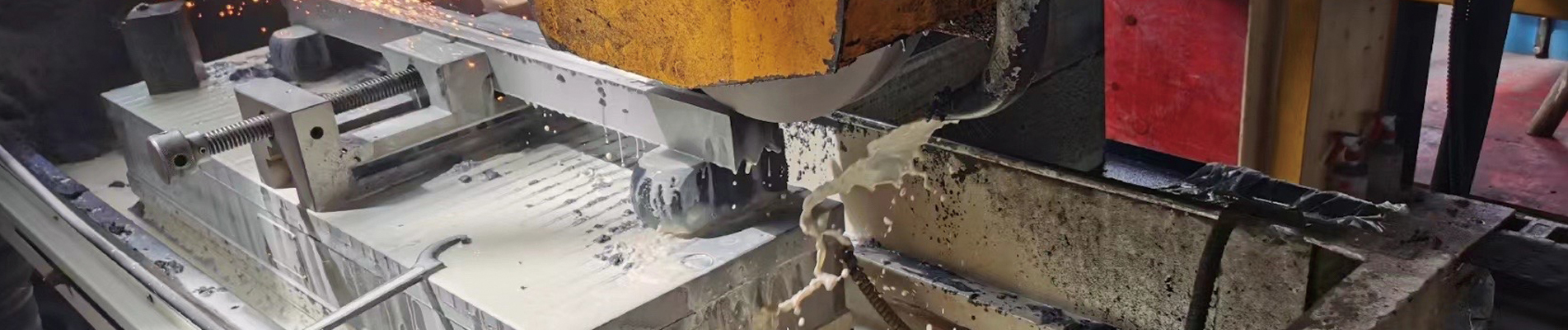

A plastic granulator can appear to be operating normally while the usable regrind becomes progressively less valuable. The drive runs, the screen discharges material, and production reports a familiar kilograms-per-hour figure. Yet operators find powder in the collection bin, extra dust in the conveying filter, irregular flakes in the hopper, or rejects from the next molding or extrusion process. When a plant complains about granulator fines, the right question is not merely “Which knife should we buy?” It is “Where are the small particles being created, why are they not leaving the system promptly, and which correction will restore usable yield?”
In most conventional screened plastic granulators, rotating knives pass stationary bed knives to shear material into pieces, while a perforated screen controls discharge. Worn edges, incorrect knife clearance, a damaged or restrictive screen, repeated recutting, unsuitable feed conditions, and downstream pneumatic transport can all change the final particle-size distribution. A new set of expensive knives cannot by itself correct a blocked discharge line or a mixed feedstock containing brittle fillers. Conversely, changing the screen without restoring the cutting edge may leave the root cause untouched.
Quick answer: If a granulator is producing too many fines, first define and measure the fines fraction, then compare a representative sample at the cutting-chamber outlet with one collected after conveying. Inspect the rotor knife–bed knife cutting pair, check clearance against the machine manufacturer's specification, evaluate screen condition and material residence time, and review feedstock, speed, loading, and dust collection. Change one controllable variable at a time. Judge every correction by acceptable regrind yield, not by motor speed or nominal throughput alone.
This guide is for recycling-line managers, injection molders, extrusion operators, maintenance engineers, process technicians, and purchasing teams. It explains the mechanisms behind plastic granulator powder, supplies a practical measurement procedure and troubleshooting matrix, and shows when precision-manufactured replacement knives from GUANG CHUAN's crusher blade range belong in the solution. The numerical examples below are expressly illustrative; they are not results from an undisclosed plant trial, guaranteed targets, or universal machine settings. The OEM manual, actual resin specification, local safety procedures, and verified production trials take precedence.
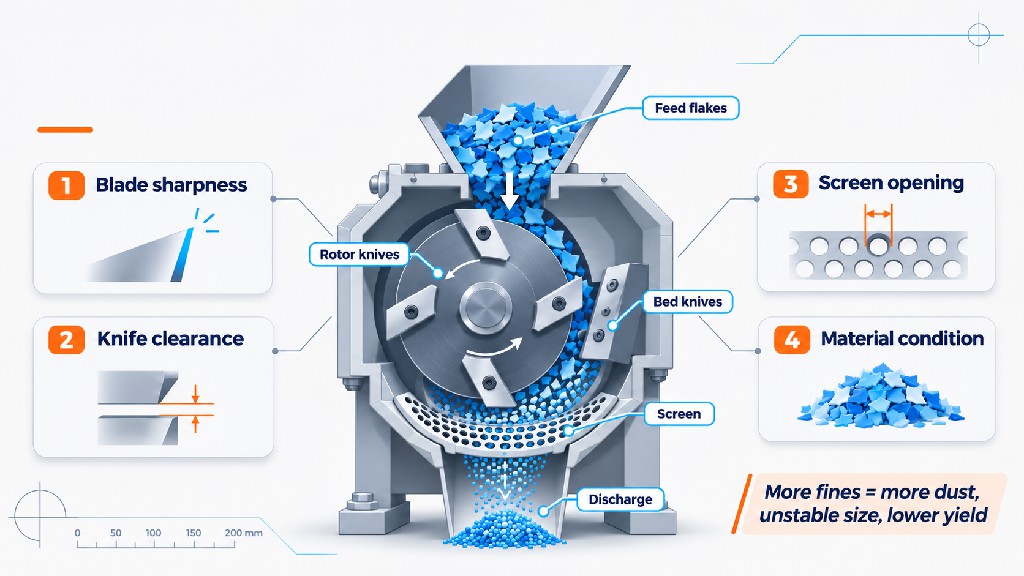
A “fine” is a particle that falls below a specified size threshold. The threshold is a commercial or process decision, not a single universally agreed number for plastic regrind. An injection molder might define fines as material passing a 1.0 mm test sieve, while a recycling customer may use another cut-off, or a combination of cut-offs, depending on the intended application. A dust-collection system may capture particles far smaller than those classified as fines for product quality. Therefore, “12% fines” is incomplete unless the test sieve, sample location, sampling procedure, and whether captured dust was included are stated.
The term granulator particle size describes a distribution, not a single dimension. A bag of regrind can contain acceptable intermediate flakes, oversized strips, small fragments, and dust simultaneously. For regular particles, a sieve series helps characterize the distribution. For flat plastic flakes, orientation affects whether a piece passes an opening; a long, thin flake may pass an aperture even though its longest dimension exceeds the stated sieve size. Do not confuse the nominal discharge-screen hole diameter with the size of every exiting particle.
Three related phenomena should be kept distinct. Fines generation is the creation of small fragments by cutting, fracture, impact, or abrasion. Fines concentration is the proportion of fines in a measured output stream, which may change if larger usable granules are retained or removed. Dust liberation is the release or entrainment of very small particles into air during granulation or subsequent handling. These phenomena overlap, but they do not have identical causes or corrective actions.
Too many fines matter because they can reduce the mass of reusable product, change the bulk behavior of regrind, increase filter loading, contribute to segregation during storage or blending, and introduce variability into downstream feeding. The specific quality consequence depends on resin, end use, formulation, additive package, drying, contamination, and processing equipment. Some operations deliberately manufacture fine powder with specialized milling equipment; that is different from unwanted fines in a granulator intended to make consistent reusable flakes.
Cumberland, a granulator equipment manufacturer, describes good-quality regrind as having a reasonably consistent particle size with minimal dust, and emphasizes that screen selection depends on the application. Its granulator FAQ is a useful machine-manufacturer perspective. It is not a source of a universal maximum fines percentage, because no single number can represent all resins and recycling processes.
A plant should record at least four quality measures: the mass percentage below an agreed sieve aperture, the mass percentage in the usable middle fraction, the percentage of oversize or long pieces, and any dust that escapes into a separate extraction or conveying collector. For some lines, moisture, contaminants, bulk density, and granule temperature also belong in the release specification. Specify the measurement location: direct discharge, post-conveyor, post-deduster, or customer packaging. Each answers a different question.
A workable internal target might read: “For dry rigid PP regrind sampled immediately after the granulator at steady-state operation, no more than the agreed percentage may pass the designated 1.0 mm test sieve, and no more than the agreed percentage may remain on the designated oversize sieve.” The percentages should be established from the next process's proven acceptance criteria and repeatable trial data. Do not borrow another plant's threshold without considering its material and screen arrangement.
Understanding the path through the machine prevents misguided maintenance. Material enters a hopper or feed chute, contacts a rotating cutting assembly, and is brought into engagement with one or more fixed counter-knives. Properly aligned, sharp edges produce a controlled shearing action. Material that remains too large to escape the screen circulates and encounters additional cutting or impact events. When a particle can leave through the screen and discharge system, its exposure to further cutting should end.
This distinction is important: the screen is not generally a precision cutter. Its primary function is classification and retention. A knife can produce small fragments before those fragments encounter the screen, while a restrictive screen can keep otherwise acceptable material in the chamber longer. Consequently, particle size is determined jointly by cutting geometry, material response, screen behavior, and the probability of prompt discharge. In the Cumberland guidance on screens, the relationship between rotor speed, screen-hole selection, throughput, and fines is explicitly treated as an operating-system trade-off rather than a fixed rule.
A sharp rotor knife passing a well-supported bed knife concentrates the cutting force into a narrow zone. With suitable geometry and an approved clearance, it separates the feedstock comparatively cleanly. When edges round off or the gap is outside specification, a flexible component may bend or stretch between the edges rather than shear promptly. The machine then uses additional revolutions and mechanical energy to reduce the same material. The resulting pieces may have ragged edges, tails, or a greater range of dimensions.
Brittle material behaves differently. Rigid, cold, degraded, or heavily filled pieces can break into small fragments around the cutting zone even when blades are sharp. A harder knife does not make a brittle polymer less brittle. Impact intensity, feed dimensions, pre-shredding, and the chance of repeated collisions can dominate. This is why an operator should inspect both the fine particles and the larger fragments: smooth cut faces, stretched fibrils, angular shattered chips, and contaminated dust tell different stories.
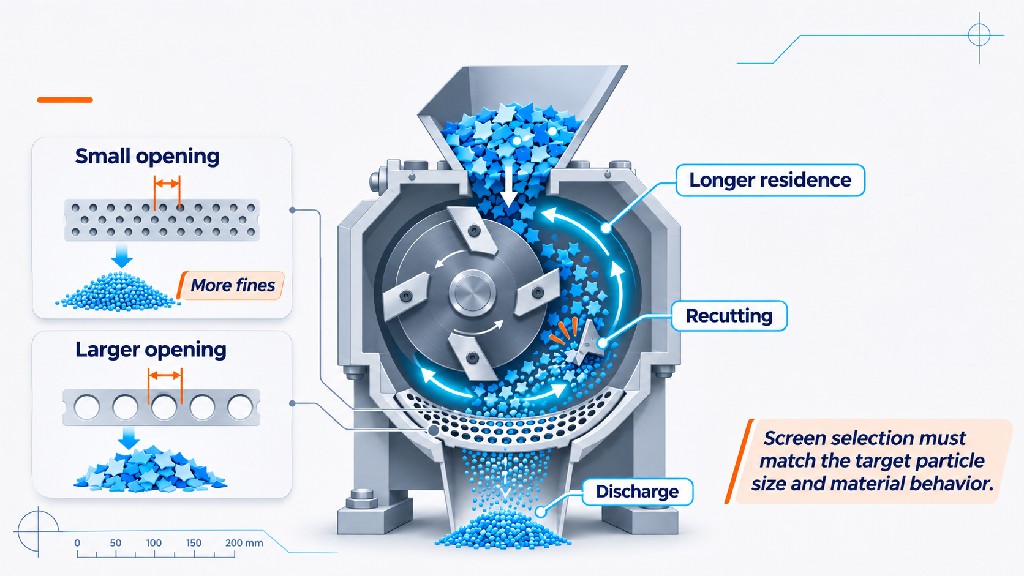
Repeated recutting is another mechanism. If acceptable granules cannot promptly pass the screen or move away from it, they stay exposed to knife passes, rotor turbulence, and other particles. Smaller screen holes, restricted open area, screen blinding, excessive recirculating load, or inadequate discharge extraction can increase residence time. A process that seems to need “finer cutting” may actually need better evacuation. The aim is to make the required cut and remove the product—not to grind it indefinitely.
More knife edges can increase the number of possible cutting engagements per revolution, but they also change how the feed enters the cutting zone and how fragments move in the chamber. Cumberland notes that additional knives can eventually produce diminishing returns if material bounces instead of being captured. Similarly, rotor speed changes tip speed, collision frequency, airflow, and material residence characteristics. Higher speed is not automatically better or worse for fines across all machines. Evaluate speed only within the manufacturer's approved range and with screen, feed rate, and material held as constant as possible.
Consider a rotor with diameter D (meters) and rotational speed n (revolutions per minute). Its approximate peripheral speed is v = π × D × n / 60, in meters per second. If D is 0.40 m and n is 600 rpm, v is approximately 12.6 m/s. This is a geometric calculation, not a recommended setting. The cutting engagement depends on knife design and loading; operating limits, balance, drive capacity, and manufacturer-approved speed must never be inferred from this formula alone.
Troubleshooting should separate a genuinely excessive production of small particles from a sampling or transport problem. The following matrix is a priority-setting tool, not a replacement for the machine manual. Multiple causes may coexist, and the recommended checks are to be performed with the appropriate operating or isolation precautions.
| Observed symptom | Likely mechanism to investigate | First discriminating check | Sensible corrective direction |
|---|---|---|---|
| Fines rise gradually over days or shifts | Rotor and bed knife wear; changing gap | Compare edge condition and OEM clearance with past records | Restore approved cutting geometry and re-test |
| Fines jump after knife service | Incorrect projection, seating, grinding profile, or clearance | Audit installation against drawing and setup record | Correct assembly before changing steel grade |
| Fine fraction rises with hot or smeared regrind | Friction, recutting, poor discharge, or unsuitable feed | Check screen blinding, product temperature trend, and load | Correct discharge and cutting efficiency |
| Output contains fines plus many long strips | Incomplete shearing or abnormal screen passage | Inspect knife pair, screen holes, and gap at several positions | Repair the actual cutting and classification defects |
| Direct discharge looks good; final bin is dusty | Pneumatic conveying or handling generates or segregates fines | Test before and after conveyance with comparable samples | Review conveying velocity, elbows, and separation |
| Quality changes when resin batch changes | Brittleness, filler content, contamination, or thickness | Compare a controlled material-only trial | Adjust sorting, conditioning, and approved process setup |
| Fines increase after installing a smaller screen | Longer chamber residence and extra recutting | Confirm screen hole size, open area, blockage and output rate | Select an appropriate screen for target and throughput |
| One region of the chamber shows abnormal dust or wear | Localized knife misalignment, chipped edge, seating or rotor issue | Map wear patterns across all knife positions | Repair damaged seats or components; verify alignment |
Edge wear is a common starting point because it can change the cutting mechanism directly. A rounded edge requires more deformation before separation, particularly with ductile films, flexible containers, and thin-walled parts. When the machine bends or rubs rather than shears, output can become ragged, temperature can rise, and residence time can increase. The problem is often made worse by maintaining only the rotor knives while ignoring damaged bed-knife edges.
Do not judge sharpness exclusively by appearance. A shiny edge can be rounded; a small localized chip may have greater process impact than a uniform light wear band. Record edge profiles, notches, and the location of wear along the full knife length. Compare the condition with the service history and a retained example of a properly ground knife. For maintenance decisions, see GUANG CHUAN's guide to deciding when crusher knives should be sharpened or replaced.
The working clearance is the gap between moving and stationary cutting edges at their passage point. If the gap becomes too large for the machine and feedstock, flexible pieces may be pinched, folded, or torn. A different gap at the left and right ends can produce uneven cutting along the chamber width. Poor seating, worn supports, incorrect shims, rotor runout, bearing problems, and uneven regrinding can all make an apparently correct single-point measurement misleading.
There is no safe universal clearance number. Design differences, machine size, rotor dynamics, thermal behavior, knife geometry, and feedstock determine the specified adjustment. An extremely narrow gap can cause metal-to-metal contact, serious knife damage, or other hazards. Qualified personnel should measure the clearance at all OEM-specified positions using the method in the correct manual, check fastening and support, and restore the manufacturer's range. GUANG CHUAN's rotor-versus-fixed-bed-knife explanation discusses why both sides of the cutting pair must be inspected.
A smaller discharge-screen aperture does not simply “dial down” all particle sizes. It changes the opportunities for particles to leave the chamber. If particles must endure more revolutions before escaping, additional impacts and cutting events can raise fines. Screen thickness, open area, perforation pattern, hole geometry, wear, and the effective distance between the rotor and screen affect this behavior. A torn, warped, or enlarged screen, meanwhile, may permit oversize material to leave and produce a broad distribution, not necessarily an isolated fines problem.
Inspect for blinded holes, trapped strips, residue, smearing, deformation, missing fasteners, wear tracks, and product buildup beneath the screen. Record the installed screen part number and nominal hole size rather than relying on memory. When equipment maker guidance permits a screen change, compare candidate screens at the same feed and stable load; assess both excessive fines and oversize. Cumberland's screen-design overview explains why the preferred combination can vary with machine speed and resin behavior.
A granulator may have good knives and a suitable screen yet continue recutting material because the discharge does not evacuate it efficiently. Problems can include a full collection vessel, clogged discharge pipe, poorly matched conveying airflow, an obstructed chute, or a malfunctioning collection system. Plastic flakes held in the chamber do not automatically become finer; however, repeated cutting and abrasion create additional opportunities for small fragments. The discharge system deserves attention before adjusting an expensive knife specification.
The useful diagnostic is a comparison between normal steady-state discharge and the period when fines become excessive. Record product mass flow, screen condition, hopper level, motor-load trend, and any unexpected hot spots. Never open the chamber or reach into a moving granulator to “see what is happening.” Use approved external observation, instrumentation, and a fully isolated inspection where required. A process that improves when the collection system is restored may not require new blades at all.
Underfeeding, sudden large slugs, bridging, thin-film wrapping, and mixed-size scrap create different cutting dynamics. A lightweight bottle may bounce before the knife grips it; a thick runner may cause an intermittent high-load event; thin film may stretch instead of entering a normal shear. Unstable feed can increase repeated contacts and broaden the product-size range. An operator who reduces feed to almost nothing may inadvertently change residence conditions and collect an unrepresentative sample.
First identify whether the machine is intended for continuous metered feeding, beside-the-press scrap, large rigid purgings, or flexible film. Keep the machine within its approved loading and drive limits. Establish a repeatable mass or volume feed method and test one change at a time. If scrap size is beyond the granulator's design, upstream pre-shredding or improved feed presentation may be more effective than trying a harder edge. Check the distinction between equipment categories in GUANG CHUAN's crusher-blades-versus-granulator-knives guide.
A resin's behavior changes with grade, temperature, moisture history, aging, glass or mineral loading, and prior processing. A brittle rigid component may shatter into angular fines on impact; a flexible polymer may stretch into strings or smear on a warm knife. Dirty post-consumer PET can carry sand, glass, labels, or metal that accelerates wear or damages an edge. Highly filled PP or PVC may contain abrasive particles that increase knife wear and dust; mixed scrap is difficult to diagnose from its resin label alone.
Segregate suspect material from a known-good reference lot and conduct a controlled comparison without altering the machine setup. Document product form, temperature or conditioning, wall thickness, filler information if known, and the cleaning or sorting history. If fines occur only with a particular batch, evaluate incoming material before changing knife metallurgy. GUANG CHUAN's PET, HDPE, PP, PVC and ABS blade-selection guide provides material-specific selection considerations.
Rotor speed, cutting angle, knife overlap, rake, and engagement sequence influence how material is gripped and separated. A replacement that physically fits but has a different bevel orientation, cutting-edge position, or projection may produce a different cut and could be unsafe. A mechanically suitable replacement must reproduce the OEM-approved geometry unless an engineered change has been reviewed and authorized. A catalog image or a nominal length-and-width match is not enough.
Do not compensate for poor discharge simply by increasing speed, or for weak edge support by specifying the sharpest possible bevel. Consider alternative geometry only after documenting the primary failure mode and operating limits. For a clear explanation of what makes controlled sharpening possible, read GUANG CHUAN's crusher blade grinding and service-life guide. Geometry changes are controlled engineering decisions, not universal cures.
Material that leaves the cutting chamber may be transported through flexible hose, hard pipe, bends, cyclones, airlocks, dedusters, and bins. Abrasion and impact can generate additional small fragments; pneumatic airflow can carry fines into a separate collector, while segregation makes certain samples appear dustier than others. If the sample taken directly under the screen meets specification but the final collection bin does not, the blade is unlikely to be the only cause.
Compare mass-balanced samples from both locations, including separated dust streams where practical. Record the position of the sampling valve, process stability, conveying settings, storage duration, and the size distribution at each point. A bag sampled near the top of a full bin may not reflect the entire batch. Fixing transport and collection can protect an otherwise satisfactory granulation process, and it avoids paying for replacement knives that cannot address the observed downstream change.
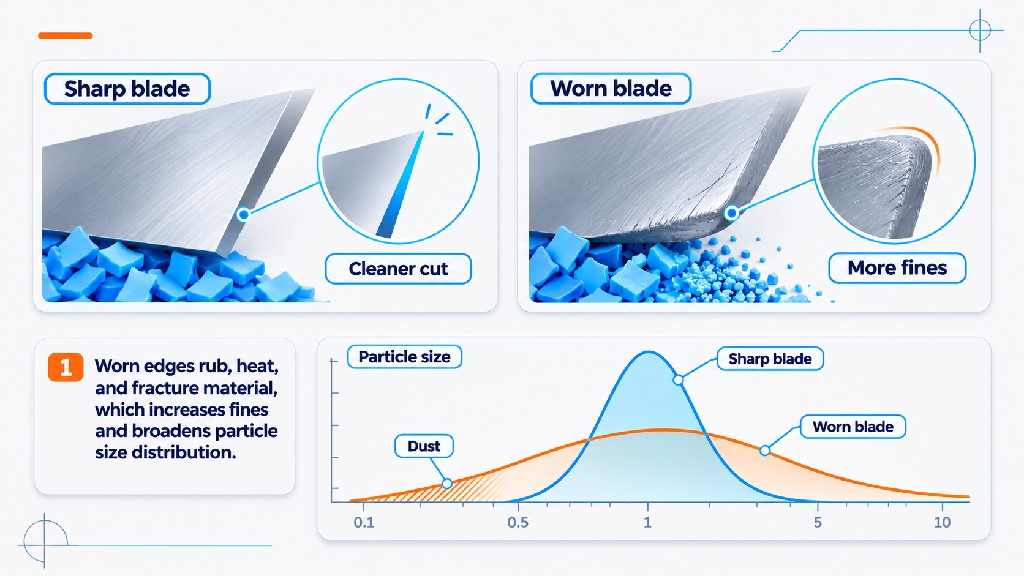
A fine layer of powder looks dramatic under bright lighting, but visual impressions cannot consistently rank two production setups. Use a documented sampling and sieve procedure so maintenance, production, suppliers, and customers are discussing the same metric. ASTM D1921-26, Standard Test Methods for Particle Size (Sieve Analysis) of Plastic Materials addresses particle-size distribution of plastic materials using dry sieving and distinguishes multiple-sieve evaluation from abbreviated percent-passing tests. A plant method may adapt the same basic concepts for irregular regrind, but it must disclose deviations; merely mentioning the standard does not mean the test was performed in full compliance.
For a sample taken at a defined point, calculate fines mass fraction (%) = (mass passing the agreed fines sieve ÷ total sample mass) × 100. If the test definition includes a separated dust collector, its mass must be incorporated consistently and without double counting. Calculate usable fraction (%) = (mass meeting the agreed usable-size specification ÷ total measured mass) × 100. Record oversize separately. These quantities need not sum to exactly 100% when test losses or off-spec contamination are present; that discrepancy must be explained.
Suppose a 1,000 g laboratory composite yields 120 g below a chosen 1.0 mm aperture, 830 g in the agreed usable range, and 45 g oversize. The total recovered mass is 995 g, with 5 g unaccounted for. Using the original 1,000 g input as the denominator gives 12.0% fines, 83.0% usable product, 4.5% oversize, and 0.5% unrecovered mass. These numbers demonstrate reporting practice; they are not an industry average or a recommended acceptance limit. Include the balance so an apparent improvement is not merely an increase in missing dust.
The curve can also be reported with D10, D50 and D90, meaning characteristic sizes at 10%, 50% and 90% cumulative passing mass, based on the chosen test method and interpolation. For broad, irregular flake distributions, those numbers are useful summaries but should not replace a direct fines cut-off and oversize measurement. A lower D50 by itself does not prove that a line has excessive dust; an increase in the very-small-particle tail may be commercially important while the median remains nearly unchanged.
Collect a representative Point A sample directly after the granulator and a Point B sample after conveying and dust separation. If A has 4% fines and B has 7%, do not immediately conclude that the conveyor manufactured 3 percentage points of dust. Differences in sampling, dedusting, particle segregation, moisture, collection location, and mass-balance boundaries can change the measured fractions. Check where all material streams go, then determine whether incremental breakage or preferential removal caused the difference.
If Point A itself is off specification, the cutting chamber, screen, feedstock, or sampling method is the first priority. If A is acceptable and B is not, investigate downstream handling and stream splitting. If both are poor only for one raw-material lot, a controlled material comparison is more informative than another blade purchase. This two-location check is often one of the lowest-cost ways to avoid replacing the wrong component.
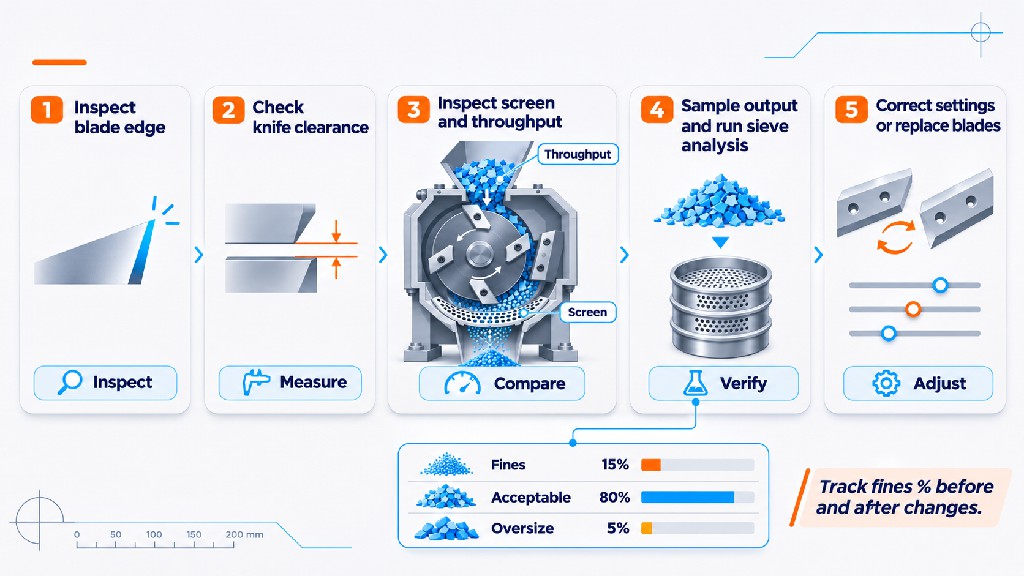
The most efficient troubleshooting sequence starts with observations that do not require entering the machine and proceeds to mechanical inspection only after appropriate energy isolation. Granulators contain rapidly rotating cutters, stored mechanical energy, electrical drives, and potentially hazardous dust. Never inspect or adjust knife clearance, clear a jam, remove a screen, or handle blades while the machine can start unexpectedly. Follow the equipment manufacturer's procedures and your workplace's documented lockout/tagout process. In the United States, OSHA 29 CFR 1910.147 sets requirements for controlling hazardous energy during servicing and maintenance when applicable.
Confirm the resin, product grade, inlet condition, screen, cutting assembly, maintenance history, and exact definition of fines. Check whether the rise appeared suddenly after a maintenance event or gradually over production. Obtain a sample before and after material transport. Log throughput and electrical load for comparable operating intervals, rather than relying on a nameplate capacity or one peak reading. If the customer complaint involves visual dust, ask for a sample or sieve definition before promising a fix.
Review the permissible operating speed, steady feed rate, the condition of the external discharge system, filter differential-pressure trends where monitored, collection-bin level, and the path to downstream equipment. Determine whether the problem changes as bins fill or a particular resin enters the line. Treat unusual noise, vibration, rising temperatures, smoke, or irregular electrical load as reasons to stop and follow the safety procedure, not as conditions for an experimental speed increase.
After qualified personnel have shut down the machine, isolated all relevant energy sources, verified the zero-energy state, and allowed movement to cease, inspect the cutting chamber. Examine rotor knives and bed knives for rounded edges, chipping, fractures, local rubbing, and evidence of material packing. Inspect the screen for clogging, elongation of holes, trapped wires, distortion, and wear. Check for foreign objects, damaged knife seats, incorrect clamps, and any loose or damaged fasteners. Do not reuse cracked or structurally suspect blades.
Using the model-specific instructions, measure the blade clearance at all specified positions. Confirm knife projection, side-to-side consistency, the condition of adjusting hardware, correct installation orientation, seating surfaces, bolt specifications, and regrinding limits. If a rotor problem is suspected, consult qualified maintenance personnel or the machine manufacturer about bearings, runout, shaft condition, and balancing requirements. Never use a generic knife gap or bolt torque discovered in an unrelated online article.
Repair the lowest-risk, verified defect first. Examples include restoring a blocked discharge path, cleaning or replacing an unsuitable screen, correcting feed stability, restoring approved knife geometry, or replacing a failed knife set. Return guards and safety devices to their proper state before restart. Use the same material lot, the same sampling protocol, and comparable throughput to measure what changed. If two modifications must occur together for safety or machine integrity, record them as a combined intervention; do not claim which one alone delivered the improvement.
Run for a defined, representative interval after initial startup stabilization. Assess average and worst-case fines, acceptable-size fraction, oversize, output temperature, throughput, energy use if metered, and maintenance observations. Record the processed tonnage since knife service. A short clean trial immediately after replacing knives may not predict how the system behaves after weeks of abrasive production. Where possible, compare the rate at which fines rise over blade service life, not just the initial value.
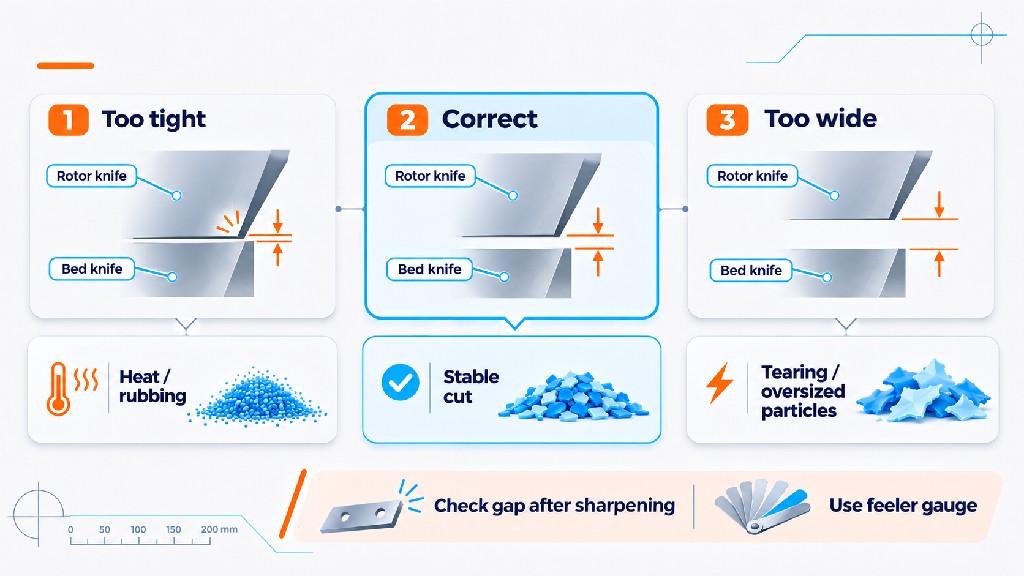
The keyword crusher blade particle size can be misleading if it suggests that a blade alone sets the output dimension. Blades create cuts; screen, residence time, feed, and material characteristics shape the observed distribution. Nevertheless, the condition of the moving and stationary cutting edges is one of the most controllable variables in a screened granulator. Poor cutting geometry can produce more dust even when the screen has not changed.
A serviceable sharp edge enters or shears the material with less unnecessary deformation than a rounded one under comparable conditions. That can reduce rubbing, repeated bending, and the time needed to produce fragments that meet the screen's discharge condition. However, a very thin acute edge is not appropriate for every load. Thick rigid purges, abrasive filled compounds, and accidental hard contamination can chip an insufficiently supported edge, immediately creating a new source of rough fracture and fines.
The purchasing specification should therefore define acceptable cutting geometry and support, not demand the lowest possible bevel angle. Edge radius, bevel orientation, material grade, grinding quality, and overall straightness may matter differently by application. If the current knife works well when new but deteriorates quickly, investigate the wear mode and material stream before requesting a redesign. If it performs poorly immediately after installation, check geometric compatibility, adjustment, and screen behavior first.
Imagine placing new rotor knives opposite a bed knife with a localized notch. The moving edges may be sharp, but material passing that damaged location still experiences defective shear. The resulting profile can include long strands, rough surfaces, or irregular chips. Similarly, a precisely ground stationary knife cannot compensate for a chipped rotor set, unstable seating, or a rotor that does not run through the intended path. The components form a cutting system and must be inspected together.
A practical inspection log records each knife's position and orientation, measured dimension after sharpening, visual damage, matched-set consistency, and the measured gap after reinstallation. Marking or labeling removed blades by location helps reveal a repeating problem near a particular feed or knife seat. A maintenance program based only on calendar days may miss an unusual load of abrasive material; recording tonnes processed and actual edge condition gives better evidence for service planning.
An alloy grade with strong abrasion resistance can preserve an effective edge longer under the right operating conditions. But hardness by itself is not a measurement of cutting quality or impact toughness. A very hard edge exposed to accidental metal inserts can chip, creating localized cutting defects. Two suppliers quoting the same nominal steel name may deliver different heat treatment, bevel geometry, finish, and dimensional accuracy. For fines problems, the most valuable steel is the one that retains the approved cutting geometry under the actual feed duty.
GUANG CHUAN describes its manufacturing capabilities and custom knife approach, including precision machining, grinding, heat treatment, and drawing-based production. Those capabilities are relevant when replacement knives must reproduce a particular machine's mounting and edge specification. They should be evaluated through drawings, material certification, dimensional inspection, and agreed tests—not assumed to guarantee a particular percentage reduction in fines.
Sharpening is appropriate only when a structurally sound knife has remaining OEM-authorized regrinding allowance and the required edge shape can be restored by a qualified grinding process. Removing too much stock, overheating the edge during grinding, or altering the bevel may shorten service life or move the cutting position. Replace knives that are cracked, severely chipped, distorted, thermally damaged, below minimum allowable dimensions, or otherwise unable to be installed safely within specification.
If several knives are installed on the same rotor, their dimensions, position, and balance implications must follow the machine manufacturer's requirements. Do not replace one knife with a heavier or significantly different profile merely because its bolt holes align. Follow the equipment manufacturer's approved setting and installation procedure after any grinding service. Additional technical detail is available in GUANG CHUAN's controlled sharpening guide.
A single troubleshooting instruction cannot serve every plastic waste stream. The dominant behavior may be tearing, abrasion, brittle fracture, smearing, wrapping, or contamination-driven edge damage. The following comparison is a qualitative diagnostic aid. It does not specify universal knife hardness, rotor speed, or screen dimensions; these must be matched to the exact machine and compound.
| Material and feed form | Typical mechanism worth checking | Blade or process priority | Important qualification |
|---|---|---|---|
| PET bottles and rigid PET scrap | Impact fracture, gritty contamination, repeated cutting of necks | Edge integrity, sorting, screen discharge | Clean PET and post-consumer dirty PET are different duties |
| HDPE containers and pipe | Bending, stretching, smearing, thick-wall loading | Sharp supported shear and approved clearance | Thin bottles and heavy pipe require different feed handling |
| Rigid PP runners or crates | Variable fracture and occasional heavy impact | Knife support, stable feed, edge condition | Mineral- or glass-filled PP may wear knives faster |
| PP/PE film or woven material | Wrapping, stringing, incomplete cut, clogged screen | Film-capable feed system and effective shearing | A conventional rigid-scrap granulator may be unsuitable |
| Rigid PVC profiles and pipe | Mineral-filled abrasion, dust, heat-related quality changes | Wear mapping, sorting, thermal and dust controls | Formulations and reinforcements differ significantly |
| ABS housings and molding scrap | Brittle or mixed fracture, impact from inserts, irregular pieces | Foreign-object removal, edge toughness and alignment | Filled, plated or blended ABS needs separate evaluation |
Post-consumer PET may enter as whole bottles, flattened containers, trays, or thick preforms. Thin bottle walls, caps, labels, dirt, and rigid neck rings produce different loading in the same machine. If dust increases immediately on a dirty bale, inspect the feed for contamination and pre-existing fines. If fines climb gradually with otherwise similar PET feed, inspect the rotor and bed knives for abrasive rounding, local chips, and incorrect clearance. In a wet recycling stage, the sampling and screen-cleanliness procedure must account for water; dry-sieve results cannot simply be compared with a wet sample.
Do not promise that switching to a higher-hardness blade will solve mixed PET feed. Sand removal, reliable bottle presentation, and adequate discharge may be more effective. If an edge is wearing rapidly on clean PET but not on other streams, capture evidence: tonnes between services, actual particle-size change, material composition, and close photographs of the damaged edge. That evidence is more actionable for a blade manufacturer than the label “PET knife.”
Rigid HDPE bottles and molded PP components can deform significantly before cutting. With dull knives or a large gap, their walls may fold or stretch instead of separating immediately. Operators may see long, thin tails alongside fines formed by repeated contact. A sharp, properly supported cutting pair can improve the likelihood of a clean cut, but feed stability and chamber design still matter. If oversize strings rise together with dust, do not attempt to fix both by simply choosing a smaller screen.
Flexible PE film, PP film, woven sacks, and raffia introduce additional problems. They may wrap around the rotor, bridge a screen, or require dedicated film-handling machinery. The correct response may involve pre-compaction, feed-roll control, rotor design, or a different machine configuration. A maintenance technician should not improvise blade clearance to compensate for equipment that was not designed for the material. Establish the intended feed capability with the OEM.
PVC compounds vary substantially. Rigid window profiles may contain substantial mineral additives and attached metal reinforcements; flexible PVC can behave more like a ductile material. Abrasive fillers may wear knife edges faster, while inappropriate cutting and prolonged friction can increase process heat. Dust and unusual fumes require particular attention to safe handling. If material discolors, scorches, or emits unexpected fumes, stop processing and follow the site's safety procedure rather than treating the problem as a routine knife-selection issue.
The process should separate concerns: evaluate feed composition and removal of attached hardware, cutting-edge condition, temperature trends, collection-system effectiveness, and any applicable exposure controls. A blade supplier can review wear and chipping mechanisms, but material safety data, ventilation design, and occupational exposure evaluation must be handled by qualified personnel. A harder blade is not a dust- or fume-control system.
Unfilled ABS scrap and reinforced or plated ABS parts do not impose identical conditions. A clean injection runner may cut predictably, while a thick housing with a screw insert can chip an edge on impact. Glass-filled engineering plastics introduce abrasive particles that may accelerate wear. Compare the rate of change in fines with the appearance of the edge: steady uniform rounding suggests a different action plan from sudden chips or cracks. Incoming inspection and sorting may prevent more downtime than the next grade change.
Whenever a plant runs multiple resins, capture a separate baseline for each stream instead of blending all fines percentages into one monthly average. The same knife set can perform acceptably on one stream and poorly on another. If mixed scrap is unavoidable, select a representative worst-case trial and specify acceptance limits for both particle-size quality and mechanical reliability. For material-oriented procurement decisions, use GUANG CHUAN's plastic crusher blade selection overview as a starting point, then provide actual feed samples and machine data.
A common reaction to inconsistent regrind is to install a smaller perforated screen. This can reduce the size of some exiting pieces, but it can also hold material in the cutting chamber longer. If a machine is running near its throughput limit, the extra circulation can raise mechanical contact and heat, increase fines, or reduce usable output per hour. Some systems combine specific small-hole screens with lower rotor speeds or optimized open area effectively; other systems require larger holes at higher speed. There is no contradiction: screen performance depends on the whole machine.
A good screen trial records more than nominal hole size. Include hole pattern, open-area ratio if supplied by the manufacturer, screen thickness, physical condition, actual motor loading, steady material throughput, and how the screen interacts with the discharge airflow. An enlarged worn hole can create oversize, whereas a blocked hole can extend residence time. Both may coexist on one damaged screen. A plant that treats “screen size” as one number may overlook the important difference between these failure modes.
Before making a change, ask what dimension matters to the next process. A narrower size distribution with slightly larger average flakes may be preferable to apparently finer regrind with heavy powder generation. For customers who specify both a maximum oversize and a maximum fines level, evaluate them as independent limits. A process that achieves the first by violating the second has not met the specification.
A maintenance recommendation becomes more convincing when it connects particle size to usable mass, downtime, and total costs. The price of a replacement blade set is visible on a purchase order; the cost of excess fines may be spread across discarded material, dedusting, cleaning, handling, reprocessing, downtime, and customer quality complaints. Nevertheless, the plant should avoid claiming financial savings from every gram of dust. The value of a fine fraction depends on whether it is truly unsaleable, recoverable in another process, or simply separated for a different product.
Consider a hypothetical line processing 800 kg/h of comparable dry feed. Assume the rejected fine fraction falls from 12% to 4% after a verified combined maintenance intervention, and all other reject categories remain unchanged. The reduction is eight percentage points, which equals 64 kg/h less material in that specified fines category. Over 2,000 operating hours, that is 128,000 kg, or 128 metric tonnes, of material reclassified from fines to other output categories if mass balances and destinations support the comparison. It is not automatically 128 tonnes of additional saleable product; a portion could become oversize or other off-spec material.
If that entire 64 kg/h becomes accepted product and the net incremental contribution is an assumed US$0.20/kg, the illustrative gross contribution difference is US$12.80/h, or US$25,600 over 2,000 hours. Subtract the actual costs of knife service, screen and labor, testing, energy, downtime, and any additional processing. The 800 kg/h, fines fractions, operating hours, and monetary value here are calculation inputs for explanation, not observed industry averages, GUANG CHUAN case-study results, or guarantees.
| Example trial indicator | Baseline | After corrective work | What the number does—and does not—show |
|---|---|---|---|
| Input / measured processing rate | 800 kg/h | 800 kg/h | A constant hypothetical comparison basis |
| Fraction below the defined fines sieve | 12% | 4% | An 8-percentage-point reduction in that measured fraction |
| Fine mass at the indicated point | 96 kg/h | 32 kg/h | 64 kg/h difference, assuming consistent boundaries |
| Potential change over 2,000 hours | — | 128 t | Not automatically 128 t of additional accepted product |
For procurement, the more defensible metric is total cost per accepted tonne over an agreed period. A simplified expression is: (knife and sharpening cost + maintenance labor + downtime cost + other trial-related operating costs) ÷ accepted tonnes, using an explicitly defined cost boundary. Compare candidate blade sets on service interval, consistency of fines level, production reliability, and verified output, not only initial hardness or quoted purchase price. If there is no reliable cost of downtime estimate, show it separately as an unresolved sensitivity rather than inventing a number.
A replacement-blade request should begin with evidence of the process failure, not an instruction to use the hardest available tool steel. GUANG CHUAN supplies and discusses industrial crusher and granulator knives, including drawing-based replacement options. Its crusher blades category provides a product starting point; a complete application review must still determine geometry, material specification, mounting compatibility, and expected service duty. A quote should distinguish an exact OEM-compatible replacement from a proposed engineering modification.
A good technical exchange should answer whether the primary failure is gradual edge rounding, impact chipping, inaccurate fit, or abnormal machine operation. Material choice can then be discussed with context. D2/SKD11-type steels and appropriately treated Cr12MoV are common candidate families in industrial knife supply, but the actual steel grade, heat treatment, hardness band, impact tolerance, and bevel must be approved for the duty. There is no single alloy and hardness that guarantees low fines across PET, PP film, glass-filled plastics, and thick purges.
Ask the supplier to identify the exact material specification; finished blade dimensions and tolerances; edge and bevel convention; heat-treatment and hardness-testing method; mounting and adjustment compatibility; inspection points; packaging and edge protection; and the limit of any sharpening or warranty statements. Confirm whether the quotation covers only rotor knives, only bed knives, or a complete matched set. A blade that matches the envelope dimensions but has the wrong cutting-edge position or hole countersink may be unsuitable or dangerous.
If a redesigned bevel or upgraded steel is proposed, request an explanation of the mechanism: is it intended to retain sharpness longer against abrasive filler, resist chipping from thick scrap, or preserve cutting geometry through more tonnage? Establish a baseline and trial protocol before placing a large order. Do not accept claims such as “50% less dust” without the resin, machine, sieve cut-off, test duration, production rate, and sampling method that support the number.
Contact the OEM or qualified service provider where the suspected root cause involves rotor balance, damaged knife holders, bearing looseness, structural distortion, guarding, interlock functions, rotor speed, approved clearance procedures, or an unverified screen modification. A precision blade manufacturer can make parts to an agreed drawing and inspect cutting edges; it cannot certify that an unapproved machine redesign is safe. Machine integrity and plant safety are prerequisites for a meaningful blade trial.
GUANG CHUAN's company and manufacturing overview explains its custom-tooling scope. For an application discussion, use the site's contact page and send the machine drawing, representative sample data, and actual operating problem. That supports a more useful quotation than asking for a “universal low-fines knife.”
A successful repair is only the beginning. Fine production can creep upward as an edge wears, filler concentration changes, or a screen becomes clogged. Convert the successful setup into a controlled baseline: record installed knife identifiers, as-installed clearance measurements, screen specifications, resin family, representative operating rate, baseline sieve fractions, and the date and tonnage of the trial. Keep the record at machine level, not merely in a purchasing spreadsheet.
Set sampling frequency based on how quickly conditions change and how costly off-spec output would be. A demanding recycling operation might sample at shift start and after a resin or equipment change; a stable low-volume line may need a different interval. These are examples of a process-control approach, not a prescribed universal schedule. Use a trend chart that distinguishes resin families and sampling points. Record maintenance interventions on the same timeline so the next technician can see which change coincided with the improvement.
Establish a service trigger around measured deterioration rather than only a fixed number of days. Useful indicators include an increase in fine fraction relative to a stable baseline, a rising trend in motor loading at comparable throughput, reduced accepted mass per hour, unusual heat or noise, and evidence of cutting-edge wear. A screen blockage or feedstock change may cause the same symptoms, so the trigger should initiate a diagnosis, not automatic blade disposal.
Protect cutting quality with clean feedstock and consistent sorting. Remove hard objects where practical, inspect pre-shredder discharge if a two-stage system is used, and maintain the conveying equipment and dust collection system. Keep spare parts identified by machine and revision so operators cannot accidentally install visually similar but incompatible knives. Store and transport blades with edge protection, avoid damage to mounting faces, and follow the OEM's procedures for all installation and sharpening activities.
Fine polymer dust may create occupational exposure and, depending on material and conditions, combustible-dust hazards. The OSHA combustible-dust overview identifies plastics among materials that can create explosible dust under certain conditions. OSHA's combustible-dust hazard communication guidance also discusses dust produced during downstream processing of plastic pellets. That does not mean every granulator or every plastic powder has the same hazard classification; a qualified site-specific assessment is required.
Do not use ordinary compressed-air blowdown to disperse accumulated fines where doing so could create a dust cloud; follow the facility's approved housekeeping and dust-control methods. Evaluate collection equipment, grounding and bonding, ignition-source control, ventilation, and applicable fire-protection requirements with qualified professionals. Never bypass guarding or interlocks to reduce downtime, and never substitute an online article for the site's safety and emergency procedures. Low-fines production is a quality objective; safe management of unavoidable dust is an independent obligation.
Confirm whether the fines are present directly at the granulator discharge, not only after the conveyor or bin. Check for a changed resin lot, changed screen, recent sharpening or installation, discharge restriction, and abnormal operating conditions. If safe external checks do not explain the change, stop, isolate, and inspect the cutting system under the OEM procedure. A sudden rise after knife replacement often justifies checking installation and clearance before buying another set.
No. Dull knives can increase tearing, rubbing, and repeated cutting, which often correlates with more fines, but actual outcomes depend on feedstock and the rest of the machine. Some ductile material may produce longer strands or a lower apparent amount of fine dust while producing poor regrind. Evaluate sharpness together with oversize, heat, throughput, residence time, and screen performance rather than assuming a single symptom has one cause.
No. A smaller hole can constrain discharge, but it can also increase retention and repeated cutting, particularly if open area or evacuation is inadequate. The best choice depends on desired product distribution, resin, rotor speed, screen design, and machine capacity. Compare fines and oversize independently, and use only screen configurations approved for the machine.
There is no universal percentage for every customer and process. The definition of fines requires a specified sieve cut-off and sampling location. An acceptable limit is determined by the needs of the next production stage, contracts, contamination and dust-control requirements, and documented acceptance trials. Two plants can report the same number while using different sieves and therefore be describing different products.
No knife alloy can eliminate all fine-particle generation. An appropriate material may help preserve the edge in an abrasive service, but it cannot correct a blocked screen, incorrect clearance, excessive recutting, brittle resin, hard contaminants, or dust created downstream. Specify metallurgical performance only after identifying why the current cutting edge fails, and verify any improvement with paired production trials.
Not necessarily every time, but both must be inspected as a cutting pair. If the bed knife is worn, chipped, or incorrectly seated, fitting new rotor knives alone may not restore clean shearing. The machine manufacturer determines permissible sharpening, reversal, minimum dimensions, set matching, and installation procedures. Where one component is sound and compatible, a qualified technician may retain it according to those requirements.
That combination suggests a wide particle-size distribution rather than simply an overly small screen. Incomplete shear may allow long tails, while repeated contact can generate fine fragments. A damaged or enlarged screen may let oversize pieces escape. Inspect the knife pair, working clearance, screen integrity, feed form, and discharge behavior; do not treat the long pieces and fines as unrelated defects.
It can, through impact and abrasion, but it can also redistribute particles and preferentially extract existing dust. Use matched samples at the chamber discharge and downstream collection points, with all separated streams accounted for, before attributing a measured increase to particle breakage. If the direct discharge already contains excessive fines, fix that upstream problem first.
ASTM D1921-26 is a relevant reference for dry-sieve measurement of plastic particle-size distributions, but irregular flakes, electrostatic dust, moisture, and unusual particle shapes may require a documented application-specific procedure. Follow the actual standard when claiming conformance. If a plant uses a simplified method, label it accurately as an internal test and maintain repeatability across comparisons.
Send the machine make and model, rotor and bed-knife drawings or samples, mounting dimensions, blade orientation, resin and feed conditions, screen specification, OEM clearance requirements, measured fines definition and baseline, photos of wear, and estimated tonnes between services. A supplier can then distinguish fitment issues from material and cutting-performance issues. Request a reviewed drawing and measurable trial acceptance criteria before ordering a production batch.
Excess granulator fines are usually a system problem with a measurable cause. Blade wear and clearance may be central, but screens, residence time, feed variability, resin behavior, and downstream transport can materially alter the final output. The efficient approach is to define the fines fraction, locate where the problem first appears, inspect the complete cutting pair, address verified faults safely, and compare accepted product before and after a controlled intervention. That process protects regrind quality and prevents unnecessary spending.
For purchasing teams, the commercial objective is a replacement knife that fits the machine, maintains safe OEM-approved geometry, and preserves acceptable particle size through a useful service interval. GUANG CHUAN supports drawing-based industrial blade sourcing and offers crusher and granulator knife options. Share your blade drawing, resin application, screen data, and sieve results through the GUANG CHUAN contact form to discuss a practical replacement or controlled knife-improvement trial. A specific diagnosis and measurable acceptance criteria make a stronger foundation for quotation than an unsupported promise of “zero fines.”
Editorial scope: This article synthesizes publicly available equipment-manufacturer guidance, official standards descriptions, safety information, and practical engineering reasoning. It does not assert that a particular customer's machine was tested, that the illustrative percentages were measured, or that a supplier can guarantee the stated outcomes. Applicable OEM instructions and qualified on-site engineering decisions govern machine adjustments and safe operation.

Leave A Message
Scan to WhatsApp :

 English