



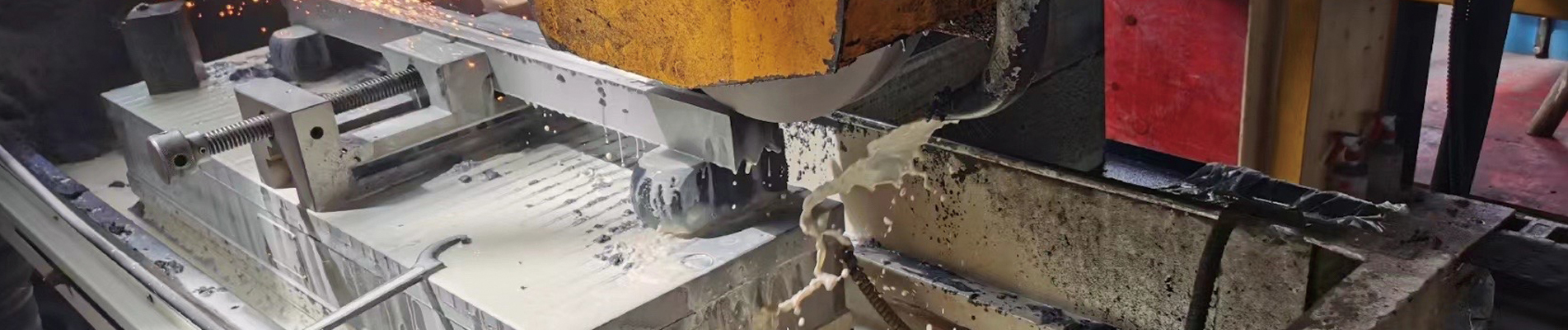

Sharpening should restore a crusher knife's cutting performance, not quietly consume its remaining service life. That is the difference between a properly controlled regrind and a blade that looks bright on the bench but fails early in the granulator. Incorrect grinding can overheat hardened steel, change the bevel, destroy edge straightness, move the cutting position, and leave too little material for secure adjustment. Worse, a badly reground rotor set may introduce vibration or knife contact that damages more than the cutting edges.
This guide explains how to sharpen crusher blades in a practical maintenance sequence: diagnose the cutting problem, document the knife's geometry, decide whether it is safe to regrind, select a suitable grinding process, remove only the necessary material, inspect the finished edge, and reinstall the knives to the original equipment manufacturer's (OEM's) requirements. It focuses on removable, hardened-steel rotor knives and stationary bed knives used in conventional screened plastic granulators. Slow-speed shredder cutters, pelletizer knives, carbide-tipped assemblies, and proprietary knife systems may require substantially different procedures.
Quick answer: Stop and isolate the machine under the approved energy-control procedure. Identify the knife and its permitted regrinding face, angle, and minimum size from the OEM drawing. Inspect for cracks, distortion, worn mounting features, and heat damage. Use a suitable, properly dressed grinding wheel and controlled cooling on a rigid, guarded grinder; restore the original edge with the least practical stock removal. Check straightness, geometry, edge condition, and matched-set consistency. Refit with specified hardware and torque, reset knife clearance at every required position, and validate the machine with a controlled production trial. Never substitute a generic sharpening angle, feed rate, grinding depth, or bolt torque for the correct machine specification.
The maintenance judgment here draws on published equipment instructions from SWEED Machinery, Jordan Reduction Solutions, the Conair granulator maintenance bulletin, and Uddeholm's technical guidance on grinding hardened tool steels. These sources describe specific equipment or materials, not universal settings. The machine's current manual, the qualified grinder's procedures, and local safety requirements take precedence.
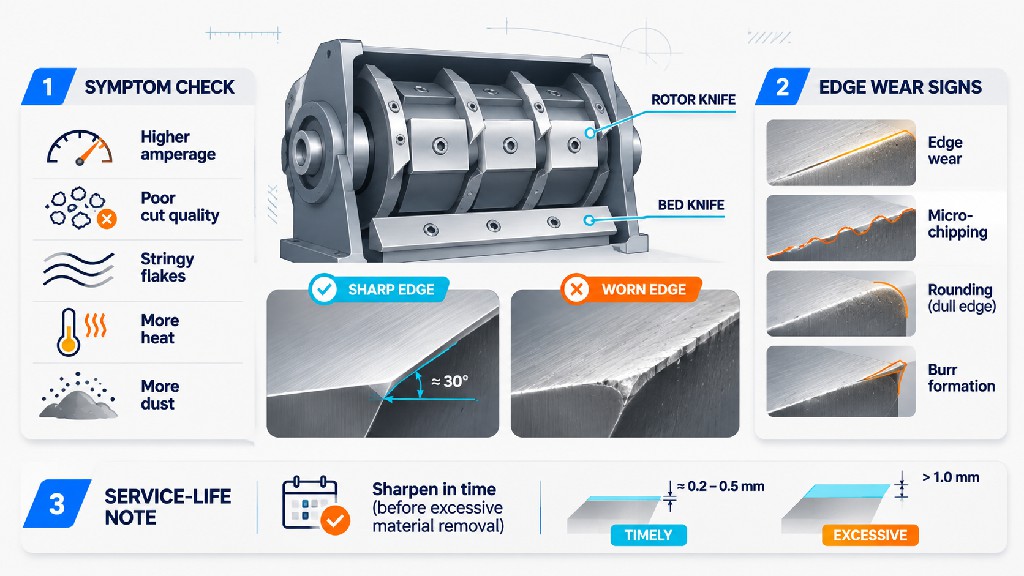
A granulator generally cuts plastic by moving rotor knives past one or more stationary bed knives. A correctly shaped edge concentrates force near the intended shearing line. As the blade rounds, the material may bend or rub before separating. Soft film can stretch; rigid runners can fracture irregularly; material may circulate longer before passing through the screen. Sharpening removes damaged steel to recover an appropriate edge, but every regrind consumes some of the blade's finite geometry allowance.
Three independent forms of damage deserve attention. First, geometric loss occurs when repeated grinding makes a knife too narrow, short, thin, or poorly positioned to meet the mounting and clearance requirements. Second, metallurgical damage occurs when grinding heat alters hardened steel near the edge. Third, system damage occurs when a mismatched set, wrong angle, loose seating face, or incorrect knife gap creates impact, vibration, or rubbing in service. An edge can look sharp and still suffer from all three.
For a cutter with a conventional straight bevel, the critical objective is not the smallest possible included angle. The original design balances sharpness, edge support, impact resistance, and the position of the cutting line relative to the opposing knife. A thinner edge may initially appear more aggressive but chip sooner on thick or contaminated scrap. Increasing the angle indiscriminately may strengthen the very tip while leaving it too blunt to shear film efficiently. Either modification can change the original loading path.
Heat deserves equal attention. Uddeholm explains that poor grinding can reduce surface hardness through overtempering or create hard, brittle transformed layers and grinding cracks when temperatures rise further. A crack may be microscopic, and the absence of visible blue discoloration does not prove that a knife escaped thermal damage. Proper cooling, wheel condition, contact geometry, and grinding parameters matter more than cosmetic shine.
The business consequence is straightforward: if a shop saves an hour by removing excessive material or grinding too aggressively, the blade may need replacement one service interval earlier. If a worn set is ground to different sizes, the plant can lose additional production time during adjustment. This is why crusher blade grinding must be treated as a controlled manufacturing operation with incoming inspection, recorded dimensions, and release criteria—not just a quick edge touch-up.
A common mistake is to blame the knives whenever throughput falls or fines increase. Those symptoms are compatible with dull edges, but they are also compatible with a blocked screen, altered feedstock, a worn bed-knife setting, a full discharge bin, insufficient extraction airflow, belt problems, or a mechanical fault. Before committing a usable set to another grind, compare the operating condition with a known good baseline and investigate the wider cutting chamber.
Conair's granulator maintenance guidance identifies the condition of the rotor and bed knives, their mutual clearance, and the discharge screen as key maintenance items. That is a useful diagnostic order because a sharp knife in an improperly set machine can give disappointing results. An unusually tight gap can also cause dangerous contact rather than poor cutting alone.
| Observation | Check before grinding | Likely maintenance direction |
|---|---|---|
| Gradual, uniform edge rounding | Knife dimensions, drawing, absence of cracks, actual cut quality | Regrind if the knife still meets all approved limits |
| Sudden deep chip or broken corner | Hard contamination, opposing knife, seat, bolt condition, rotor damage | Stop and assess structural integrity; replacement may be required |
| More fines or stringy plastic | Resin and screen changes, knife gap, edge condition, discharge path | Correct verified cause; sharpening only if edges are culpable |
| Higher motor load at comparable feed | Feed rate, jam, belt and bearing condition, rotor drag, dullness | Diagnose system before scheduling knife service |
| Heat or smearing near screen | Cutting efficiency, blocked screen, recirculation, incoming resin temperature | Address transport and cutting conditions together |
| Visible crack, bent knife, damaged hole | OEM rejection criteria and possible related machine damage | Quarantine the knife; do not conceal damage by grinding |
Record the machine model, knife part number, rotor speed, screen aperture, resin grade, filler level, incoming scrap shape, operating hours, mass processed, accepted regrind output, and any measured electrical load. Keep a labeled sample of acceptable regrind for comparison. A shift-to-shift change in kilograms per hour means little if the new job uses a harder polymer, larger purgings, or a finer screen. A useful baseline ties blade condition to the same material and setup.
Visual inspection should follow the machine manufacturer's safe access method. Look for a continuous rounded land, localized nicks, deposits, asymmetrical wear, and roughness along the cutting length. Examine the stationary knife as well as the rotating knives. A newly sharpened rotor knife cannot compensate for a damaged counter-edge. For a decision framework that goes deeper into sharpen-versus-replace timing, see GUANG CHUAN's guide to when plastic crusher blades should be sharpened or replaced.
A knife cutting clean, unfilled polypropylene runners does not experience the same abrasion as one processing dirty PET or glass-filled compounds. Consequently, a universal interval such as “sharpen every 500 hours” is not a credible specification. The defensible trigger is an inspection-backed deterioration trend and the remaining ability to restore the OEM profile. Plants can establish their own inspection frequency from historical experience, but should treat that frequency as an early-warning routine rather than a permission to keep operating damaged knives.
The term plastic crusher blade describes several distinct parts. A removable rotor knife may have a single bevel, a compound bevel, a skewed cutting line, a reversible edge, or a special seating land. A fixed bed knife may have different grinding faces and reference datums. Some installations use segmented knives. The fixture and grinding strategy suitable for one design may distort another, especially when the part is long and relatively slender.
Start with a controlled identification record: machine manufacturer and model, serial number, knife location, part or drawing revision, steel grade if traceable, heat-treatment condition, initial size, latest recorded size, minimum permitted size, bevel orientation, any approved reversible edge, and the required reference surface. Photograph the blade's installed orientation before removal and label the rotor position. Preserve any original packaging or prior grinding report that identifies the correct profile.
A supplier's sales description is not a substitute for this information. Listings often combine broad words such as alloy steel, tool steel, D2, HSS, or custom crusher knife. For example, GUANG CHUAN lists custom-size crusher-machine replacement knives and U-slot-mount crusher blades; a buyer must still confirm the actual alloy, mounting geometry, service limits, and compatibility for the specific application. D2 is a cold-work tool steel, whereas a grade such as M2 is a high-speed steel; a combined marketing title does not establish metallurgical equivalence.
The intended cutting face is not necessarily the face that is easiest to reach. Grinding an unapproved datum can change knife projection and the available adjustment range. Grinding a seating face can spoil contact with a holder; adding a hollow or concave form to a specified flat face can make clearance nonuniform. Before any metal removal, mark the approved grind surface, the do-not-grind datum, the cutting edge, and the measurement references on a working copy of the drawing.
Jordan Reduction Solutions' granulator manual specifically cautions against drawing the temper, requires perpendicular cutting edges in its referenced design, and warns against hollow grinding. SWEED's manual distinguishes between rotating-knife and stationary-knife grinding surfaces, rather than authorizing a single generic treatment for every part. These examples make the central rule clear: follow the drawing of the actual knife.
Some bed knives provide more than one approved cutting edge. If the OEM permits reversal, an unused edge may be installed after inspection without consuming a grind allowance. Other knives appear symmetrical but have asymmetric mounting references or a single qualified edge. Never flip a blade on appearance alone. Confirm the approved sequence of usable edges, its face orientation, and the required settings after reversal.
There is no universal plastic crusher blade sharpening angle. A number copied from another machine can be wrong even when both knives are used for plastic. Drawings may describe the angle between the bevel and a broad face, an included edge angle between two faces, a complementary relief angle, or the angle of a knife seat relative to the rotor. Comparing those numbers without a common reference plane creates avoidable errors.
Consider a right-angle drawing where the bevel makes 78 degrees to one reference face and 12 degrees to the perpendicular reference: those annotations describe complementary directions, not conflicting instructions. In SWEED's published SG1826AF granulator section, a rotating-knife profile is marked 78° ± 0.5°, together with a 12-degree annotation. The same model-specific drawing identifies original factory knife width as 3.250 inches and minimum post-grind width as 2.750 inches. Those values belong to that identified knife design; they should not be used for an unrelated plastic crusher.
Another manufacturer's drawing can specify a very different angle and ground face. Jordan Reduction Solutions depicts 45-degree and 75-degree sharpening geometries for separate configurations in its manual. The correct lesson is not to average those values or choose a popular “plastic knife angle.” It is to obtain the blade's drawing, note the exact datum from which the angle is measured, and reproduce the original profile within its specified tolerance.
A single-bevel knife has one primary angled face meeting a reference face. The grinding setup must preserve the reference side and edge position. A double-bevel knife has two angled faces, so changing one side without considering the other alters the included angle and often the cutting centerline. A compound edge may have a primary bevel and a short secondary land or relief. Such a land can be intentional edge reinforcement; grinding it away may reduce resistance to chipping.
In practice, the grinder should receive both the cross-sectional knife drawing and the installation drawing. The first establishes profile and grinding face; the second establishes which faces control final location inside the machine. If the knife is an unknown aftermarket replacement with no documentation, a worn sample alone may be a poor master because prior resharpening could already have changed its angle. Ask the machine maker or a qualified replacement-blade manufacturer to recover the intended geometry before cutting more steel.
Sometimes a knife family offers OEM-approved profiles for different materials, but changing the bevel should be treated as a design change, not routine maintenance. A smaller included angle can reduce initial cutting resistance while creating a more fragile tip; a larger included angle may resist some impacts but increase force or rubbing in a given setup. Feedstock, hardness, machine load, support geometry, and counter-knife clearance all influence the outcome. Make controlled changes only with the equipment designer's approval, a documented trial, and acceptance criteria for both output quality and mechanical safety.
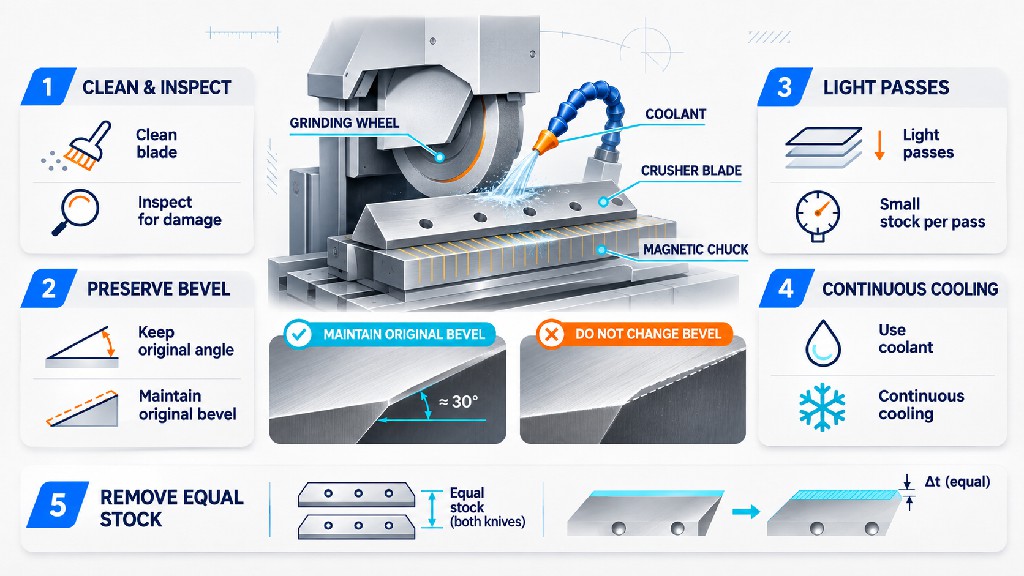
The following sequence describes the workflow a competent maintenance and grinding team should follow. It deliberately does not prescribe a universal grinding-wheel speed, depth of cut, feed rate, coolant flow, bolt torque, or knife setting because those are equipment-, material-, and wheel-dependent. Only trained, authorized personnel using the applicable machine and grinder instructions should perform the work.
Finish or safely interrupt the production job. Stop the machine through its normal shutdown method; isolate every hazardous source; apply the site's lockout/tagout program; and verify isolation before accessing the cutting chamber. Account for electrical energy, stored rotational energy, hydraulic or pneumatic systems, and any heavy covers that could fall. Prevent unexpected rotor movement using the OEM-approved means, and keep guards in place until the equipment is verified safe for the relevant service.
For U.S. workplaces, OSHA 29 CFR 1910.147 addresses control of hazardous energy during maintenance and includes requirements for isolation, stored-energy control, verification, and return to service. In other jurisdictions, follow local law and the machine's approved safety procedures. Merely pressing a stop button or opening an interlock is not a substitute for an authorized energy-control procedure.
Before disassembly, identify rotor-knife locations, bed-knife positions, direction of rotation, bevel orientation, shim locations, adjustment-screw positions, and any matched-set numbering. Take clear photographs from safe access positions after isolation. Record existing clearance measurements only where the manufacturer allows them to be taken safely. A location map helps later if one knife shows disproportionate wear or a localized chip opposite damage on a bed knife.
Follow the machine maker's removal order and lifting precautions. Long hardened knives can be heavy and extremely sharp even when called “dull.” Use edge guards, purpose-made trays, appropriate cut-resistant handling protection, and lifting equipment when required. Never place fingers under an unsecured knife, and never use the cutting edge as a leverage surface. Keep fasteners, spacers, clamps, and setting devices identified by their original locations.
Remove resin deposits and debris using a cleaning method compatible with the steel, coating, and workplace controls. Avoid aggressive scraping of precision datums. Inspect the seat-facing surface for embedded fragments, fretting, dents, corrosion, and signs that the blade was not fully supported. Cleaned parts are easier to measure reliably. If a hardened knife's seating face is damaged, simply sharpening its edge is unlikely to restore secure, repeatable alignment.
Check for cracks, severe chips, bends, distorted slots, elongated holes, fractured corners, excessive corrosion, grinding burns from prior service, and out-of-limit dimensions. Inspect the mating knife and adjacent clamps for corresponding contact marks. Use the inspection method specified by the OEM or qualified engineering team; potentially cracked knives may require a suitable nondestructive test, not only visual examination. Quarantine any part that fails structural or dimensional acceptance. Do not attempt to grind away a structural crack or weld a hardened knife without an approved repair engineering process.
Find the authorized grinding surface, nominal profile, angle tolerance, edge-straightness requirement, minimum permissible size, and whether the knife is part of a matched rotor set. Measure the knife against the specified datums using calibrated equipment appropriate to the tolerance. Record the before-grind values and the estimated material needed to remove the worn edge. If there is insufficient allowance to recover the required profile, the knife is a replacement candidate rather than a grinder job.
For long, precision-ground granulator knives, a rigid surface grinder or dedicated industrial knife grinder with suitable magnetic or mechanical workholding is often appropriate. The exact fixture depends on blade material, size, holes, profile, and contact surface. A knife must sit on a clean, stable reference and resist lifting or chatter. The grinder's wheel, guards, dressing system, coolant arrangements, and operating parameters must suit hardened tool steel and the actual operation. Do not freehand a precision granulator edge on a portable angle grinder or ordinary hand-held bench setup.
Inspect the wheel and grinder per their operating instructions; confirm the wheel's rating and suitability, and dress it to cut rather than rub. Direct properly maintained coolant into the contact zone when the approved process requires wet grinding. Establish filtration, concentration, delivery, and handling rules appropriate to the machine and abrasive. A coolant system that merely wets the blade after the hot contact has passed may not prevent thermal damage. Where a qualified dry-grinding procedure is used, it must include the material-specific controls necessary to prevent burns and cracks.
Set the workpiece by the specified datum and verify the resulting angle before grinding the entire blade. Use machine-appropriate, controlled passes. Remove the smallest practical amount of steel needed to eliminate the worn land, unacceptable nicks, and damaged edge condition while meeting the drawing. Reinspect progressively instead of taking a large cut on the assumption that all knives require equal removal. Where the OEM requires matched dimensions, plan the complete set as a unit rather than optimizing each knife in isolation.
A fresh ground face may leave a small burr at the cutting line. Remove it only using a method and amount permitted for the knife design. Over-honing can round the very edge that grinding was intended to restore, while abrasive hand work can produce inconsistent angles or secondary bevels. The correct finished condition is a controlled, continuous edge with the specified geometry and acceptable microscopic and macroscopic defects—not an arbitrary “razor sharp” feel. Never test sharpness with a bare finger.
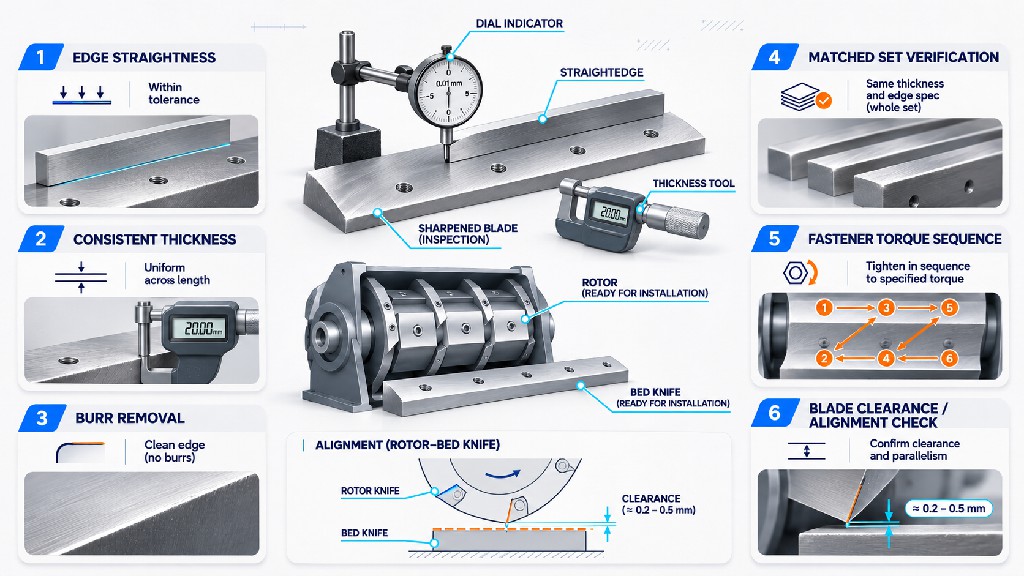
After cleaning and drying, inspect the edge along its full length under suitable lighting and magnification as necessary. Confirm no new chips, cracks, burn indications, or unacceptable burrs. Measure width or height, thickness where relevant, edge straightness, bevel angle, perpendicularity or parallelism, and any other drawing requirements. For a rotor set, verify consistent dimensions and the OEM's matching or balancing requirements. Record results by knife number so a future maintenance team can trace them.
Protect finished edges with suitable guards and corrosion prevention compatible with the customer's process. Mark the batch, part number, grind date, measured final size, accepted status, and remaining permitted allowance in a service record. Do not stamp or mark a stressed cutting surface unless the drawing authorizes it. Transport knives in separated supports so two hardened edges cannot collide. The regrinding job is not complete until the maintenance team can safely install the parts and verify operation.
Stop-work condition: If the drawing is unavailable, grinding burns appear, cracks are suspected, the knife has unknown structural repairs, or a set cannot be brought into the specified matching limits, stop and obtain an engineering disposition. Continuing to remove steel in search of a clean appearance can make a bad part less recoverable and more dangerous.
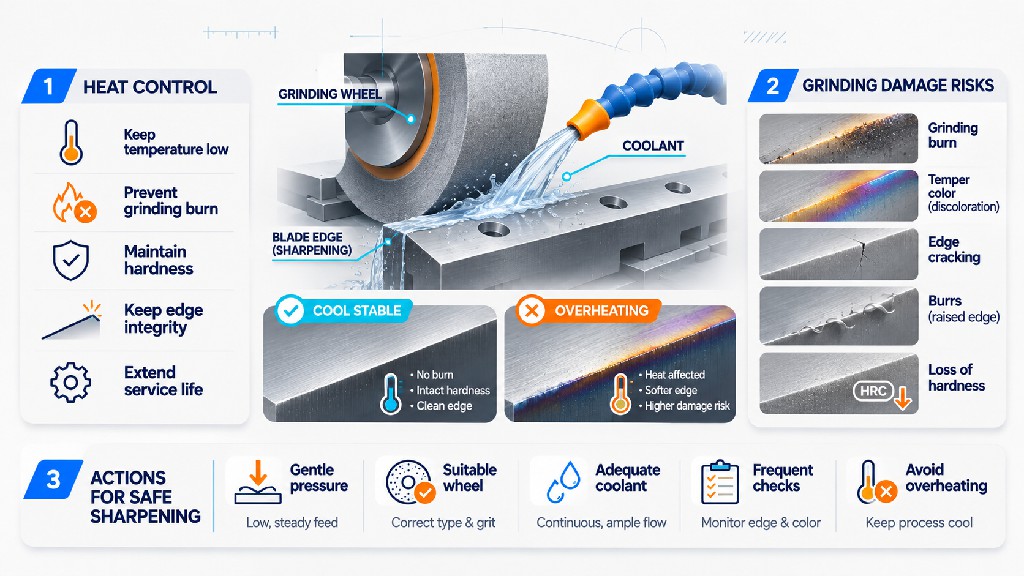
Thermal control is one of the central differences between an industrial knife regrind and casual sharpening. Hardened tool steels are designed around a particular heat-treatment history. Grinding creates intense local contact energy. If too much energy remains at the surface, the edge may be softened by overtempering, locally rehardened into a brittle condition, or left with residual tensile stresses and cracks. Those changes can shorten cutting life even if a superficial hardness reading or the finished appearance seems acceptable.
Aluminum-oxide wheels are used for many steel grinding applications. Cubic boron nitride (CBN) may be appropriate for certain hard or carbide-rich tool steels, depending on the machine, wheel bond, economics, and finishing requirements. The label “D2 blade” alone is insufficient to choose a wheel specification. Uddeholm's grinding handbook discusses abrasive type, wheel grade, wheel dressing, grinding fluid, contact geometry, and the behavior of high-carbide tool steels. Use the recommendations for the actual steel and grinding operation rather than copying a wheel setting from an unrelated machine.
A wheel that is glazed, loaded with metal, poorly dressed, or inappropriate for the steel can rub more than it cuts. Rubbing generates heat without efficiently removing damaged material. A correctly conditioned wheel, steady workholding, suitable contact area, controlled infeed, and effective cooling help manage the heat. Long blades also need support against chatter and bending. If the grinder leaves periodic marks or audible chatter, investigate the wheel, fixture, support, spindle, and parameters instead of polishing over the problem.
In a wet-grinding process, coolant has to reach the grinding zone in sufficient condition and quantity for the chosen wheel and material. Contaminated, poorly filtered, or badly directed fluid may increase wheel loading or leave heat problems unresolved. Rapidly quenching a knife after an uncontrolled overheated pass is not equivalent to preventing the heat in the first place. The process should be validated so that every part of a long blade receives consistent thermal protection.
Yellow, brown, purple, or blue surface discoloration can indicate an abnormal thermal event on some steels, but color alone is not a reliable acceptance test. Some damaged surfaces show little visible color, while surface coatings, cleaning chemistry, and lighting complicate interpretation. A suspect blade may require hardness profiling, metallographic examination, etching, or other qualified testing depending on its value and failure risk. Do not claim that a blade is undamaged merely because the polished face looks silver.
Where overheating has already occurred, the responsible action is to determine whether the damaged layer can be removed within the authorized regrinding allowance and whether required properties can be verified. If not, reject the knife. Avoid promising that a second light pass automatically restores hardness or removes cracks. For related operating problems caused by plastic smearing and excess chamber heat, consult GUANG CHUAN's granulator heat-buildup troubleshooting guide; cutting-chamber heat and grinding heat are different problems and require different controls.
The answer is: only what the approved drawing permits, and only what is needed to restore the specified edge. There is no responsible universal rule that every knife can lose a fixed number of tenths of a millimeter per sharpening or can be sharpened a certain number of times. Grinding direction, knife shape, adjustment capacity, edge location, fastener support, and machine-specific wear limits determine the permitted amount.
For example, the SWEED SG1826AF drawing in its equipment manual shows an original rotating-knife width of 3.250 inches and a minimum post-grind width of 2.750 inches. The difference is 0.500 inch (12.7 mm) of total dimensional reduction between those two reference values. This is a single model-specific example, not a recommendation to grind off 12.7 mm, not a per-service allowance, and not proof that all of that theoretical difference remains usable on an already serviced blade. Every OEM-specific limit and related adjustment requirement still applies.
For a knife whose manual expresses the limit as a minimum dimension measured from an unchanged datum, a basic tracking relationship is remaining dimensional allowance = current measured dimension − specified minimum dimension. Suppose, purely for illustration, a plant's drawing permits a minimum blade width of 70.00 mm and a measured knife is currently 72.40 mm. Its arithmetic dimensional margin is 2.40 mm. If the grinding plan removes 0.15 mm from the specified measurement direction, the projected size becomes 72.25 mm, leaving 2.25 mm above the stated minimum. These figures are invented for arithmetic illustration; they are not an OEM specification or a suggested cut depth.
Even that calculation is incomplete if the knife is bent, cracked, burned, improperly seated, or unable to achieve its prescribed protrusion or gap. The minimum dimension is only one acceptance condition. Some OEMs define a minimum body thickness, edge location, or maximum accumulated regrind instead of a simple width. Use the correct reference system, not whichever dimension is easiest to measure with a caliper.
Every grinding ticket should capture the starting dimension, ending dimension, removed stock, grinding face, edge defects, and whether the set was adjusted to match a common reference. Keep this information associated with the physical knife set, not only with the machine. Otherwise a plant may receive a knife after several subcontractor sharpening cycles and have no practical way of knowing whether one more regrind is allowed.
Where damage is localized, avoid automatically removing the whole depth of a severe notch without checking the resulting minimum size. The apparently efficient action of grinding the entire blade down to the deepest chip may destroy remaining service life. In some cases the damaged knife must be replaced; in others an OEM-approved alternative edge may be available. Do not blend a chip into a nonstandard cutting profile unless the engineer responsible for the machine authorizes it.
A rotor carrying several knives is an assembly, not simply a collection of independently sharpened tools. Knife dimensions influence their radial projection and how consistently they pass each bed-knife edge. Mass differences and uneven positions can also affect dynamic loading. In a high-speed machine, even a relatively small mismatch can create uneven cutting, increase vibration, or make the bed-knife gap difficult to adjust. A shop that saves a little grinding time by servicing only one part may cause a much more expensive line stoppage.
SWEED explicitly recommends grinding its documented granulator's rotating knives at the same time and removing similar amounts to help preserve rotor balance. The company also advises replacing all rotating knives when one reaches its end-of-life limit for that machine. Those are useful examples of a model-specific set requirement, not a universal instruction to discard every otherwise good rotor knife in every granulator. The correct rule is to check the matching requirement in the relevant OEM manual before making the service plan.
For straight rotor knives, the grinder may need to match finished dimension from the machine datum, preserve bevel geometry, maintain edge straightness, and verify that adjustment hardware can locate every cutting edge. Thickness, seating flatness, and the orientation of slotted holes can be equally important. Knives that weigh the same can still have different edge projections. Conversely, knives with equal width may differ in mass because of wear, material, or previous modifications. Both geometry and balance deserve appropriate consideration.
Do not grind the back of a knife arbitrarily to make it weigh the same as another. That may compromise clamping or structural section. Where the OEM calls for component mass matching, use its method and tolerance. Where rotor balancing is required after repair or replacement, arrange it through a qualified service using the approved standard and operating speed. No amount of knife polishing compensates for worn rotor bearings, distorted seats, or loose fastening components.
The bed knife provides the opposing edge, so its straightness and condition affect the effective clearance along the entire cut. If new rotor knives are fitted against a chipped or tilted stationary knife, output can remain inconsistent. A bed-knife adjustment may temporarily hide a geometry error at one rotor position while creating contact elsewhere. Inspect both sides of the shear system and record each accessible gap measurement as directed by the machine maker. GUANG CHUAN's rotor-knives-versus-fixed-bed-knives guide explains why these parts must be treated as a coordinated system.
Even excellent grinding will not help if the blade is reinstalled at the wrong position. The clearance between rotor and bed knives affects whether plastic shears cleanly or is squeezed and torn. A wide gap may increase stringy material and recirculation; a gap that is too tight can cause metal-to-metal contact. Correct clearance is specific to the machine model, blade design, material duty, and OEM measuring method.
To show why generic figures are dangerous, Conair's general maintenance bulletin discusses a commonly encountered clearance of 0.20–0.30 mm. A separate Conair HD Series manual provides a 0.012–0.015 inch (approximately 0.305–0.381 mm) feeler-gauge procedure for its named equipment and notes that applications vary. Neither published example licenses a technician to set an unrelated granulator by guesswork. Obtain the current clearance, tolerance, measuring position, and tightening procedure from the exact machine manual.
Ensure knife seats and mating faces are clean and undamaged. Use the correct spacers, adjusters, clamps, and fasteners; replace single-use or specified bolts when instructed. Position knives with the approved setting fixture or reference gauge. Tighten fasteners in the specified sequence with the prescribed torque and hardware condition. Never borrow a torque value from a different machine. Recheck knife position and clearance after tightening because clamping can shift the final geometry.
Check every required rotor-to-bed pairing and every specified location along the cutting width, following the OEM's safe rotor-positioning and isolation procedure. If one knife passes correctly while another contacts the bed knife, do not start production in hope that the parts will “wear in.” Investigate projection, set matching, fixture adjustment, bearing condition, holder alignment, or incorrect components. Any contact is a reason to stop commissioning and correct the cause before rotation under power.
Before energy is restored, account for tools, guards, covers, fixtures, loose parts, and personnel. Perform the manufacturer's prescribed checks, including any permitted manual rotation or mechanical verification while safely isolated. Restore safety guards and interlocks, remove lockout devices only by the authorized procedure, and conduct the approved startup. Observe sound, vibration, current, feed behavior, and discharge. Stop immediately for abnormal metallic noise, rapid current rise, severe vibration, or other unsafe conditions.
Use an agreed test feed that represents the intended production material. Record accepted throughput, regrind quality, screen condition, and motor load using the same method as the pre-service baseline. This completes the causal test: the team can now demonstrate whether the knife work improved the process. A grinder ticket without a successful production verification proves only that a machining job was completed, not that the maintenance objective was achieved.
The sharpening process must respect the steel and knife drawing, but the *reason* for service often depends on the plastic being processed. Clean post-industrial scrap generally creates a different wear pattern from dirty post-consumer material. Mineral and glass fillers increase abrasive demand. Thin film can make a slightly rounded edge apparent through stretching and wrapping, while brittle rigid polymers can generate fines that must be interpreted together with the screen and cutting conditions.
For relatively clean production scrap, a gradual reduction in shear quality may be the main sign that an otherwise healthy tool-steel edge needs service. Inspect for uniform rounding, verify the bed knife and gap, and keep the original bevel. There is usually little benefit in aggressive stock removal when the defect is modest. Where the line repeatedly produces long strips, investigate feeding geometry and shear settings rather than assuming a sharper nominal angle alone will solve the issue.
PET recycling may expose blades to sand, labels, closures, mixed plastics, and occasional harder foreign particles. Abrasive wear and isolated impact damage can occur together. A knife with light, uniform wear may be regrindable, but a deep chip after metal contamination requires a wider inspection of the rotor, bed knife, and screen. Improve sorting, washing, and metal-control arrangements before paying for a higher-priced alloy that would face the same harmful contamination.
Film can fold, wrap, and stretch instead of separating if the cutting pair no longer provides an effective shear. Look for stringy pieces, chamber deposits, wrapping, and unusual residence time. Restoring the approved edge and gap is often more important than chasing an exceptionally fine, fragile tip. A hotter cutting chamber may have a discharge or feeding cause unrelated to grinder quality, so compare feed temperature and screen condition as well.
Rigid PVC formulations can be sensitive to excessive process heat, and an abnormal odor, discoloration, or fume event requires the relevant safety and ventilation response. ABS and similar resins can show different combinations of fracture, smearing, and fines depending on grade and geometry. Glass-filled plastics, such as reinforced PA or PP, can abrade edges quickly; this may support a controlled evaluation of a more wear-resistant grade, but tougher materials and suitable edge support may be preferable when chipping dominates. There is no single alloy that solves all of these cases.
For a more detailed application comparison, see GUANG CHUAN's PET, HDPE, PP, PVC, and ABS blade-selection guide and overview of crusher-blade types and materials. These are especially useful when recurring sharpening problems suggest that the steel grade or design was poorly matched to the actual waste stream.
A disappointing startup after resharpening does not automatically mean the grinder was incompetent. The machine may have another fault, the incoming plastic may have changed, or a knife could have been fitted incorrectly. Use measured evidence to distinguish a grinding defect from an installation or process defect; do not perform repeated trial grinds without explaining the failure.
| Post-sharpening symptom | Potential causes to investigate | Useful first checks |
|---|---|---|
| Knife seems sharp, but output is still stringy | Excess gap, dull bed knife, wrong edge orientation, film wrapping | OEM clearance at all positions; opposing edge; feed presentation |
| New cutting noise or metal-on-metal contact | Incorrect projection, poor seating, wrong hardware, rotor movement | Stop; isolate; inspect for contact; recheck all datums and settings |
| New vibration after blade change | Mismatched rotor set, imbalance, loose holders, damaged bearing | Set records, seating, fasteners, OEM balance requirements |
| Fast edge chipping after the first shift | Impact contamination, incorrect bevel, inadequate support, grinding cracks | Feed incident records, profile measurement, damage examination |
| Rapid dulling with a polished-looking bevel | Thermal damage, unsuitable steel condition, abrasive feed, high rubbing | Grinding report, material traceability, authorized metallurgical tests |
| Uneven wear across blade width | Nonparallel edges, distorted seat, rotor misalignment, uneven feed | Edge straightness, contact surfaces, measured knife gap map |
| High fines despite acceptable knife geometry | Screen too fine, extra recirculation, brittle feedstock, discharge restriction | Screen condition, material change, downstream evacuation |
Frequent preventable errors include copying a generic blade angle, grinding the wrong face, clamping over debris, removing too much material to eliminate one local chip, using a glazed wheel, failing to control thermal damage, rounding the edge with excessive deburring, losing track of the knife's original position, returning unmatched rotor knives, and omitting the final dimensional report. Each error is avoidable when the shop works from the current drawing and uses an inspection record.
One particularly risky practice is attempting to “fix” a vibrating or poorly cutting machine by grinding more steel from an already sharpened set. That can move the cutting line farther from the intended location without correcting the real cause. A second risky practice is reducing the knife gap experimentally until the machine sounds different. An apparent improvement from an unapproved setting may end in edge collision. Only the OEM's adjustment method should determine the target clearance.
Preserve the affected parts, photograph the wear at each rotor position, and retain representative regrind samples. Compare the original grinding ticket with the actual installed dimensions. If chips appear at matching positions on the rotor and stationary knives, investigate contact or foreign material. If all cutting edges wear evenly but much sooner than before, review resin filler, contamination, operating rate, and the actual heat-treatment grade. If only one position repeatedly fails, investigate machine alignment and support before ordering a more expensive set.
For a commercial sharpening service, the question is not merely whether the knife is sharp enough to catch paper or scrape a fingernail. It is whether the part is ready to function in a precision cutting system. Acceptance should be traceable to the drawing, with the relevant measurements and inspection methods agreed before the grinding starts. A one-page report is often sufficient for routine jobs, provided it contains the critical information.
Incoming inspection establishes part identity, current dimensions, prior defects, and available material. In-process inspection catches incorrect setup, thermal concerns, chatter, and excessive stock removal before the whole set is affected. Final inspection verifies the drawing features and protects the customer's installation team from discovering a problem only after the rotor has been reassembled. A good report names each part, date, grinder or service provider, and the responsible inspection stage rather than claiming unsupported universal precision.
| Quality record | What the technician should verify | Acceptance authority |
|---|---|---|
| Identity and condition | Machine, position, part revision, material, cracks, damage | OEM drawing and documented rejection criteria |
| Geometry | Permitted grind face, bevel profile, final width, straightness, reference datums | Drawing tolerance and measuring procedure |
| Thermal integrity | Burn indications, surface condition, any specified hardness or crack checks | Qualified process and part-specific test requirement |
| Matched-set compliance | Finished dimensions, component pairing, balance requirement if specified | Machine manual and rotor-setting instructions |
| Service-life trace | Stock removed this service, cumulative history, remaining permitted dimension | OEM minimum size and maintenance register |
| Final release | Edge protection, identification, measurement report, installation notes | Customer purchase order and approved quality plan |
Measurement methods should suit the actual tolerance. Calipers may be adequate for a coarse stock-size check but not for verifying a tight angular, flatness, or straightness requirement on a long blade. Use appropriate gauges, precision instruments, or inspection fixtures where needed. If hardness is tested, the method and test location must be appropriate for the part; a convenient indentation on a finished cutting edge may damage it or produce misleading results. Recording a number without its method and location is weak evidence.
Ask whether the shop can reproduce the specified profile; how it supports long blades; whether its grinder, wheel, and coolant suit the steel; how it monitors overheating; whether it measures every knife or samples a set; and how it confirms matched dimensions. Also ask whether rejected knives are returned clearly segregated and whether the invoice distinguishes regrinding from replacement. The lowest quote is not necessarily the lowest maintenance cost when the service destroys a usable grind allowance or leaves installation problems for the plant.
Professional documentation becomes particularly valuable when replacement knives come from multiple suppliers. A new blade and a reconditioned original may have nominally equal dimensions but different reference faces, steel conditions, or permitted grinding history. Treat the installation drawing, not just the size printed on the invoice, as the common comparison standard.
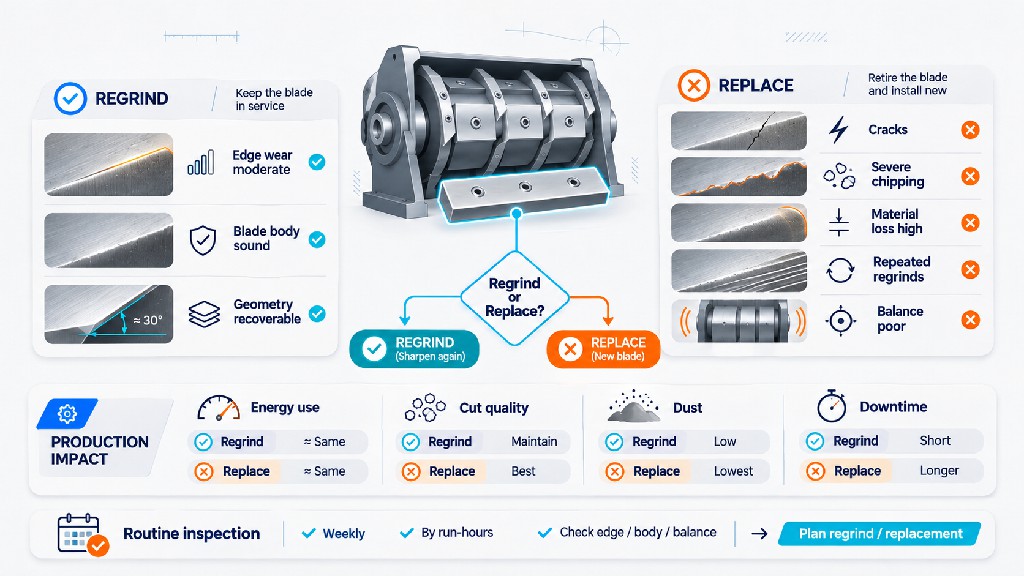
Resharpening usually makes commercial sense when the knife remains structurally sound, retains adequate geometry and adjustment allowance, can be ground reproducibly, and can support another useful production cycle. Replacement makes more sense when the knife is unsafe, below its limit, frequently failing after service, or expensive to restore relative to the next expected production period. The correct comparison includes quality, downtime, shipping, labor, and risk—not only the price of steel removed.
A practical cycle-cost model is: cutting-tool cycle cost per accepted tonne = (blade purchase or regrind cost + attributable freight + attributable labor + attributable production loss + scrap or quality cost) / accepted tonnes processed during that cycle. Compare like-for-like duty conditions, and avoid double-counting downtime already included in a contractor's service invoice. If a spare knife set allows sharpening off-line with no production interruption, the actual attributable downtime may be much lower than for an emergency same-day grinding job.
For illustration only, suppose a new knife set costs US$1,200, requires US$150 in attributable changeover loss, and processes 240 accepted tonnes before its next service decision. Its cycle cost is (1,200 + 150) / 240 = US$5.63 per accepted tonne, before any additional items. Now suppose a structurally sound set can be reground for US$180, requires US$60 freight and US$450 in attributable downtime or service loss, and then processes 170 accepted tonnes. That cycle costs (180 + 60 + 450) / 170 = US$4.06 per accepted tonne. These prices and yields are hypothetical teaching figures, not GUANG CHUAN performance claims, industry averages, or guaranteed service life.
The apparent advantage disappears if the regrind causes rejected flakes, early chipping, bearing damage, or unexpected downtime. Conversely, the calculation improves significantly when a well-managed spare-set rotation allows external sharpening while production continues. Measure the actual accepted mass—not only gross feed weight—and add the quality loss of unusable regrind if it is material to the decision.
A plant with only one usable knife set must stop production while grinding or wait for new parts. A plant with a ready, qualified spare set can replace worn knives during a planned shutdown and send the removed set for inspection and regrinding off-line. The spare set needs proper storage, edge protection, traceable service history, and periodic condition verification. It is not enough to keep an unidentified box of old knives on a shelf. A disciplined rotation turns emergency repairs into a predictable consumables program.
In-house sharpening can be attractive for plants with enough recurring knife volume to justify a precision grinder, trained personnel, inspection equipment, coolant management, maintenance, and quality controls. Outsourcing can be better for smaller sites, complex profiles, long blades requiring specialist fixturing, or cases involving suspected heat damage. The decision should account for the true hourly utilization of the grinder, rejects, process expertise, and the cost of idle production when a knife arrives out of tolerance.
An external supplier should understand the application, not just the steel grade. A service that can inspect the original drawing, advise on remaining allowance, supply a compatible replacement set when one knife is rejected, and document finish measurements may offer stronger long-term value than a service that quotes only a low per-edge grinding price.
Good procurement begins with enough technical information to eliminate guesswork. GUANG CHUAN manufactures industrial machine knives and offers crusher blade products and custom replacement options. Its company profile describes manufacturing and tooling capabilities. For an actionable inquiry, identify the machine and required outcome rather than requesting “a sharper D2 knife” without dimensions or application details.
Provide a drawing or measurable reference sample; machine make, model, year, and relevant part number; rotor or stationary position; quantity per set; original and current dimensions; hole or slot geometry; cutting-edge orientation; documented minimum size; edge-profile detail; and actual steel grade where known. Add clear photos of wear, any recent impact incident, the intended resin and filler content, contamination conditions, operating hours, and measured acceptance criteria. If no drawing is available, explicitly say so and ask for dimensional reverse engineering rather than assuming a photograph is adequate.
First, request a quotation to inspect and regrind the existing knives with a clear rejection policy. Second, request an OEM-compatible replacement set based on verified drawings, steel specification, and the machine's required fitting geometry. Comparing these options exposes the real cost of salvaging a marginal part. For heavily filled or contaminated material, a supplier may also suggest a different grade or heat-treatment strategy, but that should be presented as an engineering proposal requiring approval and validation.
Specify what evidence the delivered knives should include: finished dimensions, tolerance inspection, material identification where relevant, declared heat-treatment condition, and proper protective packaging. When recurrent failures are present, include the damaged parts and the grinding history in the discussion. A technically meaningful root-cause review can be more valuable than an immediate recommendation to purchase a harder blade.
To request an application review or replacement-blade quotation, use GUANG CHUAN's contact page. Ask specifically for confirmation of the approved edge geometry and safe minimum dimensions before authorizing grinding. The purpose of a supplier consultation is to preserve reliable production, not to force every worn blade into a replacement sale.
An effective preventive maintenance program separates inspection frequency from replacement or grinding decision. Inspecting frequently does not mean grinding frequently. The inspection program should identify damage early enough to avoid major stock removal, while allowing sound edges to remain in use until there is a defensible reason for service. Record trends under comparable operating conditions and shorten inspection intervals if the scrap stream becomes more abrasive or unpredictable.
At each production handover, operators can note unusual sound, changes in regrind quality, motor-load trends, and feed or discharge problems without opening unsafe areas. At scheduled isolated maintenance, trained technicians can inspect edges, screen, knife gaps, seats, and fasteners to the machine manual. When a set is removed, the grinding shop measures the part and its remaining allowance. After installation, maintenance records the final settings and production verification. This makes the next sharpening decision easier and less speculative.
Use clear rejection rules: visible crack or confirmed crack indication, damaged load-bearing mount, below-minimum geometry, unacceptable distortion, unresolved burn or hardness concern, or inability to maintain the OEM clearance. A knife that passes these tests may be eligible for a controlled process to regrind crusher knives; a knife that fails them should not be pressed back into service merely to reduce short-term spending.
Review the data periodically. If one steel repeatedly chips while another wears evenly, investigate toughness and foreign material. If knives consistently become unusable after only a small amount of stock is removed, examine the original design, grinder setup, and fitment adjustment capacity. If the same set performs well after every carefully documented regrind, keep the process unchanged rather than introducing a speculative improvement. Service-life preservation is achieved through disciplined consistency.
For precision granulator rotor or bed knives, freehand bench grinding is generally inappropriate because it cannot reliably control long-edge straightness, reference datums, bevel angle, thermal loading, and matched-set dimensions. Use equipment and fixtures specifically qualified for the knife drawing. A specialized industrial knife grinder or suitable surface-grinding setup is commonly a more defensible choice. Always follow grinder safety instructions and the machine manufacturer's approved service method.
The best angle is the angle specified for the actual knife and machine, measured from the stated drawing datum. Different OEMs publish different profiles, and even a 78-degree annotation can have a complementary 12-degree reference. Do not borrow a general 30-, 45-, or 60-degree internet recommendation without confirming exactly what the number describes. The included edge angle, relief, seat reference, and grind face must all agree with the approved geometry.
There is no universal calendar or operating-hour interval. Service is appropriate when performance and inspection show dull or recoverable cutting edges, other process faults have been considered, and the knife still meets the OEM regrinding limits. Resin abrasiveness, contamination, screen selection, blade grade, and actual usage can vary widely. Use trends and condition records rather than an unsupported promise of a fixed number of operating hours.
Often, yes. High-speed granulators commonly use precision rotor and stationary shear knives, while many slow-speed shredders use thick cutters or hooked and toothed geometries designed for heavy torque and impact. Grinding faces, minimum sizes, mounting methods, and balance requirements can be very different. Identify the actual machine design before applying this procedure. GUANG CHUAN offers separate crusher blades and shredder blades categories for this reason.
The number depends on initial size, accumulated material removal, minimum permissible dimensions, remaining adjustment capacity, and structural condition. Ten very light, properly controlled regrinds may consume less material than two heavy ones, but neither count establishes safety. Track dimensions at each service and respect all OEM limits. A cracked, distorted, or thermally damaged knife may require rejection regardless of remaining stock.
Inspect both sides of the cutting pair together. The need to sharpen or replace them simultaneously depends on their actual condition and the machine's instructions. Some OEMs require a matched rotor set and synchronized service for balance and clearance control. Do not assume that changing one bed knife or one rotor knife is automatically permissible. Follow the machine's approved matching and adjustment procedure.
No. Proper coolant delivery helps manage grinding heat, but a dull or unsuitable wheel, excessive contact pressure, inadequate fluid delivery, poor fixturing, or incorrect parameters can still damage hardened steel. Coolant reaching the part after the hottest contact zone is not an effective substitute for process control. A qualified grinding procedure must address wheel selection, dressing, cooling, inspection, and the specific alloy.
Minor edge defects may be recoverable if the corrected geometry remains within the drawing and the part has no disqualifying crack or structural damage. Deep chips, heat-affected layers, or damage near mounting holes may require more material removal than the knife allows. Do not promise that polishing away visible discoloration repairs metallurgical damage. Obtain a qualified inspection and reject the part if its condition cannot be established.
Investigate grinding heat damage, incorrect bevel geometry, over-honing, unsuitable steel, abnormal contamination, insufficient edge support, incorrect clearance, and repeated contact with the opposing knife. Compare the recent grinding report with the actual dimensions and review the material fed during the short service cycle. If several sets fail identically, focus on the process or machine before assuming that every blade batch is defective.
At minimum, report knife identity, original and finished reference dimensions, ground surface and specified profile, relevant angle and straightness checks, observed defects, stock removed, and status against the minimum service limit. Add the OEM's required set-matching values, special tests, and packaging information where applicable. A report should allow the receiving team to install the knives confidently without guessing how much life remains.
No. Greater abrasion resistance may help on some filled plastics, but an excessively brittle edge can chip under impacts or hard contaminants. Heat treatment, steel cleanliness, bevel support, cutting gap, and feed sorting can matter more than a nominal HRC increase. Judge material changes through a controlled comparison of accepted production, edge failure modes, grinding cost, and downtime rather than hardness alone.
Prevent foreign-object damage, keep the knife gap and discharge path within specification, inspect before severe rounding develops, maintain a labeled spare set, and use a service that measures the knife before and after grinding. Reject the idea that deeper grinding automatically gives a longer run. A good inspection and recordkeeping routine often saves more than a small discount on the per-edge grinding fee.
To preserve service life, treat how to sharpen crusher blades as a repeatable engineering procedure rather than a single grinding action. First confirm that the edge is the problem. Then verify the original drawing and remaining allowance, control grinding heat and material removal, maintain the required rotor-set consistency, and restore the approved knife clearance before putting the machine back into production. The strongest evidence of success is not a bright bevel—it is a safe, traceable knife set that achieves acceptable regrind quality and stable operation.
The same priorities apply whether you manage an in-house sharpening room, send knives to a specialist, or purchase a replacement set. Preserve the drawing, record each regrind, reject unsafe knives promptly, and compare actual cost per accepted tonne. These steps make maintenance decisions defensible for production, engineering, quality, and procurement teams alike.
Need an OEM-compatible crusher blade or a review of repeated sharpening failures? Share the machine model, knife drawings or samples, installed dimensions, steel grade, feedstock, and photographs of the worn edges with GUANG CHUAN. Review available crusher blade configurations and request a specification-based quotation. A suitable replacement should fit the existing cutting system and make future maintenance predictable—not require the plant to improvise a new angle or adjustment procedure.
Technical note: This article is an educational maintenance and purchasing guide, not a machine-specific sharpening instruction or safety certification. OEM manuals and approved drawings control grinding surfaces, angles, limits, fasteners, tolerances, and reassembly. Published source figures are explicitly attributed to the machines for which they were issued; worked commercial and dimensional examples are illustrative, not field-test results or supplier guarantees.

Leave A Message
Scan to WhatsApp :

 English