




Plastic crusher blade selection is not simply a choice between D2 steel and high-speed steel. A recycling line handling clean HDPE bottles presents a very different cutting duty from a line processing dirty PET bales, mineral-filled PVC profiles, thin polypropylene film or thick ABS injection-molding runners. The right replacement knife must fit the machine, shear the actual feedstock, survive its contaminants and preserve predictable output between maintenance stops.
This buyer's guide is written for recycling-plant owners, maintenance engineers, plastic processors, equipment OEMs and procurement teams comparing replacement PET crusher blades, HDPE crusher knives, PP crusher blades, PVC crusher blades and ABS granulator blades. It explains the operating differences that affect blade material, geometry, clearance, heat treatment, mounting accuracy and total cost. More importantly, it gives buyers a repeatable method to specify a knife and evaluate quotations instead of relying on a supplier's generic claim that a blade is “high hardness” or “long lasting.”
Quick recommendation: Begin with the machine's original blade drawing and an honest description of the plastic stream. For clean, conventional granulation, properly heat-treated D2/SKD11 or a suitable Cr12MoV grade is a practical comparison baseline. Upgrade or modify edge geometry when filler abrasion, heavy impacts, excessive fines or repeat chipping justify the additional cost. Never order a knife from resin name alone, and never use a clearance number from another granulator as an installation instruction.
How to use this article: Identify your feedstock in the material matrix, examine its dedicated section, choose an initial steel-and-edge candidate, then use the fitment checklist and controlled trial plan before approving production quantities. Recommendations below are engineering starting points, not universal recipes or claims about measured performance in a particular customer's line.
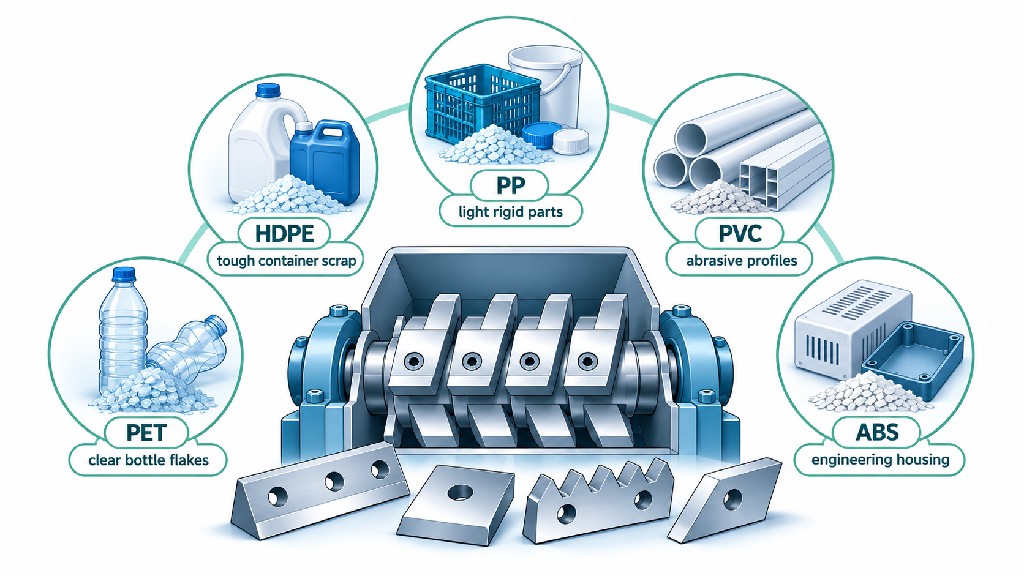
A screened plastic granulator typically reduces size through a repeated shearing action. Rotor knives pass stationary bed knives, cutting material trapped between their edges. Pieces that are small enough exit through the screen while larger pieces return to the cutting chamber. In a slower primary shredder, tooth-shaped cutters may grip and tear bulky items at much higher torque and lower speed. Although buyers sometimes call both sets “crusher blades,” the geometry and operating loads are different. GUANG CHUAN's explanation of crusher blades versus granulator knives provides a useful terminology comparison before an OEM replacement order.
Five considerations determine the real cutting duty. Form describes whether the plastic arrives as flexible film, hollow bottles, pipes, rigid housings or thick solid purges. Feed condition distinguishes clean factory scrap from post-consumer material carrying sand, adhesive, labels, metal or moisture. Composition includes not only the polymer name but also glass fiber, calcium carbonate, flame retardants, pigments and other additives. Machine configuration includes rotor speed, cutting path, bed-knife support and screen. Acceptance criteria cover usable regrind, dust, strip formation, temperature rise, throughput and the interval between planned knife service.
A hard polymer does not automatically demand the hardest blade. Edge damage may be dominated by a metal staple rather than the polymer; wear may be dominated by mineral filler rather than the base resin; poor output may result from an open knife gap instead of the alloy. Conair's practical granulator maintenance guidance specifically emphasizes sharp rotor and bed knives, correct manufacturer-recommended gap and clean, serviceable screens.
The matrix below is intended for quotation screening. “Starting point” means a candidate to discuss and test against the specific crusher or granulator; it is not a fixed OEM specification or guaranteed life ranking.
| Plastic stream | Typical feed form | Main cutting risk | Blade candidate for evaluation | Priority check before ordering |
|---|---|---|---|---|
| PET | Post-consumer bottles; rigid trays; thick PET parts | Sand, metal, labels and intermittent bottle-neck impact | D2/SKD11 or Cr12MoV; tougher edge design if impacts dominate | Contamination removal, chip history and cutter-to-bed alignment |
| HDPE | Bottles, drums, pipe, blow-molded scrap | Ductile folding, smearing, thick-wall shock | D2/SKD11 or a suitable conventional tool steel, geometry matched to wall thickness | Knife sharpness, feed presentation and controlled shear gap |
| PP | Rigid crates, runners, film, woven sacks | Stringy film, wrapping, rubbing and filler abrasion | Wear-resistant tool steel for rigid scrap; sharper, supported edge and film-oriented setup for flexible feed | Actual PP form, CaCO3 or glass content and screen performance |
| PVC | Rigid pipe, profiles, cable-related scrap, flexible components | Mineral fillers, dust, frictional heating and formulation variability | Qualified wear-resistant grade; alternative toughness and edge geometry for heavy rigid profiles | CaCO3 percentage, additives, dust extraction and temperature control |
| ABS | Housings, sheet, runners, engineering scrap | Rigid-section impact, edge fracture; severe wear if glass/mineral filled | D2/SKD11 or Cr12MoV baseline; tougher or more wear-resistant grade as actual duty requires | Wall thickness, filled versus unfilled grade, inserts and mixed engineering plastics |
Two packages of plastic labeled “PP” may be radically different: one may be clean unfilled injection-molding sprues; the other may be printed sacks containing abrasive contamination. Likewise, a recycled “ABS” stream may include plated parts, screws or glass-filled engineering blends. For this reason, a resin label belongs at the start of a specification, not at its end.
PET bottles are common in bottle-to-flake recycling. Hollow bodies often collapse easily when introduced to the cutter, but thick neck regions, residual caps, compacted bales and trapped foreign objects can produce intermittent loads. PET itself is not automatically the most abrasive feedstock on this list; dirt, glass, mineral particles and metal carried into the chamber often explain unusually rapid knife wear or edge breakage. Clean, well-sorted PET bottle scrap and dirty post-consumer PET should therefore be quoted as separate operating conditions.
For a conventional PET bottle granulator, D2 steel plastic granulator blades are a reasonable benchmark because a properly treated high-carbon, high-chromium tool steel provides useful abrasion resistance. GUANG CHUAN offers a dedicated D2 blade product for PET bottle and rigid-plastic recycling, including adjustable slotted mounting patterns. This is a relevant sourcing starting point, not proof that one steel grade suits every machine or feed.
Begin with the OEM cutting geometry, a sharp accurately ground rotor-and-bed pair and a grade known to fit the feed. Confirm whether bottles enter whole, crushed, baled or pre-washed. A correctly supported cutting edge should shear bottle walls without repeatedly pinching them. When light bottles float or bridge at the hopper, inconsistent feeding can increase recirculation and energy use even though the blade is sharp. This is a feeding and machine-process issue, not necessarily an invitation to specify a more expensive alloy.
Where gritty abrasion is dominant, a wear-resistant D2/SKD11 family grade may help retain the edge, but eliminating sand before granulation is frequently more economical than trying to cut dirt with a premium knife. Where bolt fragments or glass routinely strike the edge, investigate sorting and metal detection first. A very hard, thin edge may chip during impact, leaving a damaged section that then creates fines and noise. A supplier may recommend an edge reinforcement or alternate heat-treatment balance after reviewing the failure photographs.
Check caps, closures and labels because they can be made from plastics other than PET. The PET Bottle Recycling Council's material overview notes that bottle bodies, caps and labels can differ in resin composition; this matters to sorting and downstream separation. Blade selection alone cannot correct a mixed-polymer product-quality problem.
If the plant also uses a slow-speed PET shredder before granulation, specify the two stages separately. The GUANG CHUAN PET shredder blade guide addresses heavy impact and contamination, but primary shredder cutters should not be copied into a granulator quotation without a drawing and machine review.
HDPE appears in detergent containers, blow-molded drums, rigid pipe, transport packaging and manufacturing scrap. Its toughness and ductility can help parts resist fracture. That means a poorly set cutter may bend, stretch or rub the material before separating it. A higher-priced blade cannot compensate for a rounded edge or a gap wide enough to allow thin walls to fold into the cutting zone.
For clean HDPE bottles and regular factory scrap, a suitably ground D2/SKD11 or other approved tool steel can provide a cost-effective baseline. Evaluate the material's actual form before deciding that high hardness is necessary. A thin-walled bottle needs a reliable scissors-like shear; thick pipe sections and heavy drum wall sections introduce higher instantaneous cutting loads. Those two applications can require different edge support even when both are labeled HDPE.
In thin-wall HDPE service, cutting sharpness and controlled clearance often matter more than maximizing nominal HRC. Common symptoms of poor shear include stretched strips, ragged regrind, elevated recirculation and a relatively warm cutting chamber. Before buying new knives, check that the bed knife still has a usable edge, the rotor is not drifting, all cutting edges engage correctly, and the screen is free from deformation or clogging. A newly sharpened rotor knife working against a worn bed knife may not restore an effective cutting pair.
Thick HDPE parts can produce greater shock when they first enter the cutter. A robust bevel, suitable steel toughness, secure seating and correctly controlled feed size become more important. If an existing knife shows chips at isolated points after processing thick pipes, do not assume the steel is simply too soft. Determine whether an oversized piece or foreign object caused a local impact, whether the knife projection exceeds the machine setting or whether fasteners moved under load.
Wet bottle streams require particular attention to corrosion during storage and machine shutdown. D2 is a chromium-alloyed tool steel, but it is not automatically a corrosion-proof stainless knife. Cleaning, drying where applicable, and documented storage protection help preserve precision edges. Ask the manufacturer which protective treatment is compatible with your feedstock and any product-purity restrictions.
Choose the lowest total-cost blade that provides repeatable clean cutting and predictable service. If a current D2-equivalent blade wears gradually and is easy to resharpen, upgrading to a costly exotic alloy without a controlled trial may not be justified. If the line loses hours each week to stringy regrind, validate knife gap, feed and screen before purchasing a harder grade. This sequence avoids blaming the wrong component and produces a stronger, testable purchase specification.
Polypropylene is not one single cutting application. Rigid crates, automotive housings, injection-molding runners, thin film and woven sacks differ substantially in how they enter a rotating cutting chamber. PP is generally tough and low density, and flexible grades may stretch rather than shear when the knives are rounded or misaligned. Filled PP, including grades containing calcium carbonate or glass fiber, changes the wear problem by adding abrasive particles to the cutting interface.
Conventional tool steels such as D2/SKD11 or Cr12MoV may be appropriate candidates for clean rigid PP. Rotor and bed-knife geometry should be matched to part thickness and machine design. An aggressive, unsupported cutting edge can chip on thick runners, while an overly blunt edge increases motor load and creates rough particles. Compare steel grades only after verifying geometry, installation and contamination history.
Thin flexible material can wrap around a rotor, pass between knives without fully separating, or generate long stringy fragments. This may require a machine designed specifically for film, different feeding equipment, higher quality of edge finishing, adequate shear support and more frequent cleaning. A smaller knife gap is not universally safe: it must be compatible with the machine's expansion, rotor deflection and OEM instructions. Increasing hardness alone rarely solves wrapping, bridging or poor feeding.
When requesting PP crusher blades for raffia or woven bags, provide a sample of the feed, indicate whether it is loose or compacted, and explain whether the granulator includes a film-specific rotor or pre-compactor. If operators find filament-like tails in the output, photograph the material and measure the rotor-to-bed clearance at multiple positions before changing the edge specification.
The label “PP” hides critical differences in reinforcement. Calcium carbonate filler or glass fiber may accelerate abrasive wear, particularly when a large amount of material passes the same cutting edge. A supplier should ask for the approximate filler loading and whether it is stable from batch to batch. A higher-wear-resistance grade, reinforced edge or different maintenance interval may be worth testing; however, harder materials can increase chipping risk if the feed also contains metal or causes severe impact.
Ask for one proposal optimized for clean unfilled PP and a second, explicitly qualified proposal for filled PP if your plant runs both. An automatic recommendation to buy the most expensive blade for all PP wastes spare-part budget and hides the reason for the selected grade.
PVC deserves additional engineering attention because real-world PVC products vary widely by formulation. A rigid window profile, a pipe fitting, a flexible sheet and cable-related scrap can differ in plasticizer content, filler loading and hardness. Many rigid PVC products contain mineral additives that influence abrasion and dust generation. Buying PVC crusher blades without stating whether the stock is rigid or flexible is therefore an incomplete request.
For rigid profiles, a wear-resistant D2/SKD11 or appropriately treated Cr12MoV blade may be worth evaluating, especially when mineral-filled scrap causes progressive edge rounding. If thick profiles impose strong impacts, combine adequate wear resistance with toughness and a supported bevel. Ask the processor for material wall thickness, expected cut length, metal-reinforcement removal and a description of the dominant failure: wear, chipping, cracking or uneven edge loss.
Rigid PVC window profiles may contain reinforcement or attached hardware. Remove steel fasteners, screws and reinforcing members before crushing whenever practical. A premium edge material is not a substitute for separation of hard foreign objects. If a continuous abrasive problem remains after sorting, document knife wear after a known mass of processed material and compare candidates on the same input.
Flexible PVC can behave differently from rigid profiles: rubbing, bending and accumulation may be more important than fracture. Cleanly shearing flexible pieces may call for a sharp edge, accurate seating, a suitable screen and well-managed feed. Cable scrap can be mixed with conductors, jackets or other polymers. Identify whether the machine is a granulator for already-separated plastic, a cable recycling system or a primary shredder; their blades are not interchangeable.
Excessive frictional heating is undesirable for many plastic streams. For PVC, overheating carries an additional concern because thermal decomposition can release hazardous products, including hydrogen chloride. The U.S. Occupational Safety and Health Administration's technical manual identifies hydrogen chloride as a possible product of PVC thermal decomposition. This is not a claim that normal, properly controlled granulation produces a specific exposure level; the actual risk depends on material, temperature, ventilation and processing conditions.
PVC safety note: If material discolors, scorches, emits unusual fumes or becomes abnormally hot, stop and investigate using the site's safety procedure. Provide suitable dust and fume control, consult material safety documentation and assess occupational exposure as required. Never rely on blade steel selection as the sole control for overheating or hazardous fumes.
For PVC orders, explicitly disclose filler content, temperature-related problems and any product contamination restrictions. An experienced supplier may suggest a geometry or steel change, but the OEM's machine settings and plant safety controls remain essential.
ABS is widely used for rigid molded components, housings and production scrap. Many unfilled ABS parts granulate predictably in a correctly adjusted machine. Nevertheless, thick runners, gate regions, screws, painted or plated surfaces, recycled blends and reinforced compounds can change the loading dramatically. ABS granulator blades should therefore be chosen by grade and part form rather than assuming that every ABS stream resembles clean, unfilled molding scrap.
For clean, unfilled ABS, D2/SKD11 or a suitable equivalent tool steel is a useful benchmark when the existing machine was designed for rigid engineering plastics. A stable sharp edge improves shearing, while adequate bevel support reduces the chance of small chips from thick runners. Evaluate the original geometry and whether the current blade can be reground without compromising knife projection or its safe minimum dimensions.
Many ABS housings carry clips, inserts, labels or fasteners. A line that regularly encounters screws may experience sudden edge damage even with a high-wear-grade tool steel. Establish an incoming inspection process and a metal-separation strategy instead of budgeting for frequent breakage as an inevitable cost of recycling ABS.
Recycled ABS may be blended with PC, contain flame-retardant packages or be reinforced. Composition changes the cutting behavior and potential contamination concerns. If the plant receives PC/ABS, glass-filled ABS or unknown electronics scrap, identify the feed formulation before comparing knife grades. Glass fiber and hard fillers can justify a wear-focused trial; high-impact applications may require a tougher edge. Avoid promising that a grade named “ABS” is always low abrasion.
Do not assume that a blade suitable for neat ABS can simply be transferred to glass-reinforced engineering plastics. Where mixed grades cannot be separated, define a representative worst-case feed sample, agree on acceptable output quality and request a measured production test rather than a catalog-only recommendation.
A controlled change is justified when existing knives show reproducible rapid abrasive rounding after proper installation, or repeated chipping attributable to impact despite effective sorting. It is not justified merely because an invoice lists a cheaper steel or because a salesperson recommends the highest HRC. Ask the supplier to explain the likely failure mechanism, proposed material or bevel change, and how success will be measured on the actual line.
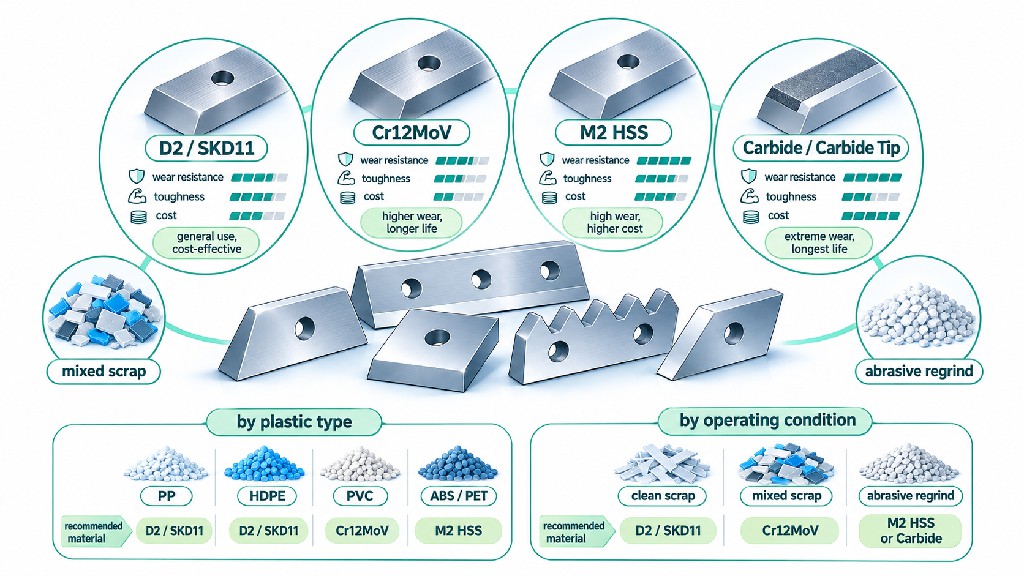
Tool steel names appear prominently in industrial blade quotations, but the name alone does not describe performance. Actual results depend on steel chemistry, cleanliness, forging or rolling quality, heat treatment, tempering, edge dimensions, grinding damage and the impact and abrasive conditions of use. Buyers should ask what a supplier can verify on the finished knives, rather than assume that every blade bearing the same material designation performs identically.
AISI D2 / DIN 1.2379 is a high-carbon, high-chromium cold-work tool steel. The Uddeholm Sverker 21 technical overview identifies the D2/1.2379 designation and describes high abrasive wear resistance with less emphasis on chipping resistance. This provides useful material-science context for granulator blade design: D2 is an established wear-resistant reference, but it is not automatically the optimal choice for violent impact or frequent metal contamination.
JIS SKD11 is a closely related high-carbon, high-chromium cold-work die-steel designation commonly compared with D2. Suppliers sometimes use the terms interchangeably, but material certificates should name the actual specification and chemistry being supplied. Composition, source and heat-treatment condition may differ within permissible ranges or across commercially described “equivalents.” A purchase order should not rely solely on the label “D2/SKD11.”
Cr12MoV is another high-carbon, high-chromium die-steel option frequently supplied for recycling knives. It may provide a commercially attractive balance for some applications, but do not present it as a guaranteed direct drop-in substitute for D2 without reviewing the specified heat treatment and duty. GUANG CHUAN's article on steel grades used for plastic crusher blades summarizes the company's D2, M2, Cr12MoV and SKD11 product directions.
M2 high-speed steel contains alloying elements selected for high hardness and wear resistance at elevated tool temperatures in demanding cutting applications. Whether it improves a plastic granulator's economics depends on edge geometry, thermal conditions and impact. It is not automatically superior to D2 in an intermittently shocked cutter; a brittle edge can fail long before its potential wear advantage is realized. Compare it only after receiving a qualified heat-treatment specification and operating justification.
Carbide or carbide-inlaid designs can be considered where abrasion is exceptionally severe and the machine supports the necessary mounting design. Tungsten carbide is hard and abrasion resistant, but brittle behavior, bonding or brazing design, grinding capability, repairability and upfront cost create additional constraints. An unsupported carbide edge in a machine frequently striking metal may be the wrong commercial choice. Seek a documented test and a manufacturer-approved mechanical design, not a generic promise of several times longer life.
| Blade material | Potential advantage | Main trade-off | Common trial situation | What to request on quotation |
|---|---|---|---|---|
| D2 / 1.2379 | Established abrasive wear resistance | Moderate impact/chipping resistance compared with tougher alternatives | PET bottles, rigid HDPE/PP, unfilled ABS, some PVC applications | Actual grade, heat treatment, target HRC and inspection record |
| SKD11 | Well-known cold-work steel option with strong wear performance | Grade label alone does not prove chemistry or toughness | General granulator replacement with an approved existing specification | Material standard and certificate rather than “equivalent” alone |
| Cr12MoV | Practical alloy option often quoted for recycling knives | Performance varies by source, section size and heat treatment | Budget-sensitive production with verified performance | Batch traceability, HRC band and actual edge specification |
| M2 HSS | High hardness and wear potential in suitable cutting duty | Cost and possible chipping sensitivity under impact | Abrasive, stable feed where an engineering trial supports the premium | Hardness, geometry, warranty terms and resharpening instructions |
| Carbide-inlaid / tipped | Strong abrasive wear potential | Edge brittleness, joint design, repair limitations and cost | Specialized abrasive feed with controlled shock and suitable tooling | Tip grade, joint design, fixture compatibility and test plan |
Many industrial granulator knife offerings advertise approximately 58–62 HRC for hardened tool-steel variants, including some products listed by GUANG CHUAN. This is a supplier-offered range, not a universal industry standard applicable to every blade material and every feedstock. A suitable specified band may be narrower, lower or higher depending on toughness, geometry and section size. HRC is a hardness measurement; it is not a direct measurement of impact toughness or service life.
For inspection and acceptance, buyers can reference ASTM E18-25 or ISO 6508-1:2023 for Rockwell hardness testing of metallic materials. Specify the measurement method, location, number of measurements and acceptance range with the supplier. Hardness measured in one location does not necessarily establish uniform properties throughout the knife, and these standards do not specify a universal hardness for plastic crusher blades.
Heat treatment changes both hardness and toughness. Two knives made from nominally comparable tool steel may behave differently after different quenching, tempering and finishing processes. Excessive grinding heat can damage an otherwise correctly treated knife; residual stresses or poor finish at a sharp corner can contribute to crack initiation. In acceptance discussions, ask how the blade is hardened, tempered, inspected and finally ground, and whether regrinding instructions are available.
A responsible supplier should also explain the trade-off when a customer requests a harder edge. If the blade regularly encounters occasional screws, extremely high edge hardness may increase catastrophic chipping risk. If the plant processes clean but mineral-filled plastic, an increase in wear resistance may be attractive. The correct decision requires a description of the dominant failure mechanism, not simply the highest available hardness number.
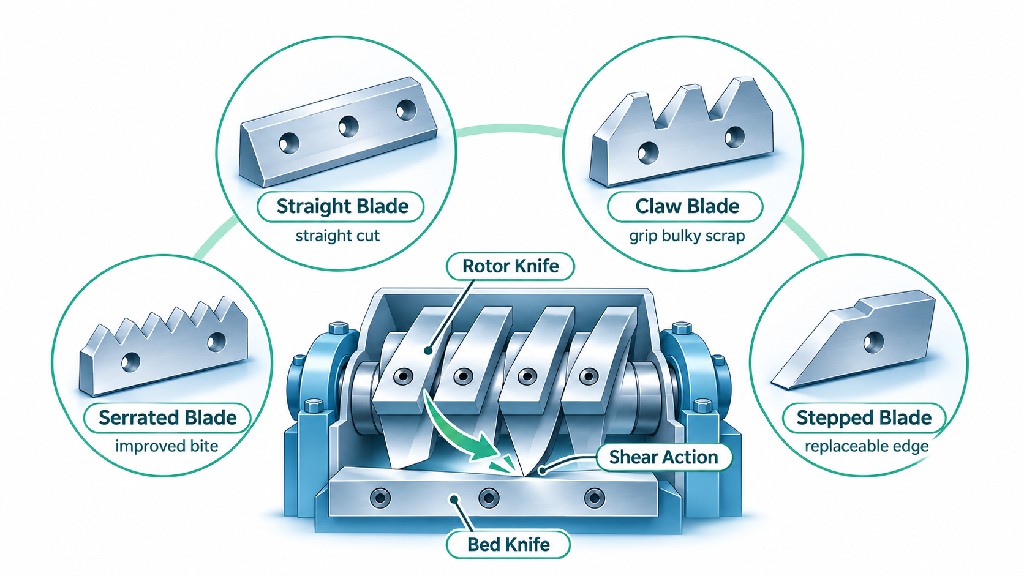
Geometry determines how force enters a cutting edge. A narrow acute edge may start a cut with relatively low resistance but provide less material behind its tip; a larger included angle or a suitable micro-bevel strengthens the edge, often at the expense of more cutting force. A compound bevel can sometimes balance initial penetration and support. The correct angle is constrained by the OEM cutter geometry, knife projection and existing rotor-to-bed clearance.
Do not confuse three different angles. The included edge angle describes the wedge between cutting faces. The ground bevel angle may be measured from a particular blade face and not equal the included angle. The installation or shear angle describes how the rotor edge meets the fixed knife along the cutting path. A quotation that states only “45 degrees” without a drawing may be ambiguous. Include a section sketch and define the measurement convention.
Some machines require a single bevel with a particular orientation to the knife seat. Others use double-bevel or reversible knives, enabling another working edge to be exposed after service. Reversibility improves potential utilization only if the unused edge, screw seats and blade body remain intact and the OEM design permits reversal. Never flip a knife simply because the opposite side looks sharp; mounting geometry and fastener loading may make it unsafe.
Clearance is the gap between passing rotor and fixed cutting edges. Too much clearance can increase bending, tearing, stringy regrind and unnecessary recirculation. Too little may risk metal-to-metal contact as the rotor heats, deflects or changes position. A correct setting must be maintained across the working width, not only at one end.
For a specific example rather than a universal setting, the Conair 8 Series Granulators user guide, service page 7:14 gives reference ranges of 0.15–0.25 mm for standard applications and 0.10–0.25 mm for film applications, with an indicated maximum of 0.30 mm in the listed configurations. The manual itself explains that proper clearance depends on the type and form of material being ground. These numbers illustrate the importance of a machine-specific manual; they must not be transferred to a different brand or cutter without OEM approval.
Check each cutting station with suitable calibrated measuring tools at the specified positions, while the machine is safely isolated and the rotor secured under the manufacturer's procedure. GUANG CHUAN's guide on adjusting blade clearance for plastic shredding explains the relationship between misalignment, cutting consistency and wear. A supplier should not promise that a replacement knife will automatically restore clearance if the machine has worn seats, a damaged rotor or incorrect mounting hardware.
A knife can meet dimensional size requirements yet perform poorly if the edge has burrs, grinding burns or uneven relief. Specify edge straightness, thickness, parallelism and acceptable finish based on the original drawing. For long straight knives, even small variations across the blade length can change local clearance. If a quotation contains an unusually tight tolerance, ask where and how it will be measured, whether it applies after heat treatment, and whether an inspection report accompanies the batch.
Avoid inventing a universal surface-roughness number or declaring a tolerance appropriate for all crusher blades. A 100 mm machine insert and a long multi-hole bed knife may have very different realistic tolerances, particularly after heat treatment. Precise measurements are useful only when they are defined, repeatable and connected to functional assembly requirements.
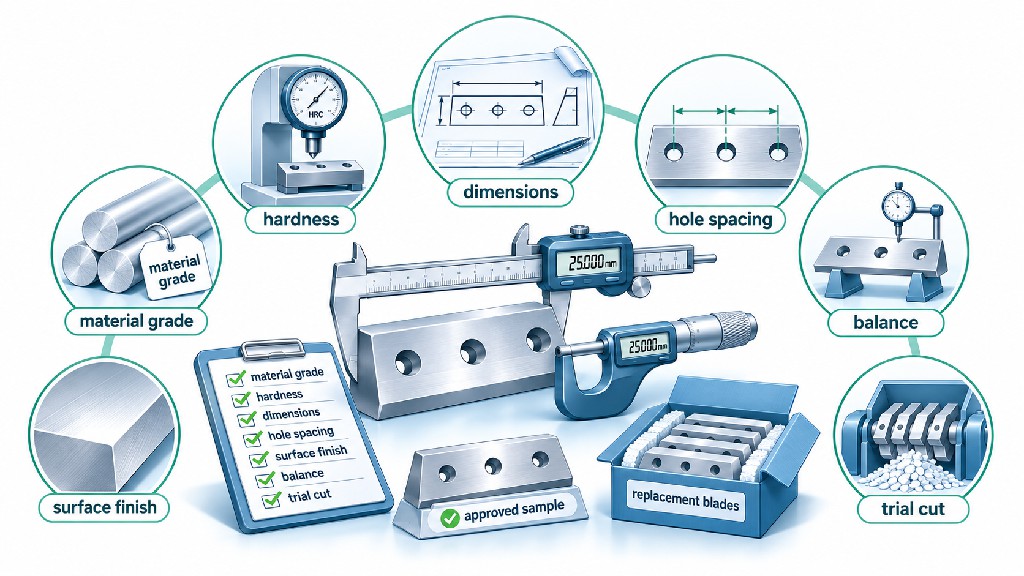
Machine compatibility is the first non-negotiable requirement. A blade with excellent metallurgy is commercially worthless if it cannot be mounted safely or if the cutting edge sits outside the design position. A replacement may look almost identical in a catalog photograph yet differ in slot width, countersink depth, hole pitch, bevel orientation or usable thickness. Obtain the original part number or an accurate drawing whenever possible.
Rotor knives move with the shaft and experience cyclic loading; bed knives provide the stationary cutting partner and depend on rigid support from the cutter housing. Their positions, hole patterns, bevels and adjustment mechanisms may differ. A buyer sometimes needs a matched rotor-and-bed set even though only one component looks visibly worn. Order counts should specify actual quantities per machine, not assume a universal set size.
For detailed part identification, refer to GUANG CHUAN's crusher/granulator comparison and its catalog of heavy-duty granulator blades for plastic lumps and purges. The latter lists material and edge customization options relevant to demanding jobs; the correct configuration still depends on the customer's machine.
| Feature | Required purchasing detail | Problem if omitted |
|---|---|---|
| Overall dimensions | Length, width, thickness and permitted tolerance, in millimeters | Interference, wrong edge projection or clamping failure |
| Hole/slot pattern | Count, diameter, width, pitch, edge offsets and slot length | Part cannot align or adjust in the holder |
| Seat details | Counterbore/countersink, relief cuts, datum face, locating features | Insufficient clamp contact or inaccurate registration |
| Edge design | Single/double bevel, angle definition, edge orientation, usable faces | Wrong shearing geometry or reversibility assumption |
| Steel and hardness | Actual grade/specification, accepted hardness range and test method | Uncontrolled variation between supplier batches |
| Machine identity | OEM, model, serial number, rotor style and original part code | Wrong product ordered under similar machine name |
| Installation constraints | Minimum knife height, clamping arrangement, OEM tightening instructions | Unsafe installation after grinding or replacement |
When no drawing exists, photograph the original part next to a scale and record dimensions with suitable calibrated tools. Send both front and back views, the cutting-edge profile and a photograph showing how the knife is mounted. Ask the supplier to produce an approval drawing before manufacturing a batch. Do not send only the outside dimensions: two blades with the same length, width and thickness may still be incompatible.
A listing that says “compatible with many brands” is not enough. A responsible seller should state what makes a replacement compatible with your model and part revision. For older or modified machines, verify the dimensions against a physical sample. Ask for clarification when the original knife has been reground repeatedly, because its current width or projection may no longer represent the new-part design.
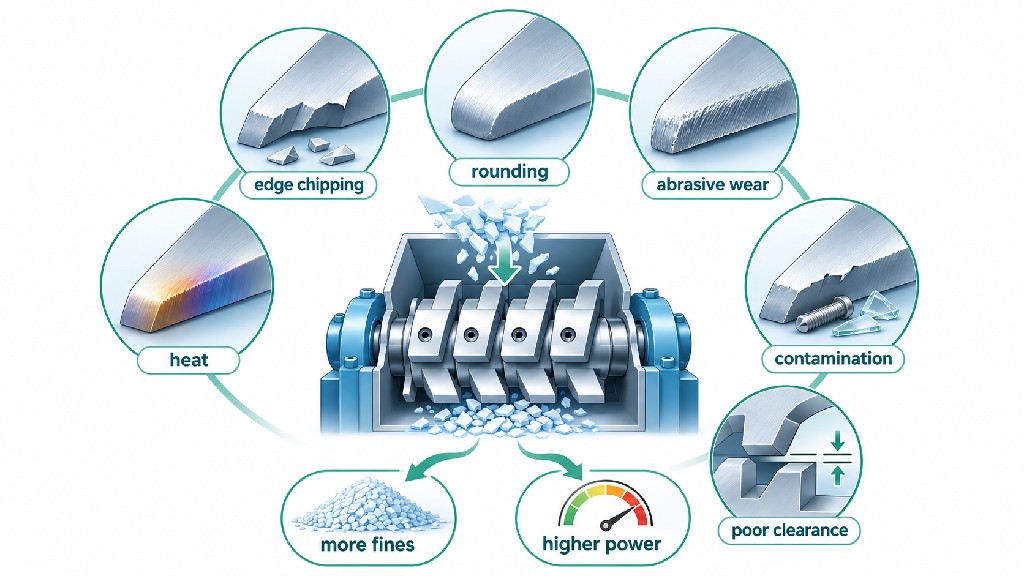
Purchasing the same knife repeatedly without diagnosing a premature failure can lock a plant into unnecessary downtime. The shape and location of damage provide useful clues. A gradual polished radius along an edge suggests a different failure mechanism from an isolated chip, a long crack near a bolt or a burned line on a ground bevel. The table below is a diagnostic starting point; it does not replace hands-on inspection by trained personnel.
| Observed problem | Possible contributing cause | Checks to perform | Potential purchasing or process action |
|---|---|---|---|
| Rapid, even edge rounding | Abrasive filler, grit, unsuitable grade or excessive recirculation | Feed cleanliness; filler loading; wear by processed mass; screen | Improve sorting; test more wear-resistant grade after baseline correction |
| Localized chipping | Metal/stone impact, thin unsupported edge, contact from wrong gap | Chip location; metal separation; edge design; rotor clearance | Remove contaminants; investigate stronger edge and toughness |
| Long cracking near holes | Incorrect fasteners, overconstraint, bad seat, stress concentration | Hole fit; clamp support; hardware; OEM tightening sequence | Correct installation design before changing blade grade |
| Stringy flakes or hanging film | Dull knives, wide gap, wrapping, inappropriate film feed | Edge condition; gap; rotor type; feeding equipment | Sharpen, align or adapt film-specific handling |
| Unexpected fines increase | Repeated recutting, damaged edges, screen restriction or overfeeding | Output distribution; screen openings; motor load; knife damage | Correct process and compare screened output during trial |
| Heat, smearing or discoloration | Excess rubbing, poor discharge, wrong geometry, process overload | Knife gap; feed; screen; actual temperature; ventilation | Reduce friction and investigate process safety before grade upgrade |
| Uneven wear across width | Misalignment, uneven feed, seat/rotor runout, bad grinding | Clearance at several points; flatness; rotor condition | Correct fit and alignment; document blade inspection limits |
GUANG CHUAN's blade-chipping troubleshooting guide discusses material, contamination, mounting and operating conditions. Its practical message is important for purchasing: do not conclude that a harder blade is needed until you know whether the damage arose from wear, impact, setup or a mixed cause.
A strong investigation should include the machine and part number, blade batch, installation date, hours operated, approximate mass processed, feedstock description, photographs of both knife sets, screen state and maintenance history. Add any change in noise, power draw, temperature or particle-size distribution. These records allow a manufacturer to recommend a specific change and let the buyer determine whether that change actually improves performance.
Commercial investigation should lead to a purchasing decision supported by operating cost. The cheapest replacement knife may require extra sharpening and downtime, while an expensive grade may not pay for itself if wear is not the main constraint. Count the whole service cycle, including the blade price allocated across its usable edges, grinding cost, skilled maintenance labor, production interruption, shipping and unacceptable regrind. When some costs are hard to measure, report them separately rather than inventing precision.
A practical comparison metric is knife-related cost per tonne of accepted regrind. Use the amount of saleable or internally reusable material, not simply the amount fed into the machine. Poor-quality fines, rejected mixed material and excessive recirculation can distort an apparent improvement if the measurement is limited to blade hours.
Knife-cycle cost = blade acquisition cost allocated to the cycle + resharpening expense + maintenance labor + downtime expense + other incremental costs.
Knife-related cost per operating hour = knife-cycle cost ÷ operating hours achieved in that cycle.
Knife-related cost per accepted tonne = knife-cycle cost ÷ accepted regrind tonnes produced during that cycle.
If throughput changes materially, record accepted tonnes directly rather than using a fixed nameplate machine capacity.
Consider a hypothetical plant comparing two approved knife packages while granulating the same clean polymer stream. These are example assumptions only, not GUANG CHUAN field-test results, market prices, guaranteed maintenance intervals or material-grade benchmarks. Both options are assumed to include the same two-hour service interruption for a knife cycle, with an internal downtime charge of $250 per hour and an accepted output rate of 0.6 tonne per running hour.
| Illustrative input | Standard package A | Premium package B |
|---|---|---|
| Acquisition cost per knife set | $600 | $1,100 |
| Usable service cycles allocated to that set | 4 | 5 |
| Allocated acquisition cost per cycle | $150 | $220 |
| Sharpening expense per cycle | $90 | $120 |
| Downtime charge per cycle (2 hours × $250) | $500 | $500 |
| Total modelled cost per cycle | $740 | $840 |
| Running hours achieved per cycle | 120 | 200 |
| Accepted material per cycle (0.6 t/h) | 72 tonnes | 120 tonnes |
| Modelled knife-related cost per accepted tonne | $10.28/t | $7.00/t |
In this example the premium package costs more to purchase but produces a lower modeled cost per accepted tonne because the assumed service interval is longer. Change that one assumption and the result may reverse. If package B reaches only 130 running hours, or requires longer maintenance and special grinding, its advantage narrows. An actual procurement review should vary the estimated life, acceptance yield, service cost and downtime rate to find the break-even point.
Do not equate “time between sharpenings” with “total blade life.” A reversible knife may provide multiple edges; a reground knife may have fewer remaining safe cycles; some designs are disposable. Ask for the minimum permitted knife size, regrinding method, whether all edges can be used and how the supplier defines a cycle. Only comparable definitions support fair competitive quotations.
Field trials replace vague marketing language with evidence. If a supplier proposes switching from D2 to M2, changing an included angle or changing an edge-support design, test one meaningful variable at a time where practical. A test in which the premium knives run only on clean plastic while the standard knives cut dirty feed cannot establish a fair comparison.
Where a plant operates two similar production lines, parallel tests may be possible, but account for differences in rotor condition, throughput and feed. For a single machine, sequential trials are still valuable if the plant collects enough data and does not change several major variables simultaneously. Prefer repeated, documented runs over a single short demonstration that stops before measurable wear occurs.
| Metric | How to record | Why it matters |
|---|---|---|
| Accepted tonnes | Weighed, documented output by material grade | Relates knife service to usable production |
| Run hours | Actual cutting operation, excluding downtime | Makes wear comparison meaningful |
| Fines / off-size share | Agreed sampling and sieve procedure | Measures quality, not just quantity |
| Energy / motor-load trend | Consistent meter or machine reading | Can reveal rubbing, dull edges and recirculation |
| Edge inspection | Images at defined intervals and positions | Distinguishes even wear from impact damage |
| Service labor | Minutes and personnel per change or regrind | Captures hidden operating expense |
| Safety-related event | Documented stop, abnormal heat, noise or contact | Prevents cost savings from hiding unacceptable risk |
Evidence of quality should be specific to the ordered blades. A website's statement about advanced equipment, experience or production capacity does not substitute for a drawing approved by the customer or an inspection record for the delivered batch. At the same time, excessive paperwork that does not connect to functional risk may add cost without improving reliability. Define what matters and request proportionate verification.
For a high-value order, reasonable requests may include the purchased steel designation and material certificate, batch or heat identification, the approved dimensional drawing, inspection of critical locating and cutting dimensions, a documented Rockwell hardness result, visual edge-quality checks, quantity and packaging confirmation, and a clear process for handling nonconforming goods. Whether additional tests are worthwhile depends on the part's value, criticality and historical failure issues.
GUANG CHUAN describes CNC machining, grinding, heat treatment and custom blade production in its company overview. Its custom-size D2/HSS crusher knife listing is relevant to OEM replacement requests. Discuss the actual inspection documents and quotation scope with the manufacturer; do not assume that every optional test or tolerance is automatically included with every order.
A short but complete request for quotation typically produces better offers than a message reading “Need PET crusher blades, best price.” Commercial buyers should describe the material, the machine and the existing problem. The supplier can then separate an exact-fit replacement from an engineering alternative and quote each on comparable terms.
Application: PET / HDPE / PP / PVC / ABS (state exact grade, rigid/film form, filled or unfilled).
Material condition: Clean factory scrap / post-consumer / washed / wet / dusty / mixed; identify metal and mineral contamination.
Machine: Manufacturer, model, serial number, rotor type, approximate capacity and operating hours per day.
Knife position: Rotor knife / fixed bed knife / primary shredder cutter; quantity at each position.
Dimensions: Overall L × W × T; hole or slot geometry; bevel and orientation; attach drawing and photographs.
Existing knife: Current steel grade, hardness if known, sharpening history and failure photographs.
Target outcome: Better edge life, fewer chips, lower fines, stable throughput, easier servicing or an exact OEM replacement.
Commercial details: Required quantity, destination, requested delivery window, inspection documents and quotation currency.
Quote request: Provide an exact-fit baseline option and, where technically justified, a clearly explained upgraded option.
If the current knife is broken, preserve both the damaged section and photographs of the mounting face before disposal. If it is heavily reground, state that explicitly so the supplier does not copy an undersized worn part as a new replacement. For special machines, request a first-article approval or sample-set trial before authorizing a large production batch.
The expected service life of any purchased blade depends on how the plant installs and maintains it. Incorrect mounting can destroy a premium knife almost immediately. Maintenance personnel should follow the machine manufacturer's lockout, rotor restraint, lifting, fastening and clearance procedures, including any requirement to replace bolts or use only specified spare parts. A written site work instruction is preferable to an informal technique passed between shifts.
Before installation, inspect seats and support surfaces for compacted debris, damaged locating features or raised burrs. Check that the knife and its fasteners are correct for that position. Tighten using the OEM sequence and specified torque, then verify clearance again because the setting may change during clamping. The Conair maintenance overview also identifies the screen as a critical component of consistent granulate quality.
Resharpening should preserve the approved angle and cutting-edge geometry, use suitable cooling and avoid thermal damage. Grinding a knife too short or beyond its permitted dimension can invalidate the machine's adjustment range and reduce clamping safety. If the blade shows serious cracks, deformation, grinding burn or extensive edge loss, replacement may be safer and more economical than another regrind. The OEM's minimum usable knife dimensions take precedence over a generic estimate of how many times a blade can be sharpened.
Keep sets identified by machine and service history. Mixing a new knife with a heavily worn or incorrectly ground cutting partner may cause uneven shear and make it difficult to diagnose a problem. Log dates, tonnes, operating hours, sharpenings, inspections and abnormal events. A good record improves future quotations and prevents the purchasing team from using blade price as its only decision variable.
There is no single best grade for all PET applications. For a conventional granulator processing reasonably clean PET bottles, D2/SKD11 or a suitable Cr12MoV knife is a practical option to evaluate. Dirty post-consumer PET may wear knives quickly because of sand or other particles, while thick PET pieces and metal contamination raise the importance of edge toughness. Choose after inspecting the actual feed, machine and historical failure mode.
Not necessarily. Even if a supplier quotes the same nominal HRC band, HDPE performance is strongly influenced by part thickness, shear geometry and the tendency of flexible walls to fold or smear. Hardness alone does not guarantee clean cutting. Review the OEM's geometry and clearance first, then define a hardness range consistent with the selected steel and duty.
They can be. Rigid PP crates and molding runners typically present a different feeding and impact pattern from PP film or woven sacks. Flexible products may need specialized rotor design, feeding and tighter process control to prevent stringing or wrapping. Additional calcium carbonate or glass fiber in filled PP may increase abrasive wear. Tell the supplier both the PP grade and the physical form.
Possible causes include mineral fillers, dirt, poor clearance, repeated recutting, inappropriate edge geometry or improper installation. A rigid PVC profile with substantial filler can wear a cutting edge differently from flexible PVC. Evaluate contamination and machine condition before upgrading tool steel. Also investigate abnormal heat or fumes promptly because PVC decomposition can create additional health hazards.
Yes, correctly specified D2-type granulator knives can be a suitable candidate for many clean, unfilled ABS applications. They are not automatically the best for every reinforced, plated or mixed ABS feed. Thick sections and unexpected metal inserts may create impact failures; glass or mineral fillers increase wear. Compare real operating conditions and inspect the edge rather than assuming the base resin tells the whole story.
No. M2 may offer useful hardness and wear characteristics for specific stable cutting duties, but higher price and different toughness behavior can undermine that advantage when shocks or contamination dominate. Ask what measurable problem M2 is intended to solve, which edge design accompanies it, and what results from a controlled trial would justify purchasing it.
Use the clearance specified for your particular granulator configuration and feed form by the OEM. A Conair 8 Series manual gives certain reference ranges, but those figures are not universal settings for resin types or different machines. Measure at all specified positions after safe installation and check again after service. Unapproved adjustments risk knife contact and machine damage.
There is no credible universal hours-based answer for all machines and plastics. Interval depends on grit, filler, steel, speed, geometry, feeding and output acceptance criteria. Track accepted tonnes and cutting quality, then sharpen when the documented service criteria are met. Some OEM designs are disposable or have limited permissible grinding dimensions; follow the specific manual.
Identify the mounting position on a machine drawing or in the manual. Rotor knives travel around the shaft, while stationary bed knives form the fixed shearing partner. Their bevel, slots, edge orientation and quantities can differ. Supply photographs and an old part number if you cannot identify the position. A complete quotation may need both sets and suitable hardware.
Custom manufacture is possible for many blade designs, but a sample alone may be misleading if it is broken, distorted or repeatedly reground. Supply the machine model, original drawing if available, critical dimensions and a reference sample. Ask for an approval drawing and documented acceptance requirements before the order is placed. GUANG CHUAN describes custom and OEM/ODM blade capability on its About Us page.
Not by default. Hardness can improve some wear characteristics while reducing tolerance for chipping in certain geometries or heat-treatment conditions. If knife edges chip on metal and thick lumps, a harder but less impact-tolerant blade can fail sooner. First classify the failure as abrasive wear, impact breakage, rubbing, overheating or mounting damage, then target the root cause.
Send the blade's technical drawing, material stream and composition, existing part number, machine model, quantity, target outcome, destination and preferred inspection documents. Specify whether prices should include freight and what delivery terms are expected. For uncertain fitment or a substantial grade change, request a sample or first-article evaluation before buying several sets.
Successful plastic crusher blade selection begins with a well-defined cutting duty. PET demands attention to bottle handling and contamination; HDPE to clean shearing of ductile walls and thick sections; PP to the difference between rigid scrap, flexible film and abrasive fillers; PVC to formulation, mineral abrasion and safe thermal control; and ABS to rigid impacts, additives and foreign objects. In every case, the OEM machine's configuration, effective knife gap and accurate mounting are just as important as the steel name.
Procurement teams should compare approved dimensions, steel documentation, edge design, inspection records and cost per accepted tonne. Maintenance teams should record why knives fail and test improvements under controlled conditions. These practices turn a replacement knife purchase into a measurable operational decision rather than a commodity-price contest.
Request an application-matched crusher blade quotation from GUANG CHUAN. Ma'anshan Guangchuan Machinery Knife Mold Technology Co., Ltd. supplies industrial crusher and granulator knives and offers custom size, material and mounting options. Review the company's D2 PET granulator blades, heavy-duty lump and purge knives or crusher blade category. Send your drawing, machine model, material type, feed condition and damage photos through the contact page or email 13285553934@163.com. Request an exact-fit baseline quote and a technically justified alternative where an upgrade makes sense.
Technical scope and limitations: This is a general selection and purchasing guide based on published manufacturer information, standards references and engineering principles; it is not an equipment-specific safety procedure, independent product-life certification or guarantee of comparative performance. All dimensional, clearance, speed, torque, resharpening and workplace-safety requirements must be confirmed against the applicable OEM documentation and site procedures. Values explicitly labeled illustrative are calculation examples, not measured production results.

Leave A Message
Scan to WhatsApp :

 English