




A crusher blade that looks identical to an old part can still be the wrong replacement. A mounting hole may be only slightly misplaced, the cutting bevel may face the wrong direction, or the edge may sit outside the intended cutting circle. Any of these problems can turn a routine knife change into a shutdown. The solution is to order replacement crusher blades as controlled machine components, not simply as pieces of hardened steel.
Quick answer: To order custom crusher blades from a drawing or sample, identify the machine and each knife's position; provide a dimensioned drawing or labeled, serviceable sample; confirm length, width, thickness, holes, bevel geometry, seating surfaces, material and heat treatment; disclose the processed material and operating conditions; then agree on an approval drawing, inspection criteria, quantity, delivery terms and a first-article process before batch manufacture. If you have only a worn blade, tell the manufacturer what is worn and which original dimensions are unknown.
GUANG CHUAN, the trade name of Ma'anshan Guangchuan Machinery Knife Mold Technology Co., Ltd., describes drawing- and sample-based OEM/ODM manufacturing on its About Us page. This guide explains how buyers can turn that capability into a technically clear request for quotation (RFQ). It is intended for recycling plants, plastics processors, machinery maintenance teams, equipment builders, distributors and purchasing professionals ordering OEM crusher knives or custom granulator blades.
Before you request a price: Send the best available drawing, three or more clear photographs, the machine make and model, number of knives in each set, feed material, requested quantity, destination country and any known failure history. Missing information is not an automatic reason to stop; it is a reason to label assumptions for engineering review rather than allowing them to become production dimensions.
Engineering and commercial scope: Dimensions, prices, tolerance examples and calculations identified as examples below are illustrative, not GUANG CHUAN quotations, certified manufacturing capabilities or universal machine specifications. Machine-specific OEM instructions, approved drawings and applicable safety rules control the final decision. Do not install a replacement until it has been checked by qualified personnel against the actual equipment.
Jump to the practical guidance
A plastic granulator cuts because rotating knives pass stationary bed knives with a controlled relationship between their cutting edges. Many crushers use a related cutting mechanism; other size-reduction machines use hooked or toothed cutters with different fastening and load paths. In any case, the knife's geometry, its seat, the fasteners and the mating component work as a system. Replacing one part without understanding that system introduces risk.
The word crusher blade is a broad purchasing term. In one plant it may mean a straight rotating granulator knife. In another, it means a stationary bed knife, a segmented cutter or a specially profiled blade. A quotation must therefore identify the physical part, not rely on the generic name. Our article on crusher blades versus granulator knives explains the overlapping terminology and where differences matter.
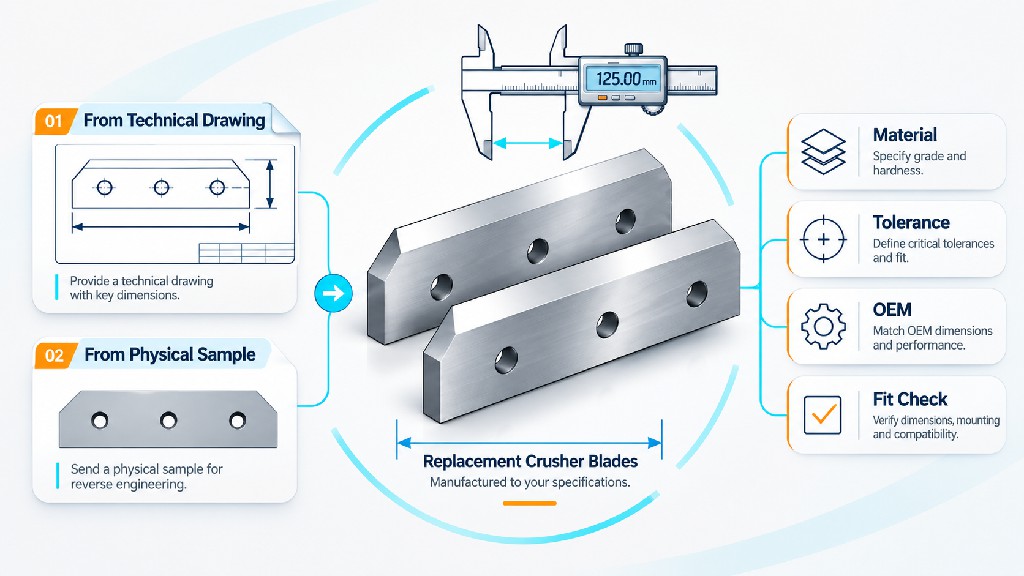
Consider three purchases. A maintenance buyer with an approved OEM drawing can ask a crusher blade manufacturer to make an exact replacement to a controlled revision. An operator with one unused spare knife can submit a physical reference and ask for reverse engineering. A plant with only repeatedly sharpened, chipped knives must reconstruct missing dimensions from additional evidence. These are three different engineering tasks, even when the final quantity is the same.
The distinction matters commercially. A supplier that quotes instantly from a single photograph may be pricing an assumed shape rather than a defined part. A technically useful quotation states what is included, which dimensions need confirmation, and whether any measurement, tooling, first-article inspection or sampling work is additional. The lowest unit price is not the lowest total cost if the knives need rework or cause lost production.
Begin by recording the equipment manufacturer, model, serial number where appropriate, cutting-chamber configuration and available OEM knife or spare-part number. A machine model can have revisions, alternative rotor designs and different knife mounting arrangements. The number stamped on an old component may be a batch mark instead of an orderable part number, so photograph it without assuming what it means.
Then specify whether the part is a rotor knife, stationary bed knife, counter-knife, segmented knife, or another cutting element. Rotor knives rotate with the shaft or rotor body. Stationary bed knives form the opposing cutting edge. Their angles, mounting surfaces, fastening patterns and adjustment methods are not interchangeable. For a visual explanation of these duties, see GUANG CHUAN's guide to rotor knives versus fixed bed knives.
Count the blades installed in a complete working set. A rotor might carry several rows, and each row might use one long knife or multiple sections. Note the number of bed knives, whether two sides of an edge can be used, and whether there are left- and right-hand versions. Requesting “six blades” without explaining the set configuration can leave the buyer with six correct-looking parts that do not form a usable set.
Also describe the purchasing objective. Is the order an unchanged OEM-compatible replacement, a trial of an alternative steel grade, an emergency replacement for a damaged set, or a redesigned knife to reduce wear? A drop-in replacement should preserve approved interfaces and cutting geometry. A redesign requires separate engineering approval, even if the part still fits the bolt holes.
Record the processing context: PET bottles, HDPE drums, PP runners, PVC profiles, ABS housings, film, pipe, wood, fibers, or mixed scrap; typical wall thickness; throughput demands; operating hours; and known contamination such as sand, labels, screws or embedded metal. These facts help distinguish abrasive wear from impact chipping and material smearing. Our PET, HDPE, PP, PVC and ABS blade-selection guide provides further application context.
You can begin a useful enquiry without a finished engineering drawing. A clear first message establishes what is known, what is uncertain and what outcome you need. The checklist below can be completed by purchasing with help from maintenance and engineering. “Unknown” is an acceptable temporary answer; a fabricated number is not.
| Information | What the buyer should send | Why the manufacturer needs it |
|---|---|---|
| Machine identity | Make, model, revision, serial reference and original part number if available | Confirms the intended equipment and helps detect incompatible variants |
| Knife position | Rotor, bed, counter-knife, section number, orientation and quantity per set | Prevents mixing different parts under one generic blade name |
| Reference | 2D PDF drawing, CAD file, photographs and/or labeled physical sample | Establishes the basis for quotation and manufacturing |
| Main dimensions | Length, width or height, thickness, hole pattern and units | Defines the component envelope and installation interface |
| Cutting details | Bevel angle, single or double edge, edge direction, ground surfaces and profile | Determines the working geometry rather than appearance alone |
| Material requirements | Existing steel grade if known, heat-treatment specification, service problem | Supports a grade proposal and realistic performance discussion |
| Operating application | Feedstock, wall thickness, contamination, output and operating conditions | Exposes wear, toughness and edge-retention requirements |
| Quality requirements | Critical tolerances, first article, hardness and dimensional evidence | Establishes acceptance conditions before production |
| Commercial details | Quantity in pieces and sets, target delivery date, destination and trade term | Makes competing quotations comparable |
Provide files in easy-to-review formats. A readable PDF drawing is practical for quotation; STEP or another agreed native CAD format can support interpretation of complex profiles. For an original drawing, include its revision identifier and the date of the currently approved issue. If the only source is an old scanned drawing, tell the manufacturer whether any handwritten changes were officially released. Do not assume a high-resolution image is dimensionally accurate simply because the edges look straight on screen.
For photos, supply at least one image of the complete blade, one of the seating or back face, one of the cutting edge, and close-ups of mounting holes and damage. Place a ruler or known reference near the part for orientation, but use measurement records rather than photo pixels to establish precision dimensions. Name files consistently: for example, “Rotor_A_top.jpg,” “Rotor_A_back.jpg,” and “Bed_B_holes.jpg.”
Explain your preferred approval workflow. For a familiar repeat order, the buyer may accept production against an unchanged approved drawing. For a new part or reconstructed sample, the safer commercial route is drawing approval followed by first-article or small-lot verification. Specify this before the quote, because inspection scope and approval stages can affect price and schedule.
A controlled original drawing is generally the strongest starting point for custom granulator blades. It should identify the part, material, heat treatment, dimensions, edge geometry, tolerances, surface requirements and any assembly or inspection notes. A purchase order should identify the same drawing number and revision. If the drawing calls for separate assembly notes or a knife-setting fixture, submit those relevant documents as well.
The supplier still needs application information. Two blades drawn with identical dimensions can require different performance because one processes clean PP runners and another handles heavily contaminated recycling scrap. Material grade and heat treatment should therefore be considered in the context of duty, not selected only by matching physical shape. If a buyer deliberately changes grade, hardness or edge angle, record it as a proposed deviation rather than silently modifying the original specification.
Read the drawing from the functional mounting datums. Which surface rests against the knife seat? Which face is clamped? Which edge shears against the opposite knife? Which holes actually locate the blade, and which holes merely provide bolt clearance? The answer determines the proper inspection setup. A shop that measures hole positions from an arbitrary exterior edge can report attractive numbers while missing the fit that matters inside the machine.
Check for ambiguous drafting conventions. Is a stated bevel angle measured from the broad face or from a reference perpendicular to it? Is the edge single-bevel or double-bevel? Are dimensions in inches or millimeters? Are left-hand and right-hand views explicitly labeled? Does the drawing specify a nominal material grade or a particular certified chemistry and treatment? A manufacturer should raise these questions during drawing review rather than interpret uncertain features independently.
Finally, separate must match requirements from open for engineering proposal. Mounting interfaces, cutting-circle position and safety-related details typically belong to the first category. An alternate steel grade, coating or packaging layout may be negotiable if performance and compatibility are validated. This separation accelerates procurement because the supplier can offer a technical alternative without erasing the buyer's acceptance criteria.
A physical sample often makes replacement possible after an original machine supplier stops supporting an older model. Yet a used blade is a record of wear and service history, not necessarily an accurate representation of its original geometry. Repeated sharpening removes material. An impact can deform the back, bend a long knife, crack a hole or chip the cutting edge. Heat can change the condition of hardened steel. Copying every measured feature may reproduce those defects.
First choose the best reference. An unused OEM spare in reliable condition is preferable to a moderately worn knife; a moderately worn but undamaged knife is preferable to a severely chipped blade. If several used knives remain, supply more than one and identify which ones were reground or repaired. Comparing examples can help distinguish original features from damage, although agreement between worn samples does not prove the original design.
Second record provenance. Tag the sample with machine model, part location, rotor row, orientation, current measured size, previous sharpening history if known, and a unique tracking identifier. Use packaging that protects sharp edges, prevents movement and meets carrier requirements. If international shipping is involved, ask about customs descriptions, temporary import or return procedures and any restrictions before dispatch. A manufacturer should acknowledge receipt and record which sample corresponds to each proposed part number.
Third measure and classify features. Mounting faces, back edges and hole locations can sometimes survive wear more reliably than cutting edges. In contrast, blade height, cutting tip location, bevel width and edge radius may be changed by grinding. The engineer should mark each dimension as directly measured, reconstructed from mating equipment, inferred from multiple samples or still requiring buyer confirmation. This simple evidence classification is useful in a reverse-engineering report.
Fourth validate against the machine. If the original knife is short after repeated regrinding, the machine's knife-setting range, seat, fixture and cutting-circle requirements can help determine whether the replacement needs a larger original dimension. That determination must come from the OEM specification or a competent machine engineering review. Never assume that adding the apparent wear amount to a sample automatically recreates a safe original blade.
Fifth freeze the reconstructed drawing. After sample analysis, the crusher blade manufacturer should create or review a dimensioned approval drawing. The buyer checks hole and seat interfaces, edge orientation, part count and critical dimensions before accepting it. A purchase order referencing only “copy attached sample” leaves avoidable disputes about which sample features are intentional and which result from damage.
If the sample is damaged beyond reliable reconstruction and no machine interface can be documented, a responsible supplier may decline to promise drop-in compatibility. That is a useful engineering warning, not poor customer service. The missing information should be obtained from the machine builder, maintenance records, a serviceable comparison part or a qualified inspection of the machine.
For common rectangular rotor or bed knives, begin with overall length, new-part height or width, thickness and the location and diameter of mounting holes. Then describe the mounting face, back-seat geometry, edge bevel and any slots, counterbores, chamfers or reliefs. For profiled crushers, also capture the profile, tooth pitch, segment identity and datum scheme. The exact list depends on the design.
Length: Measure between the specified end faces. Long knives may have end clearances within the chamber; a correct nominal length does not compensate for incorrect squareness, bow or attachment positions. If several short segments make one cutting row, document their individual lengths and arrangement instead of combining them into one overall number.
Height or working width: Clarify which direction is measured from the back seat to the cutting edge. This dimension may define the installed cutting circle or the available adjustment range. A well-used sample can be shorter than a new blade. If the OEM defines a minimum permitted regrind dimension, record it separately from the original dimension so a manufacturer does not confuse the rejection limit with the new-part target.
Thickness: Identify the two reference faces and whether they are ground. Thickness variation can affect seating, clamping and cutting alignment. If the blade has a recessed area, counterbore or stepped land, one thickness value is not enough. Specify which portions contact the machine and whether a localized relief must be maintained.
Mounting hole pattern: Record hole count, shape, diameter, center-to-center spacing, edge distances, counterbores, countersinks, slots and any nonuniform pitch. State which holes provide location and which allow fastener clearance or adjustment. Include the bolt size and seating arrangement only when verified; nominal bolt size alone does not define a hole diameter or countersink. A worn sample may have elongated holes that should not be copied as deliberate design.
Straightness, parallelism and flatness: A blade can match its basic dimensions and still rock on its seat because it is twisted or bowed. Long mounting faces deserve particular attention because small local seating errors can affect clamping pressure and edge position. Agree on measurement method and the specific surface being evaluated; saying “must be perfectly flat” is not a testable procurement instruction.
Edge location: The cutting edge's position relative to mounting datums is often more important than the blade's overall dimensions taken separately. Where a setting jig or fixture establishes installed height, capture that method. If the machine needs matched rotor knives, define the allowable difference within the set and the reference from which it is measured. Do not assume that equal lengths alone create equal cutting radius.
For a detailed discussion of industrial blade drawing discipline in another cutting application, the GUANG CHUAN article How to Order Replacement Circular Slitter Knives: Dimensions, Drawings and Tolerances Required shows why functional datums and controlled revisions matter. The specific slitter dimensions are not transferable to crusher knives, but the purchasing principle is the same.
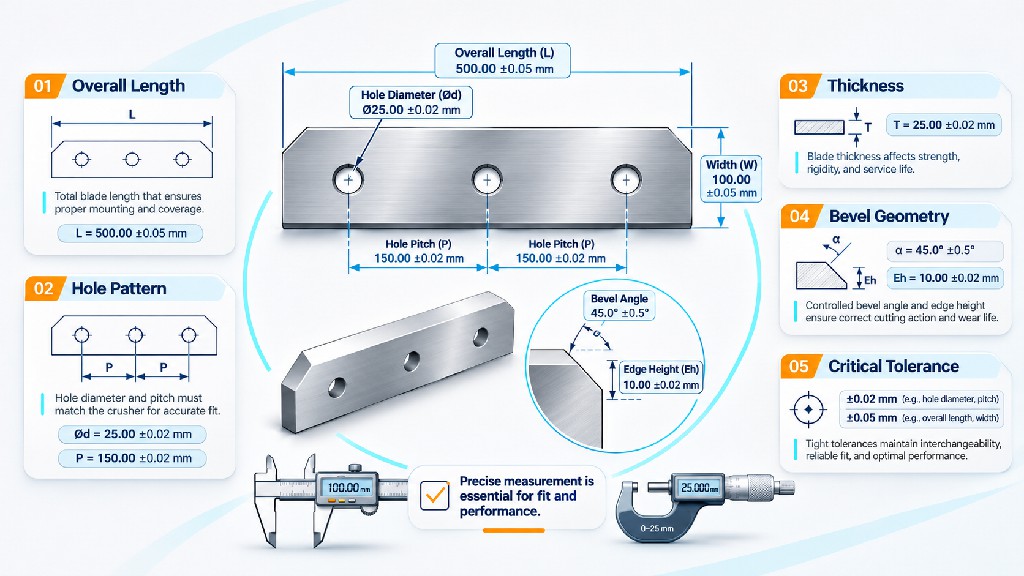
The edge is not just a sharp line. Its included angle, bevel direction, edge land and surface finish affect how material enters and passes through the cutting zone. A single-bevel knife can have its bevel on one side or the other. A double-bevel knife can have equal or unequal faces. A blade with the correct outside dimensions but an inverted bevel may position the cutting edge incorrectly or interfere with its mating knife.
When you draw an edge, mark the blade's installed orientation and show the opposing rotor or bed knife. Use a section view if necessary. State exactly how the angle is measured: for example, “bevel face to mounting face” rather than just “35 degrees.” Avoid guessing an angle from a photo. If only a worn sample exists, ask for a reconstructed edge drawing and obtain the machine engineer's approval.
Not every crusher needs the same edge angle. Thin, flexible feedstocks and thick rigid parts impose different demands on cutting sharpness, shock resistance and mechanical strength. The machine design also matters. Cumberland's technical discussion of granulator knives explains the importance of knife configuration, tip angle, sharpness and rotor-to-bed clearance. It supports a system-level selection approach, not a universal bevel specification.
A useful RFQ includes the expected material, operating speed where relevant, normal contamination and any historical edge failure. Chipping close to fastener holes is a different problem from gradually rounded cutting edges. A proposal to increase hardness may help one wear mode but worsen brittle chipping in another. Buyers should ask for a reasoned material and edge recommendation tied to actual failure evidence.
If the machine uses matched rotating knives, the supplier should know whether they must be ground or inspected as a set. In its GP/X/BP central-granulator manual, Cumberland instructs that rotor knives are ground to equal dimensions and installed as sets. That is an example of why machine-specific service instructions must accompany the replacement request; it is not a claim that all crusher models have identical set requirements.
Knife steel is a trade-off among wear resistance, toughness, manufacturability, cost and the ability to maintain a useful cutting edge. There is no defensible universal answer to “Which is the best crusher blade material?” A useful blade manufacturer asks what material is being cut, how contamination enters the stream, how the knives currently fail, and which machine constraints cannot change.
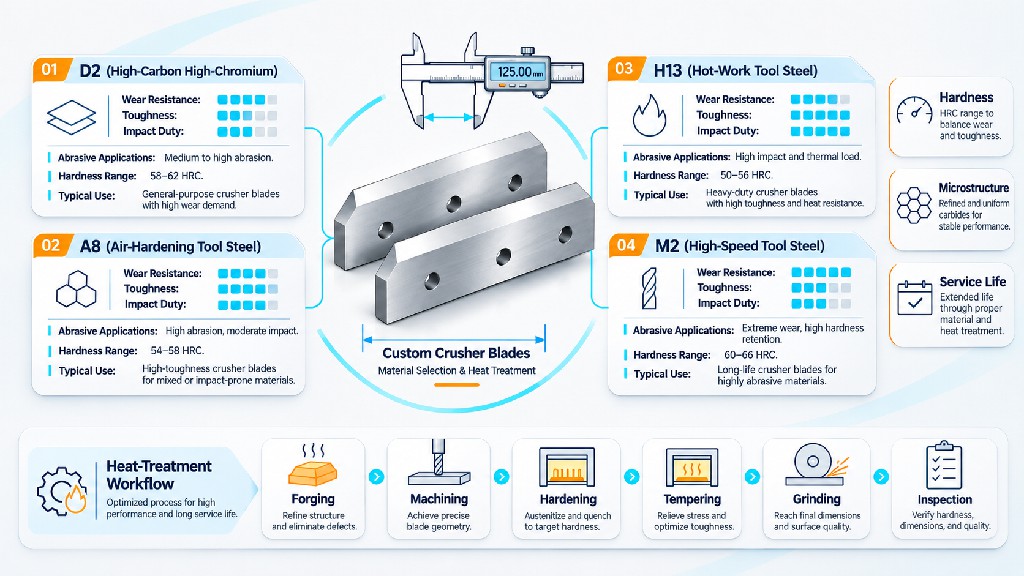
Buyers may encounter steel descriptions such as D2, SKD11, 1.2379, DC53, Cr12MoV, high-speed steel and other alloy tool steels. Names from different standards or producers should not be treated as automatically identical. Chemistry limits, processing route and final heat treatment can vary. If a named grade is mandatory, specify the required grade standard, acceptable substitutes, any certificate requirement and the approval process for a substitution.
D2-type high-carbon, high-chromium cold-work tool steel is frequently discussed where abrasive wear is important; tougher alternative tool steels may be more appropriate where shock or contamination dominates. These are selection considerations, not a recommendation to install a specific grade without checking the machine and duty. Very hard edges may resist certain forms of abrasion while being less tolerant of severe impact or inadequate support. The geometry and heat treatment can matter as much as the nominal alloy name.
Hardness must be specified as a testable condition. Where Rockwell C hardness is appropriate, agree on a target range, test position, sampling plan and acceptance method. ISO 6508-1:2023 specifies the Rockwell hardness test method for metallic materials; ASTM E18 is another recognized Rockwell test-method reference. Neither standard tells the buyer what hardness a particular crusher blade should have. The correct hardness target comes from an approved design or qualified engineering decision.
Also define what evidence you need. A material identification certificate and a measured hardness report answer different questions. A hardness result does not establish chemistry, toughness, freedom from cracks or correct edge grinding. Similarly, calling steel “heat treated” is insufficient without agreed acceptance requirements. Ask whether the selected alloy is supplied and treated under traceable lot control, and what documents will be delivered with the order.
A coating, carbide insert or unconventional edge construction can sometimes be proposed, but it changes cost, grinding, repair and compatibility assumptions. Do not treat a new material as a guaranteed longer-life replacement on marketing language alone. Run a controlled trial under comparable material, operating load and sharpening conditions if the objective is to justify a grade upgrade.
For background on blade constructions and application differences, see Plastic Crusher Blades: Types, Materials and Selection Guide. Use its general selection framework alongside the real machine data, not as a substitute for your approved part specification.
A precision drawing should describe both nominal dimensions and permitted variation. For a simple knife, the most important controls may be the back seating face, thickness, hole pattern and cutting-edge location. On a long rotor knife, straightness and the relationship between the edge and seating datum may dominate. For a profiled cutter, tooth position and a multi-feature datum system could be more important.
Do not apply an aggressive general tolerance to every feature simply because it appears professional. A tolerance of plus or minus 0.01 mm on an irrelevant external corner may add inspection cost without improving fit. Conversely, a much looser hole-location requirement may make the entire part unusable. The sensible approach is to identify critical-to-fit and critical-to-cut characteristics and agree on the inspection method for each.
The international standard ISO 1101:2017 establishes the symbol language and interpretation rules for geometrical tolerancing. It is useful when an engineering drawing specifies form, orientation, location or runout. Invoking ISO 1101 does not automatically select numerical tolerances; the approved design must still state the required values and datums.
| Characteristic | Reason to control it | Example of the required clarification |
|---|---|---|
| Mounting face flatness | Supports stable contact and clamping | Which face is datum A, and how will flatness be checked? |
| Hole locations | Allows safe assembly and repeatable placement | Which edge or datum controls hole coordinates? |
| Blade thickness | Affects clamping and installed edge position | Is the tolerance over the entire blade or selected contact lands? |
| Cutting-edge straightness | Helps maintain predictable knife relationship | What is the permitted deviation over the working length? |
| Edge-to-seat dimension | Controls installed knife height or cutting circle | Is the reference the new-part edge, a fixture, or the mounting seat? |
| Bevel orientation and angle | Controls cutting action and interference | Is the angle dimensioned from a defined face and view? |
| Hardness and edge condition | Supports the intended wear/impact performance | What test scale, location and acceptance range apply? |
A sample specification might show a nominal 240.00 mm overall length and an approved tolerance of plus or minus 0.10 mm. That numerical example only demonstrates how to write a requirement; it is not a standard crusher knife tolerance or a statement of GUANG CHUAN manufacturing capability. Actual permissible values must come from the application, machine drawing and agreed inspection approach.
Be careful with metric conversions. An inch dimension must be converted using 1 inch = 25.4 mm exactly, but manufacturing tolerance should not be silently created by rounding. If an original drawing specifies 0.250 inch with its own limits, simply stating 6.35 mm may omit essential precision information. Record original units, tolerance limits and the approved converted drawing before releasing production.
The cutting gap is the clearance between mating rotor and bed knives at the operating cutting position. Too little clearance may cause contact and damage; too much can reduce the clean shearing action, depending on the material and machine design. However, the correct clearance is a property of the assembled machine, not an isolated dimension printed on every replacement blade.
For a concrete manufacturer example, the Cumberland GP/X/BP central-granulator manual specifies a knife gap of 0.006–0.008 inch (approximately 0.15–0.20 mm) for the models covered. The manual also discusses matched rotor knives and rechecking adjustment after service. This figure is useful evidence of the scale of clearance in a particular granulator design, not a universal setting for all crushers, plastics or knife systems. Other OEM manuals may specify different gaps and methods.
Therefore, tell the replacement supplier how the machine adjusts clearance. Are rotor knives fixed and bed knives adjustable? Does the rotor use an external setting jig? Can a short, repeatedly sharpened blade still reach the specified cutting position? Does the machine require matched sets or a specified installed radius? These questions can reveal a replacement issue before any steel is cut.
Do not demand that a blade vendor guarantee a running gap without information about the rotor, bed-knife seat, wear, bearings, adjustment mechanism and installation. A perfectly manufactured knife cannot correct a distorted bed, loose bearings or contaminated seating surfaces. If excessive fines, noise, motor load or overheating occurred with the old knives, ask maintenance to diagnose the whole cutting system before redesigning the replacement blades.
An unchanged OEM-compatible order has one central goal: reproduce an approved component so it can perform the same intended function without redesigning the machine. The purchase documentation should reference the approved geometry and define any permitted material substitutions. Such parts are commonly described commercially as OEM crusher knives or granulator replacement knives, but those labels do not, by themselves, prove approval by the original equipment maker.
A reverse-engineered replacement has a different evidence basis. Its dimensions are reconstructed from samples and machine interfaces and must be confirmed through a review-and-test process. An improved replacement introduces another layer: perhaps a revised grade for abrasive recycled material, a different edge treatment, or a design that allows controlled repeated sharpening. Every change needs an identified objective and acceptance test.
For a first improvement project, keep the comparison manageable. Change only the variable being evaluated where feasible; use equivalent feedstock, throughput and operating conditions; compare wear and output after defined service intervals; and record reasons for any stoppage. A claim of “twice the blade life” is not meaningful without a baseline, comparable duty and clear end-of-life criterion.
Some buyers also need private-label packaging, a customer-specific part number or recurring OEM supply. In that case, specify drawing ownership, confidentiality, revision management, product marking and change notification in the contract. Do not assume that a replacement supplier automatically owns the OEM's intellectual property or that the ability to measure a sample grants permission to reproduce a protected design in every jurisdiction. Buyers remain responsible for checking relevant commercial and intellectual-property obligations.
A good ordering process makes uncertainty visible early and removes it in controlled stages. The steps below describe a sensible buyer-supplier workflow, not a promise that every order uses identical documents or timing.
1. Submit the RFQ. Send your drawing or sample information, blade position, machine data, application, quantity, delivery location and target date. State if the part is critical to an imminent shutdown. The supplier should respond with any information gaps rather than making silent assumptions about critical features.
2. Complete engineering review. Ask the crusher blade manufacturer to examine geometry, machine interface, material choice, manufacturing practicality and inspection. If the order is sample-based, the review should identify reconstructed dimensions. Important unknowns must be resolved through evidence or explicitly placed on the buyer's approval list.
3. Receive a comparable quotation. A useful quotation identifies price basis, quantity, grade, drawing revision, inspection scope, tooling or sampling charges, packing, delivery term, shipping responsibility and quotation validity. A verbal “same as sample” description is not a sufficient substitute for a released specification.
4. Approve a drawing or controlled specification. The buyer signs off the critical dimensions, orientation, material and agreed deviations. Any change after approval should receive a documented revision. This protects both parties if a knife is later judged against an obsolete drawing or if a supplier proposes an alternative edge detail.
5. Agree on first-article requirements. For a new or uncertain component, define whether one piece, a representative pair or a complete installed set will be inspected before batch release. Decide what happens if the first article passes dimensional checks but the machine trial reveals an installation conflict. A complete set may be necessary when fit depends on matched knife geometry.
6. Release batch production and inspection. Production should follow the approved revision. The parties should agree how critical characteristics are sampled and recorded, which certificates are required, and whether identified parts will be shipped by lot. Request inspection reports in advance if they are needed to authorize dispatch.
7. Arrange packing and shipping. Sharp, hardened knives require protected edges, corrosion control and secure packaging. Confirm the delivery address, trade term, shipping documents and labeling. For imported goods, agree on responsibility for customs clearance and other destination charges.
8. Perform incoming verification and controlled installation. Check counts, markings, condition and agreed inspection evidence against the purchase order. Keep the packaging and documents until the blades are accepted. Qualified maintenance personnel then verify installation, settings and safe operation according to the equipment's instructions.
This process can be shortened for an already approved repeat part. The important point is that eliminating unnecessary paperwork should not eliminate configuration control. The fastest repeat order is often the one whose drawing, material, inspection plan and part number were documented correctly the first time.
Inspection is the bridge between a promising quotation and a repeatable replacement part. For custom crusher blades, the inspection plan should focus on actual failure risks rather than adding certificates solely to decorate a sales package. Ask which measurements will be made, with what method, against what reference and with what acceptance limits.
A basic dimensional record may include length, width or height, thickness, relevant hole diameters and positions, edge-to-datum dimensions, bevel geometry, flatness and straightness where specified. The inspection method must fit the tolerance and blade shape. A handheld caliper may be adequate for a noncritical external dimension, but it may be inappropriate for verifying a tight geometric relationship across a long ground edge.
Where material identity matters, define traceability expectations: steel grade designation, material heat or batch reference, and the relationship between the certificate and finished blade lot. For hardness, request the approved Rockwell scale, range, sample location and method. For precision-machined parts, you may also need a first-article drawing ballooned to show how measured results map to inspection characteristics.
Visual examination should address chipping, cracks, burrs, grinding damage, discoloration and transport damage. A bright polished finish does not prove the absence of microscopic defects, and a photograph is not a substitute for an agreed dimensional test. If nondestructive testing is necessary for a particular duty, specify the appropriate method, standard and acceptance criteria during engineering review rather than assuming it is included in every unit price.
For matched sets, confirm how individual blades are marked and packed together. If a machine builder requires set-to-set size matching or installation positions, ask that the inspection record preserve those identities. If independent buyers combine knives from several batches, they may lose the dimensional pairing that was intended in production.
Ask also how nonconformities are handled. Will the supplier segregate an out-of-tolerance part? Can it be reworked without losing the specified heat treatment, edge geometry or minimum dimension? Who approves a deviation? A responsible process does not treat a measurement that misses the agreed drawing as acceptable merely because the part “probably fits.”
The purchase price of a knife is visible; the cost of receiving, fitting, adjusting, sharpening and replacing it is less obvious. For a production plant, a sensible purchasing comparison considers purchase price per set, expected usable hours, regrind allowance, scrap or fines, changeover labor, inspection and shipping. A premium grade is not automatically more economical, but a cheaper unit price is not automatically the better deal either.
Illustrative calculation, not actual supplier data: Suppose a complete knife set costs $360 and provides 400 acceptable operating hours before replacement, while another costs $500 and provides 700 comparable hours. Blade purchase cost alone would be $360 / 400 = $0.90 per operating hour for the first set and $500 / 700 = about $0.71 per operating hour for the second. The second set is more expensive up front yet cheaper per hour under these hypothetical conditions. That conclusion could reverse when labor, freight, sharpening or different feed contamination is included.
The calculation only becomes decision-grade after the service-hour numbers are measured in comparable conditions. Define acceptable cut quality, throughput, motor load, downtime and rejection limits. A high service-hour total achieved by operating with dull knives and excessive fines is not necessarily a success. Better data separates blade wear from machine adjustments, screens, feedstock changes and operator practices.
For recurring orders, ask suppliers to quote a documented part number and agreed reorder quantities. Ordering several spare sets may reduce exposure to unpredictable freight and production schedules, but too much inventory ties up capital and risks storing an obsolete revision. Use consumption and replenishment data rather than relying on arbitrary bulk discounts.
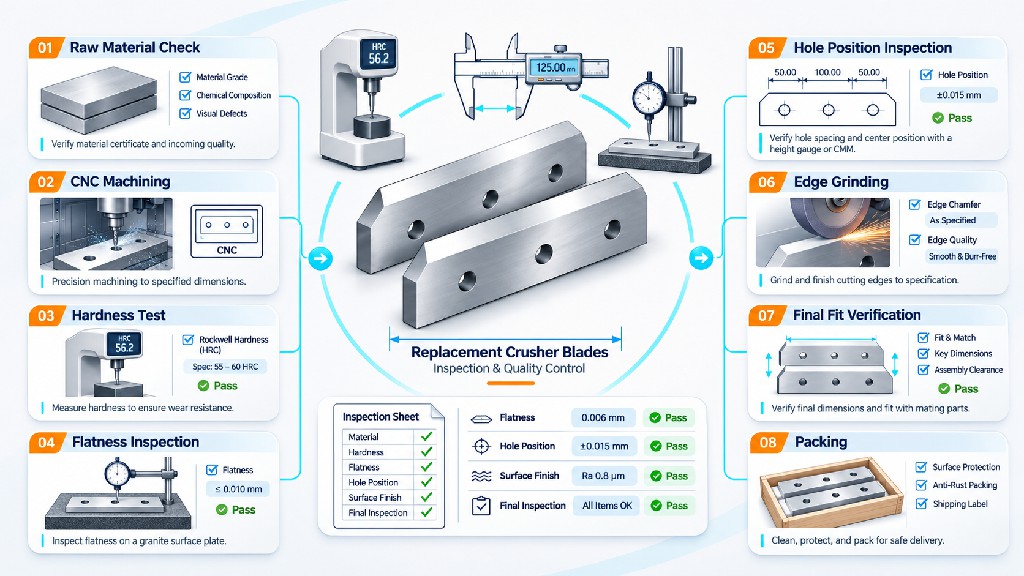
Imagine a recycling plant has one worn straight rotor knife, no usable original drawing, and a machine that processes clean PP injection-molding runners. The operator photographs the blade and records a measured length of 240.2 mm, a measured remaining height of 58.4 mm and a thickness of 12.0 mm. These values are invented for illustration, not specifications of any known commercial knife. Maintenance reports that the blade has been reground multiple times.
A weak enquiry would read: “Please copy 240 x 58 x 12 crusher blades, D2, best price.” That message confuses measured remaining height with new-part height, provides no hole pattern, contains an unverified steel choice and omits which way the edge must face. The supplier might quote a part that can never be mounted safely.
A better enquiry states: “Straight rotor knife, PP runner granulator, machine model and serial attached; measured used sample approximately 240.2 mm long, 58.4 mm remaining height, 12.0 mm thick. Original new height unknown because of repeated sharpening. Mounting-face and hole photos attached; hole coordinates to be verified. Six pieces required as one set. Request reverse-engineering review, proposed approval drawing, material recommendation and first-article quotation.”
The next engineering action is to establish the knife's functional datums and evaluate the actual machine interface. The buyer measures or provides the mounting seat and available adjustment range under approved maintenance procedures. The supplier measures the sample, flags its worn edge and identifies uncertain geometry. Together they confirm the required new-part height and bevel orientation before approving the drawing. Neither party assumes that 58.4 mm is the correct manufacturing target.
Once the drawing is approved, the order can specify critical hole positions, the selected steel, heat-treatment criteria, matched-set requirements and agreed inspection records. The buyer might choose one approved first article or an entire matched first set, depending on whether installation and running clearance can be meaningfully evaluated with a single knife. Only after that evaluation should the remaining production quantity be released.
This example demonstrates the commercial value of technical discipline. The supplier is not being asked merely to “make a blade.” It is being asked to deliver a documented, repeatable solution to an identifiable maintenance need. The resulting approved part file can support future reorders without repeating the entire sample-reconstruction exercise.
Copying a blade that has been sharpened too many times. The working height may already be far below the original dimension. State the remaining measurement as a used-part observation, not as the intended new-part size. Check the OEM's allowable regrind limits and setting method before reconstruction.
Sending a top-view photograph but not the back and edge. The cutting edge may be single-bevel, double-bevel or asymmetric, and the mounting side may determine its direction. Provide multiple views and an installed-orientation sketch so the manufacturer does not mirror a part by mistake.
Measuring hole spacing from a worn edge. A cutting edge is often a poor reference after service. Specify dimensions from functional mounting datums and check actual hole features rather than using a damaged external boundary as the coordinate origin.
Calling all knives in the chamber identical. Rotor and bed knives may have different geometry, material, dimensions or adjustment requirements. Label them separately and record installed counts. Do not combine left-hand and right-hand pieces under one part number without confirming interchangeability.
Requesting the hardest possible material. A hardened edge can still chip if the duty requires more toughness, or if metal contamination and impact are severe. Describe the actual failure mode and request a reasoned grade and treatment proposal.
Treating the quoted quantity as a complete machine set without checking. A supplier may quote per piece. Write quantities both as individual pieces and as complete sets, such as “12 rotor pieces and 4 bed pieces, enough for two complete changes,” when those counts match the machine.
Skipping the approval drawing because the sample looks simple. Even a rectangular knife can have a complex hole pattern, localized relief or asymmetric bevel. Approve a manufacturing definition before releasing the batch, particularly when the sample is damaged.
Assuming a new blade will solve every process problem. Excessive fines, slow throughput, heat and high motor current can also involve screens, discharge restrictions, feedstock, clearance, bearings or machine settings. The articles on when to sharpen or replace crusher blades and how to sharpen without shortening service life help separate knife condition from other causes.
Hardened blades can be damaged after passing inspection. Loose components may strike one another during transport, chipping corners or working edges. Shipping protection should keep edges separated, prevent abrasion, limit moisture exposure and secure heavy parts against movement. For long knives, packaging should also reduce bending risk. Ask for clear identification of the part and its protected cutting edge.
Agree on packing quantity by box, gross weight, part labels and whether matched sets must remain grouped. If a buyer receives a mixed batch without identification, incoming inspection and future reordering become harder. For private-label or OEM supply, define the permitted marking method and whether markings can appear on functional mounting faces.
International quotations should specify the named place and the agreed rule under Incoterms 2020, as explained by the International Chamber of Commerce. For example, EXW, FCA, DAP and DDP allocate responsibilities differently. An Incoterm does not replace the sales contract and does not itself establish product quality, payment terms or ownership of technical drawings. Confirm who arranges carriage, handles clearance and pays duties before comparing delivered prices.
At receipt, check the shipment against the purchase order: part numbers, piece counts, revisions, dimensions where agreed, certificates, visible condition and lot markings. Store the accepted knives in protective packaging away from moisture and accidental contact. Maintain records connecting the installed set with its production lot and service start date; this helps establish whether a future issue is caused by a particular order, adjustment or processing change.
A repeat purchase should refer to the approved drawing and revision, not simply “same as last time.” If the machine has been modified, or the original vendor proposes a different alloy or process, require written review before substitution. Revision control is a practical business tool: it makes urgent replenishment faster and reduces disputes about what was ordered.
Ordering the correct knife does not eliminate installation hazards. Cutting edges are sharp, blades may be heavy, and rotating machinery can retain hazardous energy. Maintenance must be performed by authorized, qualified personnel under the machine's documented isolation, rotor-restraint, handling, fastening and guarding procedures. The United States OSHA 29 CFR 1910.147 lockout/tagout standard describes hazardous-energy control requirements for covered servicing and maintenance activities; local rules and the equipment manufacturer's instructions may also apply.
Before installation, inspect the knife seat and fasteners for burrs, damage, trapped debris and other defects. Do not attempt to use clamping force to flatten a distorted blade or seat. Verify that the new part's mounting geometry corresponds to the approved drawing and that any specified fastener grade, condition and tightening procedure match the machine manual. Published torque values from an unrelated granulator should not be copied into another machine.
If the equipment uses matched knives or a setting jig, keep the correct set together and use the prescribed method. Verify cutting clearance at the required locations according to the OEM's procedure, with all energy isolated and the rotor secured as required. Recheck the assembly after tightening where the manual instructs, because clamping and adjustment can alter edge positions.
Only a qualified team should authorize return to operation after guards, interlocks and other protections are restored. Commissioning checks may include noise, vibration, amperage, throughput, feed behavior, granulate quality and abnormal heat under controlled conditions. If the machine runs poorly with new knives, do not assume the steel grade is at fault; compare installed geometry and machine condition against the baseline before making further changes.
Document the installation date, blade lot, observed setup data and the first service results. Those records transform replacement knives from anonymous consumables into traceable maintenance components. They also make it easier to compare a future sample-based quotation with the actual performance of an approved set.
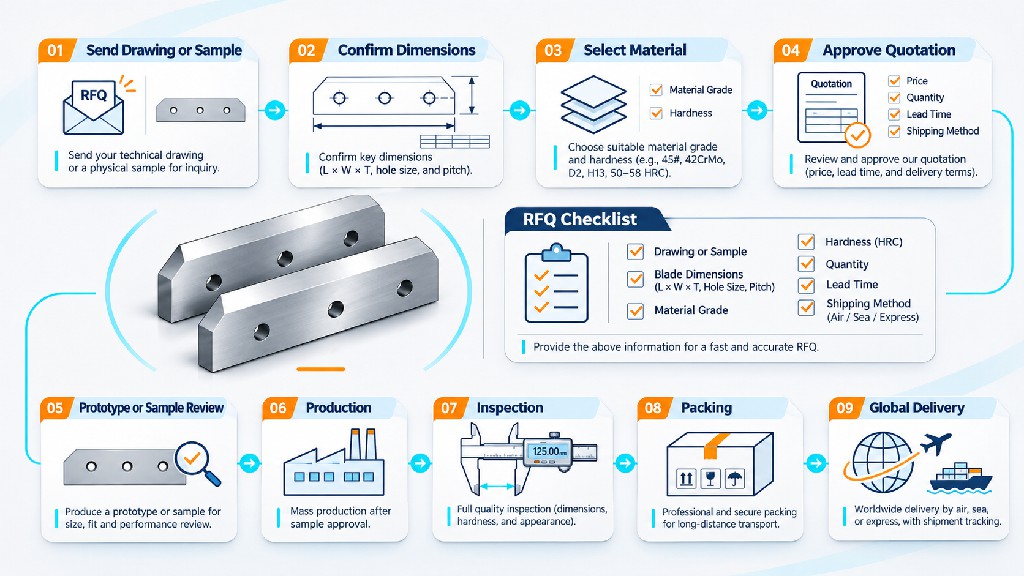
The following template can be copied into an email or enquiry form. It gives a crusher blade manufacturer enough context to identify missing technical information and propose the right quotation pathway without pretending that a photograph is a completed engineering specification.
Subject: RFQ — Replacement Crusher Blades / Machine Model [MODEL] / [QUANTITY] Pieces
We need replacement knives for a [manufacturer and model] crusher or granulator. The knife is a [rotor / bed / other] part, identified as [OEM number or local identifier]. Our machine uses [quantity] pieces in each set. We require [quantity] complete sets, equivalent to [total pieces].
Attached are [approved drawing and revision / labeled sample photos / existing measurements]. The sample is [unused / worn / previously reground / chipped]. Known dimensions and units are [details]. The dimensions still requiring confirmation are [details]. Please do not treat used-edge height as original height unless verified.
We process [polymer or other material], with [typical feed thickness, contamination and operating conditions]. Current problems, if any, include [wear / chipping / excessive fines / heat / other]. We request [exact replacement / material recommendation / redesigned trial] and [specified certificates or inspection records].
Please confirm your technical questions, recommended material and heat-treatment basis, drawing or sample-review process, unit and set price, MOQ if applicable, first-article arrangements, production lead time, packing method and shipping quotation to [city and country] under [preferred Incoterm and named place]. Our requested delivery date is [date]. Please identify assumptions, exceptions and any charges for engineering or sample approval.
Add full-size images or CAD files as attachments rather than pasting only tiny previews into an email. If the commercial team has no drawing, send the RFQ anyway, but say explicitly that the quote is preliminary pending reverse engineering. A buyer and supplier can work efficiently with missing data when its status is visible to everyone.
GUANG CHUAN's published company profile identifies it as an industrial blade and machinery-knife manufacturer located in Ma'anshan, China. It states that the company uses CNC machining, grinding and heat-treatment equipment and offers customization based on technical drawings or physical samples. These publicly described capabilities are relevant to buyers seeking custom crusher blades, OEM crusher knives, and custom granulator blades rather than an off-the-shelf part of uncertain fit.
The appropriate next step is an engineering enquiry, not an unsupported promise of universal compatibility. GUANG CHUAN can be asked to review a drawing or reference sample, identify any missing critical dimensions, discuss material selection and provide a quotation subject to an agreed specification. Buyers should confirm grade availability, achievable tolerances, inspection scope, minimum quantities and lead time for their specific part before ordering. No particular tolerance, certification, throughput improvement or delivery interval is represented here as guaranteed for every project.
Start with the Crusher Blades product category, review the manufacturer's About Us and OEM/ODM description, or submit your information through the GUANG CHUAN contact page. For a useful first response, attach the blade drawing or labeled photos, state the machine model, describe the material being processed and provide quantities in both pieces and complete sets.
Request a technical quotation: Email 13285553934@163.com with the subject “Custom Replacement Crusher Blades — Drawing/Sample RFQ.” Where available, include a drawing revision, installation orientation, steel specification, inspection expectations and delivery location. Ask for clarification of any uncertain feature before giving final production approval.
Yes, a supplier that accepts custom work may evaluate a physical sample and available machine data. The important limitation is that a worn sample does not reliably disclose its original edge height, bevel or every critical tolerance. Share any serviceable spare, prior purchase records, mounting details and multiple photographs. Request a reconstructed drawing for buyer approval. Where functional dimensions cannot be established with confidence, the supplier and buyer should obtain more evidence instead of promising a guaranteed fit.
Sometimes, particularly when the knife is undamaged and its mounting and cutting geometry are clear. One sample may be inadequate when it is bent, badly chipped, heavily reground or part of a matched set with different installed positions. A competent review separates directly measured dimensions from inferred ones and considers the mating machine components. The supplier should state which assumptions need written approval before production.
“Custom” usually describes manufacture to a customer-specific size or design. “OEM crusher knives” can describe original equipment parts or replacement parts intended for a particular OEM machine, depending on the seller. The label alone does not prove that a blade is supplied by, licensed by or approved by that machine builder. Ask for the applicable drawing and part number, the permitted substitution policy, and a clear statement of origin and compatibility.
It depends on the condition of both parts and the machine's maintenance requirements. Replacing one knife type can be reasonable if the opposite knife remains serviceable and the approved cutting relationship can be restored. But a new rotor knife will not correct a cracked or damaged bed knife. Some machines require rotating knives to be maintained as matched sets. Consult the OEM manual and evaluate the complete cutting system, not just the visibly dull component.
At minimum, identify the machine, knife position, number of parts, approximate length, width, thickness, mounting-hole arrangement, cutting-edge type, application and desired quantity. Provide a drawing or clear sample photographs and mark uncertain dimensions as uncertain. The list can support a preliminary quotation, but the supplier may require more detail before committing to tooling, hardening, finishing, or a batch with guaranteed fit.
There is no single correct Rockwell C value for every crusher blade. Required hardness depends on alloy, edge geometry, impact load, feed contamination and approved heat treatment. Copying an unverified hardness value from a sales page can encourage the wrong material selection. Specify the OEM requirement if available; otherwise ask for a documented recommendation and agreed inspection range. A measured hardness number alone does not establish a blade's toughness or service life.
They are related designations that buyers often compare, but they should not be assumed to be fully interchangeable on name alone. Applicable composition limits, manufacturer specifications, treatment and finished characteristics require review. If a replacement order permits equivalents, define who can approve substitutions and which performance and inspection requirements the alternate material must meet. For an exact replacement, follow the approved grade requirement unless a deviation is explicitly accepted.
Specify the machine manufacturer's required installed clearance and adjustment procedure if known. As one documented example, a Cumberland manual for certain central granulators gives 0.006–0.008 inch, approximately 0.15–0.20 mm. That is not a universal figure. The actual installed gap depends on the rotor, bed knives, mounting and condition of the equipment. If you do not have the OEM specification, do not instruct a supplier to assume a generic gap for a safety-critical installation.
Start by calculating the exact number in one complete service change, including rotor and bed positions. Then use consumption history, emergency-stock needs, planned maintenance intervals and lead-time uncertainty to decide spare inventory. For a reconstructed or modified design, begin with an agreed first article or trial set before committing to a large order. Clarify whether quoted quantity means individual knives, matched pairs, rows or complete machine sets.
The most useful records are those linked to drawing requirements: a dimensional report for critical features, a material certificate or grade traceability when specified, and an appropriate hardness record where required. A first-article record is especially valuable when a part has been reverse engineered. Agree on the document type and sampling extent before placing the order; do not assume a supplier's marketing statement is equivalent to an inspection certificate for the actual shipment.
Potentially, but longer service life needs verification under representative feedstock and operating conditions. Compare cost per acceptable operating hour and include sharpening, freight, labor, rejects and downtime. A more expensive blade may be economical if it offers measurable gains, while a high-hardness upgrade may perform worse in an impact-heavy stream. A controlled trial provides stronger evidence than general life-extension claims.
First isolate the machine and do not force installation. Compare the delivered parts with the approved drawing, purchase order, inspection report and original sample evidence. Check whether the mismatch concerns manufacturing conformance, incorrect buyer-supplied data, an unapproved drawing change or deterioration of the machine seat. Document measurements and photographs before requesting corrective action. A clear approval and inspection trail makes resolution much easier.
Retain the approved drawing revision, buyer and supplier part numbers, steel and treatment specification, first-article results, lot marking, quantity per set and actual service feedback. On the next purchase order, reference that controlled part definition and identify any requested changes. This is more reliable than sending a new photograph of an old blade each time. It also helps multiple plants or maintenance teams buy the same defined replacement without introducing undocumented variations.
A successful replacement order answers five questions: Will the knife fit the machine? Will its edge occupy the correct position? Is the selected steel appropriate for the actual feed and failure mode? Can the supplier inspect the important characteristics? Can the same part be ordered again under a controlled revision? If any answer remains uncertain, resolve it at drawing review rather than during a production shutdown.
For buyers who need replacement crusher blades quickly, the most valuable action is to send an accurate, clearly labeled RFQ today. Include the best drawing or sample, identify the blade's actual function, distinguish worn dimensions from new-part targets, specify the number of complete sets and ask for explicit technical confirmation. With those basics, GUANG CHUAN can review the request against its stated custom-manufacturing services and discuss an appropriate quote and approval process.

Leave A Message
Scan to WhatsApp :

 English