




Serrated packaging blades and straight packaging blades can both produce excellent packaging cuts. Neither is universally better. The right choice depends on how the machine cuts, how the film responds to the cutting load, and what the finished package must do: separate cleanly, resist accidental tearing, open easily, or present a smooth premium-looking edge. A blade that performs beautifully on a rigidly supported paper laminate may stretch a thin polyethylene web. A tooth pattern that starts a cut reliably in a soft film can leave unwanted notches in a package designed to resist tearing.
For purchasing managers and packaging engineers, the decision is not simply “teeth or no teeth.” It is a choice about cut initiation, support, tooth geometry, machine clearance, finished-edge quality, service life, and cost per accepted package. This guide explains those decisions in practical terms, compares typical applications, identifies measurable acceptance criteria, and shows how to request a replacement knife quotation that a manufacturer can actually manufacture and verify.
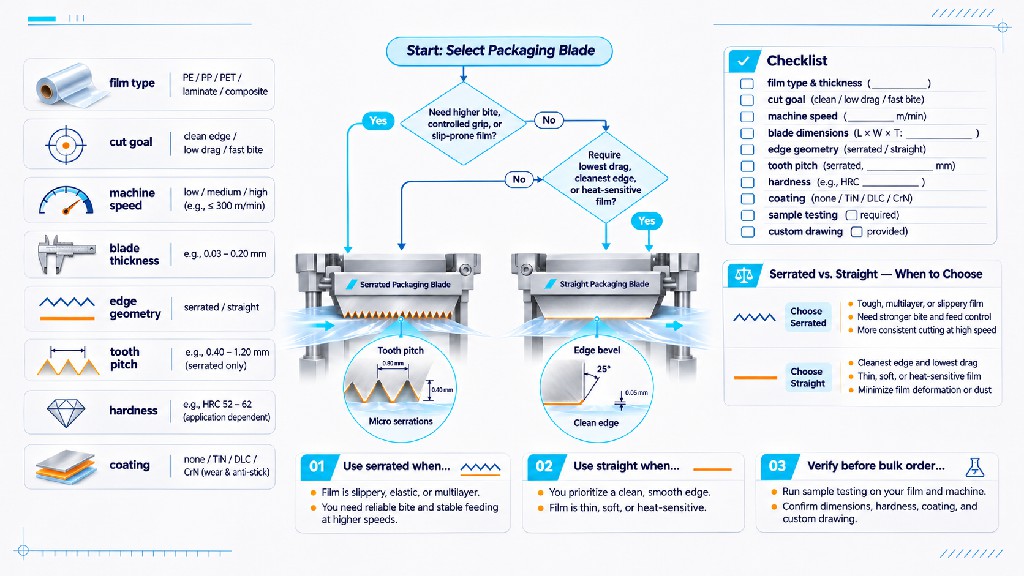
Quick answer: Consider a finely serrated edge when a soft or extensible film stretches before a plain knife penetrates, when an easy-open zigzag edge is required, or when the machine was designed around a toothed cross-cut knife. Consider a straight, continuous edge when a smooth separation line is a product requirement, when the machine provides controlled shearing support, or when edge notches would create unacceptable tear initiation points. Before committing to either option, test the real laminate on the actual machine at production speed.
Technical scope and evidence: This article focuses on replaceable knives in vertical form-fill-seal (VFFS), horizontal flow wrapping, pouch cutting, bag making, and related flexible-packaging equipment. The information combines published equipment guidance, publicly available testing standards, and product descriptions. Recommendations are engineering selection principles, not a claim that every film or machine behaves identically. Any numerical purchasing example identified as illustrative is a calculation, not a GUANG CHUAN factory test or a published industry average.
In This Guide
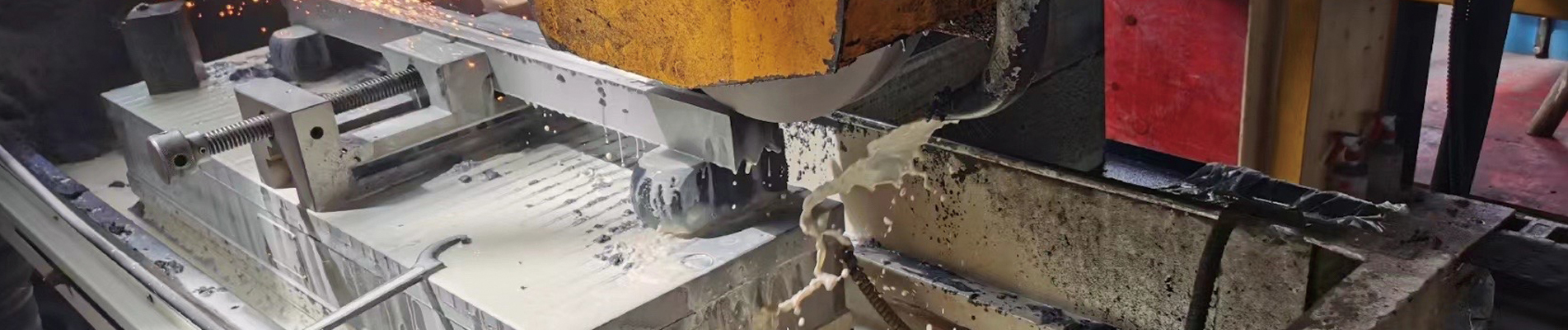
The cutting knife is small relative to the packaging machine, but an unreliable cut can stop a high-output line. Common visible symptoms include film tails that remain connected between packs, stretched edges, cut pieces stuck to the knife, jagged slits, partial separation, and tears that run into the sealed area. Some defects appear only after hours of operation, when a knife warms up, adhesive residue accumulates, a holder shifts, or a cutting edge begins to wear.
In a VFFS machine, the cross-cut blade is commonly positioned between the sealing jaws. A technical guide from Bosch's packaging-equipment literature describes a knife moving between the jaws to separate finished bags and specifically discusses fine, coarse, and unserrated edges. That source is useful because it connects blade geometry to the machine layout rather than treating a knife as an isolated consumer product. See the technical guide to vertical form-fill-seal machines under its discussion of the blade and serration.
The knife's first task is to initiate a controlled fracture or shear in the packaging material. Its second task is to carry that cut across the intended width without dragging the web, damaging a seal, or creating uncontrolled tear paths. Its third task is to do this repeatedly with the available stroke, force, speed, and opposing support. When those conditions change, a previously reliable knife may become the wrong choice even if it still looks sharp.
A purchasing comparison should therefore ask three questions before comparing catalog prices. What is the mechanism that brings the cutting edge into contact with the material? What defect, precisely, should the new knife eliminate? How will the factory decide that a replacement blade is successful after a full production run? Without those answers, a serrated vs straight blade comparison becomes an exercise in guesswork.
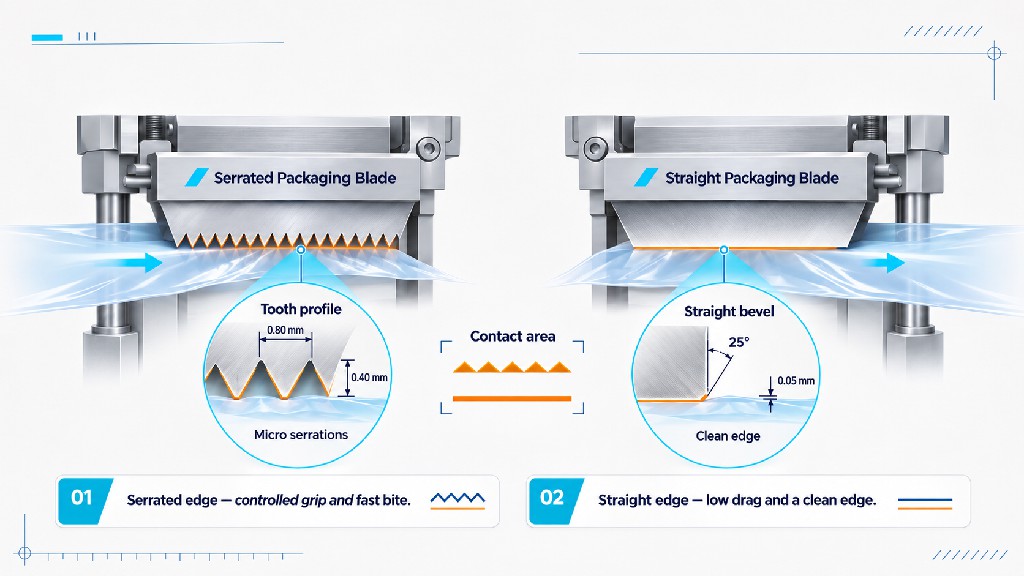
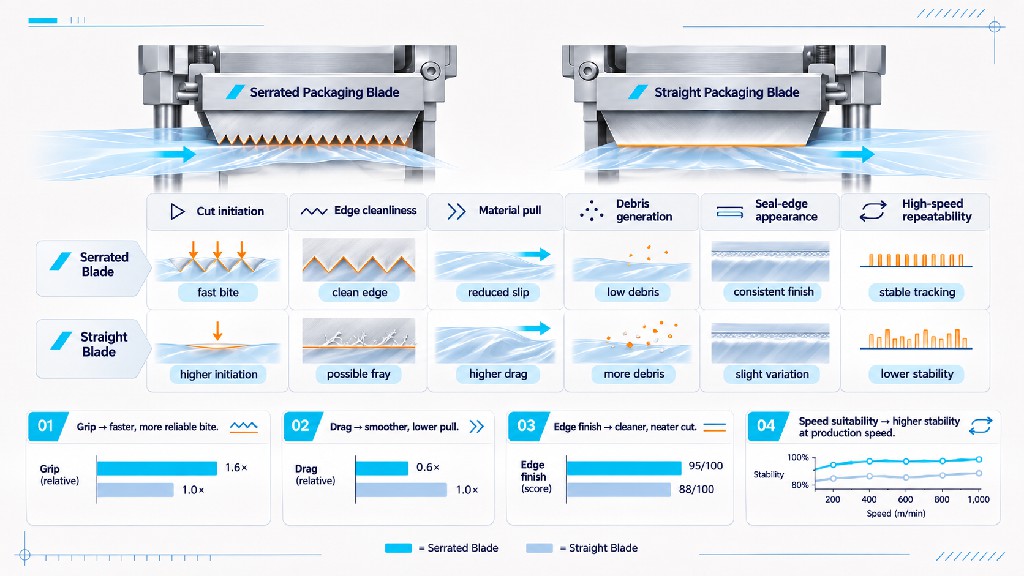
A serrated packaging blade has a sequence of teeth, points, or scalloped cutting features along its working edge. The profile may be fine and closely spaced or visibly coarse. In a reciprocating cross-cut assembly, individual tooth tips may engage the web before the recessed portions of the profile. That staged initial engagement can help start cuts in materials that otherwise move or stretch away from a continuous edge. It does not guarantee a lower total cutting force, and the result depends on tooth sharpness, stroke, film tension, penetration depth, and the anvil or counter-edge.
Packaging toothed blades are not interchangeable with all other serrated tools. A saw blade removes material through a kerf; a packaging cross-cut knife normally separates a thin web without producing sawdust or chips. A perforation blade intentionally leaves bridges of uncut material; a full-cut serrated knife should normally separate the entire width. A tooth profile chosen for a tear-off line may be unsuitable where the customer expects a smooth edge.
The main geometry terms are tooth pitch, measured from one corresponding point to the next; tooth depth or height, describing how far peaks project relative to valleys; tip radius, which influences local initiation; flank angle, affecting penetration and robustness; and edge bevel, which influences how the cutting load is transmitted. “Serrated” by itself does not specify any of these dimensions. Two knives with an identical length and nominal steel grade can behave very differently if their teeth are different.
GUANG CHUAN's published packaging machine toothed blades range includes straight-form serrated knives, shaped packaging knives, T-type variants, and other custom profiles. Here, straight-form serrated refers to the overall straight shape of a blade with teeth. It must not be confused with a straight cutting edge, which is continuous and unnotched. That distinction is essential when placing an order by drawing or photograph. For more context on the company's published product families, see its packaging machine knives: types, materials, and selection guide.
A straight packaging blade has a continuous, non-serrated cutting edge. It may be used in a guillotine-like stroke, a supported shear arrangement, or another machine-specific cutting system. In the right arrangement, it can make a relatively smooth cut line with minimal tooth imprint. The decisive detail is how the film is supported during engagement. If the web is held correctly and the cutting action is stable, a straight blade can produce an excellent finish on flexible film as well as paper-based materials.
A straight edge does not automatically mean lower force, sharper cutting, or better package quality. In a poorly supported system, a continuous edge may press a thin elastic film forward before initiating the cut. This can stretch the film, pull a newly formed seal, or leave a hanging tab. Increasing stroke or air pressure may hide the problem briefly but can accelerate wear or cause mechanical interference. Conversely, a well-adjusted shear can be so effective that adding teeth would provide no benefit.
Straight packaging blades are commonly considered when a smooth edge is visually important, when the manufacturer does not want numerous small tear-initiation notches, or when an opposing blade and precise shear clearance already control the fracture. Edge-bevel selection still matters. A single-bevel knife and a double-bevel knife may create different reactions and require different mounting orientations; neither should be substituted solely because the outside dimensions appear similar.
One important purchasing limitation: a supplier's catalog may contain many serrated machine knives without listing every non-serrated variant. GUANG CHUAN publishes custom blade engineering and sample-replication services. For a straight-edge replacement, the practical route is to provide an existing drawing, a photograph that clearly shows the edge, or an approved physical sample and ask for confirmation of manufacturing feasibility rather than assuming that any toothed part can simply be ground flat.
| Selection factor | Serrated packaging blades | Straight packaging blades | Buyer takeaway |
|---|---|---|---|
| Cut initiation on poorly supported soft film | Tooth tips can initiate contact locally; may reduce stretch-before-cut in a suitable setup | Continuous contact can push or stretch film if support is insufficient | Check the real web and anvil before deciding |
| Appearance of a full cut | Normally produces a toothed or zigzag edge | Normally produces a continuous-looking edge | Use the finished pack's acceptance standard |
| Easy-open behavior | Edge notches may assist tear initiation where intended | Usually offers fewer deliberate opening notches | Test controlled opening without seal damage |
| Resistance to unintended tearing | Tooth valleys can act as stress concentrators | May be preferable where notches are undesirable | Confirm handling and transport performance |
| Thin, easy-tearing film | Fine teeth may be appropriate | Can work with correct support and shear geometry | Avoid assuming coarse teeth are always stronger |
| Reinforced paper or tougher laminate | Coarser teeth may be appropriate for a designed rip edge | Often useful for smooth trimming with adequate force | Match finish requirements and material structure |
| Knife cleaning | Tooth valleys may collect film debris or adhesive | Continuous edge can be easier to wipe and inspect | Assess residue and safe access |
| Resharpening | Must preserve tooth pitch, height, and profile | Typically simpler edge geometry, but bevel must be preserved | Compare qualified sharpening cost |
| Inspection | Tooth-to-tooth consistency, peak damage, overall dimensions | Straightness, edge continuity, bevel, overall dimensions | Specify measurable features in the drawing |
| Best purchasing criterion | Verified cut quality at the required production rate | Verified cut quality at the required production rate | Choose by accepted packages per total cost |
This table is a qualitative engineering decision aid, not measured comparative performance data. A superior result with either profile requires a matching cutter holder, machine stroke, film structure, sharpness, alignment, and maintenance. No universal percentage reduction in force, scrap, or downtime should be inferred from an edge description alone.
A sharp tooth tip contacts a small part of the film first. Under favorable conditions it creates an initial opening before the remaining web has been pushed out of the cutting plane. As the blade advances, neighboring teeth and tooth flanks extend the fracture along the intended line. With a straight edge, initial engagement may involve a larger continuous region unless the knife is angled, the web is tensioned, or the arrangement provides progressive shearing. This difference is one reason tooth design can matter in thin, flexible substrates.
However, cutting is not decided by tip geometry alone. A supported film behaves differently from a loose film span. The counter-surface may be a resilient pad, a hardened opposing edge, or a specially designed slot. An extremely sharp tooth striking hard metal can chip. An edge that never reaches far enough into a resilient support may fail to separate the film. The machine's intended cutting depth and mechanical stops must be respected instead of being adjusted by trial-and-error contact with a stationary jaw.
The cut also depends on web tension. Too little tension permits flutter, folding, or sliding. Too much tension can encourage a small notch to propagate beyond the intended cut, particularly in oriented film. A poor tracking adjustment may cause a single side of the knife to reach the film first, producing alternating failures across the pack width. A knife change is often the last adjustment to make after basic transport and alignment problems have been ruled out.
A full-cut knife must sever the complete material cross-section over the required width. A perforating knife deliberately leaves ties or bridges so bags stay connected until torn apart. A notching feature creates a localized start point, which can be paired with a straight cross-cut or a smooth sealed edge. These functions are sometimes combined in machine-specific blades, but buyers must not assume that all toothed knives produce a perforation or that all zigzag cuts create a satisfactory consumer opening.
Before ordering, identify whether the desired result is complete separation, a controlled tear-off line between packs, a corner notch, or decorative edge finishing. Ask the equipment manufacturer whether the cutter acts against an anvil, passes through a slot, or shears against a second knife. The answers determine the required tooth form, clearance, and orientation.
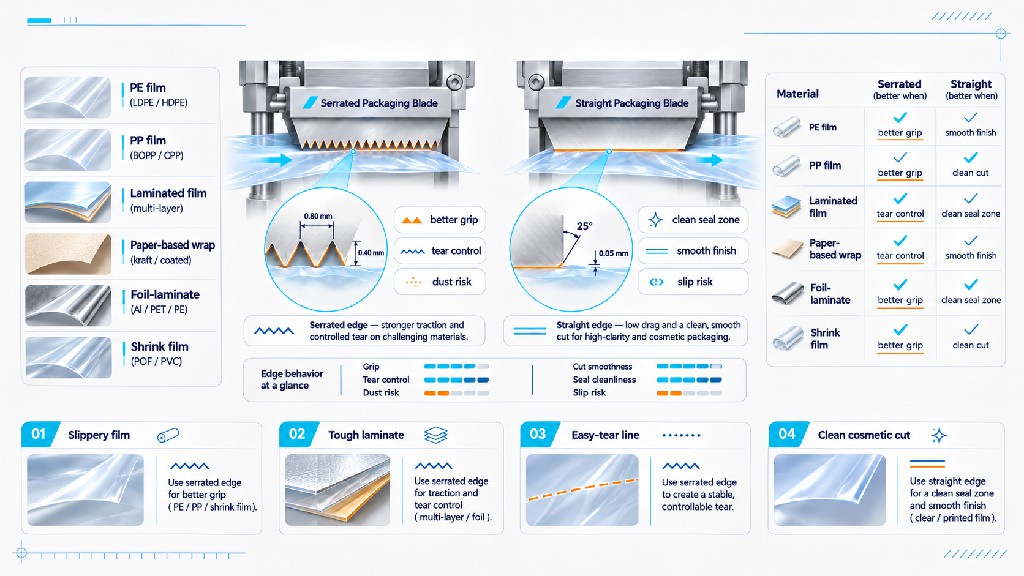
Packaging film is not a single engineering material. A thin cast polyethylene layer, oriented polypropylene, PET laminate, paper/polymer composite, and aluminum-foil laminate can have different elongation, tear behavior, and sensitivity to a concentrated notch. Even two rolls identified by the same trade name can perform differently because of thickness, orientation, adhesive construction, surface treatment, or coating. The strongest decision is therefore based on the real material structure rather than a generic “plastic film” label.
| Packaging substrate or product | Sensible initial edge to trial | Critical verification |
|---|---|---|
| Thin PE-based flexible bag film | Fine serration and a supported straight edge as competing trials | Film stretching, hanging tabs, full separation |
| BOPP or other oriented film | Fine tooth profile or straight edge depending on tear requirements | Unwanted crack propagation and opening direction |
| PET/PE or multi-layer laminate | Application-specific serrated or straight design | Layer dragging, delamination, and cut consistency |
| Foil-containing laminate | Controlled, well-supported edge with verified sharpness | Foil burrs, laminate damage, and microscopic tears |
| Paper/polymer composite | Straight edge for neat trimming; tooth form for intended tear access | Fiber dust, edge quality, tear initiation |
| Thick reinforced bag material | Coarser serration may merit a trial where easy opening is required | Peak chipping, cut completion, operator opening force |
| Printed premium sachet or cosmetic pouch | Straight edge where visual finish dominates; fine serration if necessary | Appearance, graphics registration, seal margin |
These are starting hypotheses, not automatic recommendations. The machine builder's approved blade and film supplier's data sheet take priority. The exact laminate and its production orientation should be included in the sample trial. If the packaging line changes material supplier, recheck the cut rather than assuming the original setup remains valid.
Biaxially oriented materials can exhibit direction-dependent tear behavior. A small cut or notch may redirect a tear along a preferred direction, causing unexpected damage to the package body. On the other hand, a controlled notch in a specified location may make consumer opening much easier. If the design relies on a tear notch, sample both directions and verify that the opening stays away from the seal. An evenly toothed edge is not a substitute for a deliberate easy-open design.
ASTM's D1922 method for tear propagation in plastic film measures a particular type of propagation behavior after the tear has started. It does not rank packaging knife types or predict machine cut force directly. It can nevertheless help a packaging engineer compare film lots and understand why a laminate that cuts acceptably may tear unexpectedly after cutting. For thin film tensile characterization, ASTM D882 describes tensile-property testing; that information can help distinguish film elongation issues from an actual blade-quality problem.
Ask the film supplier for nominal thickness and allowed variation, preferably by individual layer in a laminate. Record the total thickness, measured range, orientation, and whether the film includes an adhesive, ink, barrier coating, or heat-seal layer. A 60-micrometer film is 0.060 mm, but its cutting response cannot be predicted from that number alone. Material chemistry, temperature, line tension, and web restraint may matter more than thickness differences of a few micrometers.
For a new quotation, provide both the nominal construction and physical samples from recent production. A photograph of a damaged pouch is useful, but without actual film it rarely reveals whether the root cause is a blunt knife, a changed laminate, an overheated sealing jaw, or a worn anvil.
“More teeth” is not a universal performance upgrade. A fine serration offers many small potential points of initiation. It may yield a relatively subtle edge and can be a good starting point on thin packaging films. A coarse serration has more widely spaced points and creates more pronounced openings or notches. It can be useful for a deliberate rip edge in certain stronger papers or reinforced bags. Both can fail when their tooth depth, tip condition, or penetrating stroke is poorly matched to the material.
Bosch's VFFS guidance distinguishes fine serration for thin or easily torn packaging material and coarser serration for a reinforced paper bag where notches are meant to help the customer open the package. It also recognizes unserrated blades for smooth edges. This practical equipment-level distinction is more meaningful than an unsupported claim that a particular pitch is always optimal. The guide provides application examples, not a universal pitch table.
The way to specify serrations is by a controlled technical drawing: tooth pitch and tolerance; tooth included angle or flank geometry; tip radius or defined sharpness requirement; tooth height; direction and location of the working edge; steel grade; hardness range; and the precise mounting datums. If the current knife is successful, preserve its functional geometry rather than rewriting a new profile from a generic online diagram.
An excessively sharp and thin tooth may cut well on its first shift but chip during an accidental contact. A very robust tooth may survive impacts yet struggle to penetrate flexible film at the available stroke. If tooth peaks are inconsistent, some teeth engage first while others do little work. The result can be uneven tearing, local overload, or inconsistent package appearance. Quality inspection should therefore assess the profile at multiple positions along the blade, not just the overall length.
The consumer sees the result of the cutting process even when they never see the knife. A pouch with a straight, even top edge may communicate precision and a premium finish. A controlled zigzag edge may communicate easy opening and functional convenience. Neither appearance is inherently more professional; the intended use decides. A snack package that is difficult to open can be just as undesirable as a cosmetic pouch with rough-looking edges.
There are two distinct quality questions: whether the pack is securely closed before use, and whether the user can open it as designed. A notch can help initiate opening yet also become a weak point during handling. An attractive straight cut can look clean but offer too little leverage for the consumer to start tearing. The correct design balances transport integrity, handling resistance, and opening behavior.
Evaluate representative packs after conditioning, not only immediately after the machine stops. Check opening from the intended corner, opening by left- and right-handed users where relevant, behavior after compression in a shipping carton, and whether the tear deviates into the product cavity. For high-value or regulated products, the end customer's packaging specification takes precedence over a generic easy-open preference.
Do not treat a serrated cutting blade as a seal-strength control by itself. Seals are primarily formed through the specified heat, pressure, dwell time, material structure, and jaw condition. A knife can damage a nearby seam if it stretches or overcuts the film, but installing a toothed knife does not automatically make a heat seal stronger. For quantitative seal measurements, ASTM F88/F88M covers the strength of seals in flexible barrier materials. Test before and after a knife change if there is evidence that cutting affects the seal margin. GUANG CHUAN also discusses this production relationship in its article on serrated blades and packaging-machine sealing; the key qualification is that the knife can protect or disturb an existing seal, rather than create seal strength independently.
In vertical form-fill-seal packaging, film travels around a forming tube, longitudinal and transverse seals are produced, and a knife commonly separates one completed bag from the next. Many VFFS cutters operate in a confined area between sealing jaws; the knife must clear the machine components while still reaching the film reliably. This makes mounting design and stroke just as important as tooth pitch.
Start by identifying whether the knife travels with one jaw or uses its own actuator. Record the cutter slot width, available travel, blade face orientation, and whether the film is immobilized during cutting. For intermittent systems, the web may be stationary during part of the cycle; in continuous-motion systems, cutting timing and relative velocity require additional attention. An edge copied from a different machine may look correct yet interfere at speed.
A serrated cross-cut blade is worth considering when thin or elastic film visibly stretches under the existing edge, or when the package's upper edge is expected to be easy to tear. A straight blade is worth considering where a smooth finish is required and the mechanism supplies reliable support or shearing action. In both cases, measure the clearance to the sealing jaw. The blade must not strike jaw surfaces or reach into an unsafe area of the equipment.
GUANG CHUAN lists a T-type HSS vertical-packaging serrated blade among its machine-specific product forms. The T-type reference is useful for comparing mounting structure, not proof that a T-shaped knife fits every VFFS machine. Supply the original OEM part number, front and side photographs, and a dimensioned drawing before purchasing a replacement.
Horizontal form-fill-seal machines and pillow-pack wrappers often manage film differently from vertical baggers. The product moves horizontally and the cross-cut may be integrated with a rotary crimping and sealing system or another synchronized cutter. Cutting action, opposing support, acceleration, and product-clearance requirements therefore differ. A cross-cut blade can be straight, toothed, or specially profiled, but the design must match the exact machine mechanism.
The practical decision often begins with symptoms rather than material names. Does the pack show a string of film left at one side? Is the cut line slightly curved because the film shifted? Are the serrations damaging printed graphics or a narrow seal allowance? Is the issue present only at maximum speed? Document how the defect changes with line speed and actual film tension before altering the edge.
When a line uses a rotary knife, the blade may need a designed helix, offset, or clearance to create progressive contact. Do not replace that geometry with a visually similar flat, straight knife. A broad catalog term such as packaging knife edge conceals these motion details. Ask the OEM or replacement-blade manufacturer for a drawing specifically matching the cutting head and holder.
For pillow packs, consistent seal margins and product protection are frequently more important than simply making the cut look sharp. Verify that the finished bag length remains within the product specification and that no metal edge can contact the product during an incorrectly timed stroke. If a new blade improves separation but introduces seal damage or bag-length variation, it should not pass qualification.
Bag-making equipment may produce fully separated bags, bags connected on a roll, or predetermined tear-off sections. These outputs use different cut patterns. A full separation should leave no connecting bridges. A perforated roll deliberately retains bridges so adjacent bags remain together until use. A tear notch starts an opening at one selected location. The cutter geometry and acceptance testing must correspond to the required function.
For connected bags, a tooth-like profile alone is not enough to define perforation. The buyer must specify the pattern of cut segments and uncut ties, including pitch, cut-to-tie ratio, and positions relative to seams or printed registration marks. The ratio should be engineered for the actual material and load rather than copied from a universal template. A perforation that releases easily for the consumer may fail too soon during winding or transport.
For ready-to-fill sachets, the business objective may instead be a clean edge that does not damage the heat seal or create loose debris. When laminated films contain foil or brittle coatings, verify that cut edges are free of undesirable flaking. The product's intended use, especially where contamination could matter, should determine allowable defects and inspection frequency.
Historical packaging equipment designs show that both notching and full cutting can be incorporated into specialized knives. The lesson for procurement is straightforward: name the desired cut operation, define its geometry, and test the produced package. Do not buy a replacement merely because a product photograph shows teeth.
Edge shape and blade material solve different problems. Serrations or a continuous edge influence how the cut begins and what the pack edge looks like. Steel composition, heat treatment, microstructure, coating, and manufacturing quality affect how long that geometry remains usable. Buying a more expensive material cannot correct an incorrect tooth pattern or a misaligned cutter.
Common industrial purchasing options include high-speed steel such as M2, cold-work tool steel such as D2 or its specified equivalents, selected alloy tool steels, appropriate stainless grades, and in specialized circumstances carbide. These are material categories, not guaranteed service-life rankings. The suitable grade depends on abrasive fillers, paper fibers, production cycles, corrosion exposure, impact risk, and the practical cost of replacement.
M2 HSS can be attractive where edge retention and manufacturing precision are priorities, provided the blade is processed and handled correctly. D2-type tool steels can provide wear resistance but their toughness and edge-chipping behavior must be assessed against the actual cutter mechanism. An alloy tool steel may offer an economical balance on a line with moderate abrasion and frequent changeovers. Stainless is worth considering where cleaning procedures and corrosion exposure require it, but “stainless” alone does not define hardness or a food-contact compliance claim.
Tungsten carbide may offer substantial wear resistance in suitable applications but is comparatively sensitive to impact and improper support; it should not be chosen solely to maximize hardness. Ask whether the machine permits the selected grade and whether there is an established sharpening or regrinding route. A brittle hard edge can be commercially worse than a more forgiving tool steel if it fails unpredictably.
GUANG CHUAN's published HSS serrated packaging blade specifications describe customizable material grades, tooth geometry, and dimensions for a particular listed product. Such specifications are useful when forming an RFQ, but a buyer must verify which tolerance and hardness values are achievable and contractually agreed for the selected geometry and production batch. The linked listing, for example, gives a blade-length range of 50–400 mm and a working-hardness range of 56–61 HRC for that particular product; it also advertises highly controlled tooth-pitch and hole-position tolerances. These are published catalog specifications, not verified measurements for a buyer's custom batch, and they are not universal industry requirements. Do not transfer an advertised value blindly to every blade model.
A credible purchase order describes the functional part, not simply “serrated knife, steel, 200 mm.” Include the complete outline, thickness, hole diameters, slot locations, working edge direction, bevel orientation, fastening features, and allowable deviation from the relevant mounting datums. If the part has an asymmetric bevel, a mirror-image version may bolt into the same holder and still cut incorrectly.
For a toothed blade, specify pitch, tooth depth, angle, tip condition, overall edge length, transition at the two ends, and any interrupted-tooth sections. Clarify whether the dimension applies before or after a coating. For a straight blade, define continuous-edge straightness, bevel geometry, allowable burr condition, and any polished or coated surfaces. Every tolerance should be measurable with agreed inspection equipment and methods.
It is a mistake to specify the tightest conceivable tolerance across the whole part. Excessively restrictive tolerances increase machining and inspection cost without necessarily improving cutting. Tighten the datums that control mounting, alignment, and blade reach first. Then define edge features according to how the machine actually locates and uses the knife.
If an existing part is worn, it is not a perfect master sample. Its tooth height may have been reduced through resharpening, its corners damaged, and its mounting holes distorted by overtightening. Whenever possible, combine the physical sample with an OEM drawing or an approved new sample. Ask the blade manufacturer to identify features that are reconstructed rather than directly measured.
A short technical approval drawing with revision number is more valuable than a long email thread. Have the production engineer approve orientation and critical dimensions before tooling begins. For repeat purchases, retain the approved revision, inspection record, and packing identification to avoid accidentally mixing functionally different versions in the spare-parts cabinet.
Film stretches and refuses to separate. Inspect whether the blade reaches its designed cutting position and whether the backing or opposing edge supports the film. Check web tension, film change history, edge sharpness, and whether residue prevents full contact. A fine serration may improve initiation in a suitable machine, but it is not a substitute for repairing a worn actuator or damaged anvil.
A few tabs remain connected across the cut. Inspect tooth peaks for missing or rounded sections, then check whether the blade is parallel to the target line. Uneven pressure or a holder that tilts can leave the same part of every pack connected. A straight knife with a nick can cause a similar symptom; replacing the whole knife without checking the holder can conceal the defect for only a short time.
A cut starts correctly but tears into the bag. Check film direction, mechanical tension, tear resistance, and the location of the nearest notch. A tooth that creates deep valleys may be inappropriate for a laminate susceptible to uncontrolled tear propagation. Compare a finer tooth profile or a straight edge, but verify that the chosen design still allows the intended consumer opening.
Edges appear fuzzy, chipped, or dust-laden. For paper-containing material, inspect fiber generation and cutting support. For multilayer laminates, inspect for delamination and brittle coating fracture. Check the bevel and for burrs left by poor sharpening. Contamination limits may require additional visual or microscopic inspection rather than simply increasing cutting pressure.
The cut deteriorates during a long shift. Look for adhesive transfer, heat exposure, poor cleaning access, loss of fastener preload, and blade wear. Keep a record of defects by elapsed cycles, film lot, and machine setting. The point at which quality degrades often identifies the mechanism more effectively than a photograph of a single failed pack.
Bags cut inconsistently only at high speed. Record machine speed, knife actuation timing, web registration, oscillation, and clamp condition. A stronger blade may not solve synchronization errors. The correct replacement can only be chosen after isolating the cutting operation from motion-control and sealing faults.
The strongest way to select a blade is to compare two candidates under controlled production conditions. Establish a baseline with the current approved knife. Then test the proposed alternative using the same machine, material construction, roll orientation, product format, pack length, and inspection procedure. If operating conditions change between trials, record the changes instead of presenting the results as a simple blade-to-blade comparison.
First, confirm safe fit and mechanical clearance with the machine isolated. Check fastening, blade projection, stroke limits, and opposing contact according to the OEM instructions. Inspect the material path and remove unrelated sources of web instability. Run the machine at a controlled commissioning speed, then at ordinary production conditions only after the assembly has been verified safe.
Second, collect a defined sample. For example, a buyer may agree to inspect 500 consecutive packs per candidate at the same approved speed and record full separation, visual edge score, unwanted tears, seal damage, and debris. The number 500 is an illustrative sampling plan, not a statistical guarantee or a universal qualification rule; critical applications should use the sampling plan required by the customer and applicable quality system.
Third, assess performance across a meaningful period, not merely the first five minutes. Log every stoppage, cleaning intervention, knife adjustment, and reject. If possible, repeat the trial after the knife has accumulated cycles or when a second film roll is used. The reason is simple: initial cut quality and sustained cut quality are separate measures of economic value.
Fourth, decide the pass/fail criteria before looking at results. Typical criteria might include zero incomplete separations in the agreed sample, no seal damage, a defined maximum number of visual defects, no unacceptable debris, and documented safe operation. A chosen blade should pass all mandatory criteria; a cheaper blade that fails packaging integrity must be rejected regardless of unit price.
Finally, preserve the approved blade drawing and machine settings as a controlled combination. A successful A/B trial without part traceability is hard to reproduce six months later when the next replacement batch arrives.
External standards provide a disciplined vocabulary, but not every standard measures knife performance directly. Use each for the problem it actually addresses. ASTM D1922 measures tear-propagation resistance of specified plastic film specimens after initiation, which can be relevant when a cut produces an unintended tear path. ASTM D882 addresses tensile properties of thin plastic sheeting and can help characterize deformation or elongation differences between film lots. ASTM D1894 addresses static and kinetic coefficients of friction of plastic film and sheeting and may be useful when transport or slipping behavior changes between films.
ASTM F88/F88M measures seal strength of flexible barrier materials. It can help detect changes in the seal area, but it is not a direct cutting-force test. ASTM D1709 concerns impact resistance by a falling dart, which may be relevant to broader film robustness but should not be used to certify a knife's cut quality. The official ASTM D1894, ASTM F88/F88M, and ASTM D1709 descriptions explain their separate scopes.
Do not publish a blanket statement such as “the blade meets ASTM D1922.” D1922 is a film test method, not a universal serrated knife certification standard. Likewise, film testing cannot replace in-machine validation. Two materials with similar laboratory tear results may respond differently because of their structure, processing direction, sealing state, and how the cutter supports the web.
For machine safety, consult the OEM's operating instructions and applicable safety requirements. ISO 12100 describes principles for machinery risk assessment and risk reduction; it is not permission to bypass guards or defeat an interlock during knife trials. For procurement quality processes, ISO 9001:2026 is the current published quality-management requirements standard. Mentioning it here does not imply that a particular blade supplier is certified to that edition; certificates and their scope should be verified directly.
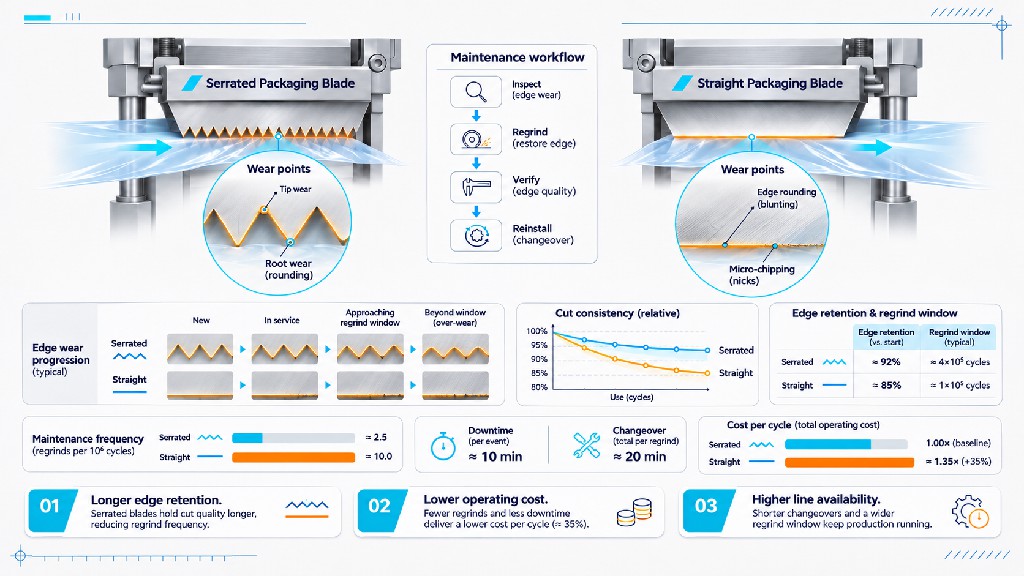
The cheapest knife to buy is not necessarily the cheapest knife to operate. The commercial calculation must include the blade purchase cost, the number of accepted packages produced during its useful life, cleaning and changeover labor, material scrap, and the expected cost of stoppages. There is no credible industry-wide rule that serrated blades always last a fixed percentage longer than straight blades; service life is determined by application, steel, treatment, machine condition, and the acceptance threshold for cut quality.
Consider an illustrative example in which a buyer compares two safe and compatible knife candidates for one packaging line. These numbers are deliberately hypothetical and are not published GUANG CHUAN performance measurements. Suppose Candidate A costs US$80, is used for 400,000 attempted packs, and produces 0.5% rejected packs. Candidate B costs US$120, is used for 600,000 attempted packs, and produces 0.2% rejected packs. Ignore other costs initially to isolate the arithmetic.
| Illustrative commercial measure | Candidate A | Candidate B |
|---|---|---|
| Purchase price per knife | US$80 | US$120 |
| Attempted packs during knife life | 400,000 | 600,000 |
| Assumed reject rate | 0.5% | 0.2% |
| Accepted packs | 398,000 | 598,800 |
| Knife purchase cost per 1,000 accepted packs | US$0.201 | US$0.200 |
The calculation is accepted packs = attempted packs × (1 − reject rate), followed by knife cost per 1,000 accepted packs = knife price ÷ accepted packs × 1,000. Under these assumptions, the more expensive blade costs approximately the same per accepted 1,000 packs, even before any difference in downtime or wasted packaging material is included. That is not a reason to select Candidate B automatically: the calculation assumes both knives pass safety, finish, integrity, and machinery-compatibility requirements.
Next, calculate the broader cost. For an illustrative stoppage of 12 minutes on a line that would otherwise run at 120 packs/minute, the line loses 1,440 attempted production opportunities during the stop. That figure is an arithmetic production estimate, not a monetary loss. To convert the loss into business value, use the factory's actual marginal contribution, recoverable output, labor impact, overtime, and material waste—not gross selling price. Record whether the stop was truly caused by the knife, rather than assigning every stoppage to the cutter.
A disciplined cost review compares cost per good package over a defined production period and includes spare-parts availability. An affordable blade that the supplier can reproduce consistently may be more valuable than a nominally superior edge with uncertain dimensions or long replenishment risk. Ask for repeatability data, approved drawings, and delivery commitments along with the unit quotation.
Good maintenance protects both cut quality and personnel. Follow the machine's lockout, isolation, guarding, and blade-handling procedures before cleaning or changing the cutter. Packaging blades can cause serious injury even when stationary. Never reach into a moving jaw assembly to remove film tails or scrape an edge while the equipment is energized.
Clean adhesive and film residue using a procedure compatible with the machine, knife material, and packaging environment. Tooth valleys can retain residue and require more careful inspection than a continuous edge. Avoid improvised abrasive cleaning that changes the tooth shape or produces loose particles. If cleaning requires a special solvent, verify compatibility with the blade finish, food-contact environment where applicable, and local safety rules.
Sharpening a straight knife means maintaining the correct bevel, edge straightness, and overall blade height. Sharpening a serrated knife additionally requires preserving tooth pitch and relative peak heights. An unqualified grinding process can flatten the teeth, change the clearance to the anvil, or create microscopic chips. A knife that has been shortened beyond the machine's allowable adjustment range should not be returned to service simply because its edge looks sharp.
Set replacement triggers by measured performance rather than calendar days alone. Useful triggers include a sustained increase in incomplete cuts, unacceptable pack-edge variation, repeated need to increase cutting pressure, visible chipping, or a defined cycle limit validated for the application. Keep removed blades labeled so the quality team can distinguish normal wear from accidental impact or inappropriate sharpening.
Batch-to-batch consistency matters because replacing a knife should not require a full process redesign. Verify incoming dimensions, edge profile, corrosion condition, protective packaging, and lot identification before putting new parts into production. Where the manufacturer offers regrinding, ask how the post-sharpening geometry is inspected and whether the part remains inside the agreed service envelope.
An effective request for quotation provides enough information to let the manufacturer quote the right function, not merely the cheapest visually similar part. Start with the equipment manufacturer and machine model, cutter assembly type, existing part number, and the required quantity. Attach an approved technical drawing if available. If there is no drawing, provide clear photographs of the front, back, edge, and mounting features with a scale, plus a sample that can be measured.
Add the material to be cut: polymer or paper structure, thickness range, laminate layer description, important coatings, print location, and sample roll direction. Explain whether the product needs full separation, easy-open notches, partial perforation, or a continuous smooth edge. Describe current performance: reject type, failure frequency, machine cycles, production speed, and when the problem occurs. Those symptoms help the supplier evaluate whether a different geometry could be worth trialing.
Specify commercial requirements separately: annual consumption, expected delivery schedule, desired spare inventory, destination market, documentation needs, and whether samples or a controlled first batch are required. Request a quotation showing material grade, heat-treatment condition, hardness acceptance criteria, critical tolerances, inspection method, lead time, and treatment of any engineering change. If the replacement is reverse-engineered from a worn sample, ask the manufacturer to identify uncertain features requiring buyer approval.
For serrated replacements, explicitly write “toothed cutting edge” and include a tooth drawing. For straight replacements, explicitly write “continuous non-serrated cutting edge.” An order saying “straight packaging knife” is ambiguous because a straight-bodied knife may still have teeth. That ambiguity is common enough to deserve its own line in the RFQ.
GUANG CHUAN's custom manufacturing and OEM/ODM service page describes drawing-to-product work, sample replication, dimensional inspection, hardness testing, and edge inspection. Buyers can use that published scope as the starting point for a technical conversation. Final properties, inspection records, pricing, and delivery dates still need to be confirmed for the actual blade configuration.
A reliable supplier should be willing to discuss the application and explain which dimensions control function. Ask whether the factory can show a controlled drawing and identify the measurement method for tooth pitch, mounting position, edge condition, and flatness or straightness where relevant. Where a tolerance is advertised, establish whether it applies to the full finished component, a particular test feature, or only a specific product model.
Request material identification suitable for the risk and order size. For critical applications, discuss heat-treatment records, hardness test locations, and traceability to a production lot. A very high hardness number is not sufficient evidence of cutting quality. The steel's suitability also depends on microstructure, toughness, finished edge geometry, and resistance to the specific wear mechanism.
Ask practical questions about revision control. If a manufacturing change is proposed, who approves a revised tooth pitch or bevel? Will repeat orders be matched to the approved sample? How are left-hand and right-hand versions identified? What happens if an incoming batch passes dimensions but fails an on-machine cut trial? These commercial process questions are essential to repeatable sourcing.
GUANG CHUAN presents packaging blades as part of its wider industrial cutting tool portfolio, which also includes film slitting and other machine-knife applications. That breadth is useful when a factory needs cross-cutting and web-slitting components, but each item must still be qualified independently. A positive performance result on a rotary slitter is not proof of suitability for a reciprocating serrated VFFS cutter.
Good supplier evaluation is evidence-based rather than slogan-based. Do not accept unverified claims such as “zero rejects,” “guaranteed twice the life,” or “fits all bagging machines.” Ask for drawings, materials, inspection evidence, trial criteria, and accountable communication. Those items make it easier to compare domestic and overseas suppliers fairly.
A snack-packing line produces otherwise acceptable seals, but several packs per shift remain joined by thin film strands. A technician confirms that the blade is correctly installed and that the actuator reaches its designed stroke. The existing straight edge is sharp; the soft film visibly deflects before the cut begins. Under these circumstances, a fine serrated trial is reasonable, provided the OEM confirms compatibility. Evaluate complete separation, seal protection, debris, and finished-edge appearance. If the machine instead has worn backing support, repair that condition before concluding that the plain edge is unsuitable.
A personal-care brand wants a continuous visual edge and has customer-approved opening instructions elsewhere on the pouch. Its cutting machine provides stable shearing support and passes the required speed trial using a straight knife. A serrated knife would add visible notches without a consumer benefit. Here, the straight cutting edge is the better commercial choice because it meets the packaging specification and does not add unnecessary complexity. The result must still be verified after the blade has accumulated normal operating cycles.
A product is packaged in reinforced paper-composite bags. The customer wants a noticeable starting edge that can be torn without scissors, and the seal layout permits that feature. A coarser tooth profile may be appropriate for a trial, consistent with the example discussed in Bosch's VFFS guidance. But the correct tooth height and notch position must be engineered so the bag remains strong during filling, stacking, and shipment. Opening convenience should not be purchased at the expense of handling integrity.
These scenarios are illustrations of decision logic, not anonymized customer case studies. They show why a credible answer to “which cutting edge is better?” begins with end use and machine behavior. The same blade profile could be the right choice for one packaging format and the wrong one for another.
No. Serration describes edge geometry, not a universal sharpness ranking. Tooth tips may initiate contact locally, but a poorly ground serrated blade can be dull, chipped, or inconsistent. A properly prepared straight blade can be exceptionally sharp. Judge performance by controlled cutting results and measurable edge condition, not the presence of visible teeth.
They can change how cutting force is introduced and distributed over time, especially by concentrating initial contact at tooth tips. Whether peak force or total cutting energy decreases depends on the substrate, support, geometry, speed, and machine. Without controlled tests on the same material and machine, no reliable percentage can be quoted.
For unsupported soft PE film that stretches before separation, a fine serrated knife may be worth testing. A straight knife may perform equally well or better with correct anvil support and shearing geometry. Specify film thickness, additives, machine type, and required edge finish before deciding.
BOPP behavior depends on orientation, laminate structure, and whether the finished edge should encourage tearing. Fine teeth may help initiate a designed opening; continuous edges may be better when notches are undesirable. Trial both with the actual roll direction and verify that no tear runs into the package body.
Only if the machine builder approves the replacement and the new geometry meets cutting, clearance, and finished-pack requirements. Matching length and mounting holes is not enough. A different edge can change stroke demand, opposing contact, opening behavior, and cleaning frequency.
No. A serrated knife may make a fully separated zigzag cut. Perforation requires intentionally uncut bridges or another controlled pattern. Buyers should specify whether they need full separation, a tear-off connection, or a localized tear notch.
There is no universal pitch that fits all films or machines. Start with an OEM drawing or a known successful sample, then consider changes based on material behavior and pack appearance. Specify pitch, tooth height, profile, tolerance, and how the profile is inspected.
A knife can influence seal integrity indirectly if it pulls material or cuts too close to the seam. It does not replace control of sealing temperature, pressure, dwell time, and film construction. Use a relevant seal-strength test when a knife change may affect the seal, and do not describe a blade alone as a seal-strength guarantee.
Not by default. HSS, D2-type tool steels, and stainless grades have different combinations of wear response, toughness, corrosion behavior, manufacturing requirements, and cost. Confirm the exact grade and treatment and evaluate service life in the real machine. A premium material will not rescue incorrect dimensions or poor cutter support.
Provide overall length, width, thickness, location and size of holes and slots, mounting datums, edge orientation, bevel, material grade, and critical tolerances. For serrated tools, add tooth pitch, profile, tip and root details, and end conditions. Include the machine model, film samples, and a description of the expected cut.
Use accepted packs or operating cycles until an agreed replacement threshold, along with reject counts, cleaning stops, and any adjustments. A knife that remains physically intact but can no longer produce acceptable packages has reached the end of its useful operating life for that application.
Sometimes a machine's existing knife performs adequately across a validated group of films. However, materials with different elongation, orientation, coatings, and laminate structures may need different profiles or settings. Confirm a blade across the full intended material range rather than assuming universal compatibility from a catalog description.
A straight tooth blade usually describes a straight-bodied machine knife whose working edge still has teeth. A straight-edge blade has a continuous, non-serrated cutting edge. To avoid quotation errors, use a drawing and write “serrated” or “non-serrated” explicitly.
Replace the knife when tooth damage, accumulated grinding loss, mounting damage, cracks, edge distortion, or out-of-spec dimensions make safe and repeatable operation doubtful. Qualified sharpening can be economical when the full geometry can be restored and inspected. The machine's allowable blade height and installation limits are mandatory.
Buy enough to conduct a safe fit check and a meaningful production trial, including a spare if needed. The quantity should match the machine's qualification plan, the variability of film lots, and the consequences of failure. Confirm that the final production batch will follow the same approved drawing and material specification.
Choose serrated packaging blades when controlled local cut initiation, a deliberately toothed finish, or a designed tear-access feature is valuable to the finished package and compatible with the equipment. Choose straight packaging blades when a continuous finish, reduced unwanted notching, or a proven supported shearing arrangement best serves the product. Neither is automatically stronger, cheaper, sharper, or longer-lived across every application.
Begin with the packaging specification and the machine's cutting mechanism. Confirm the film structure and the precise defect to solve. Use an approved drawing, trial the proposed edge on real production material, and compare accepted packs, defects, service interventions, and total cost. The winning knife is not the one with the most impressive isolated property; it is the one that safely and repeatably produces the right package at the required manufacturing rate.
Need a replacement or custom cutting knife? Review GUANG CHUAN's packaging machine toothed blades and precision HSS serrated knife example, then send your machine model, approved drawing or physical sample, film construction, target cut, and monthly or annual quantity through the contact page. Ask for confirmation of edge geometry, critical tolerances, material specification, a sample approval route, and an itemized quotation. An engineering-first request improves the chance that the first delivered blade will solve the actual cutting problem.

Leave A Message
Scan to WhatsApp :

 English