



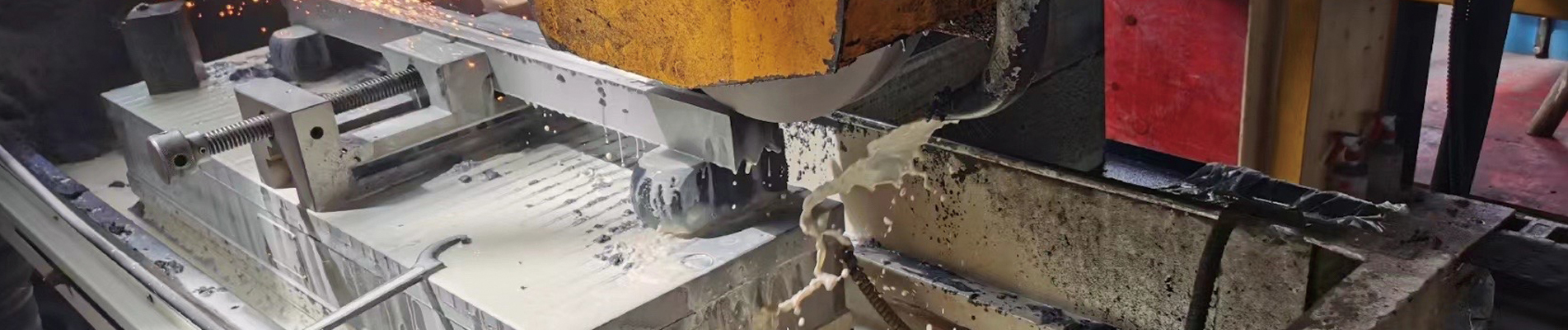

For a flexible-packaging converter, a slitting blade is not simply a spare part. It sits at the point where an expensive printed or laminated master roll becomes a product that customers will inspect, unwind, seal, coat, or process again. A clean slit protects usable yield and roll appearance. A poor slit can leave stretched edges, microscopic debris, blocked layers, inconsistent roll widths, and complaints that are much more expensive than the knife itself.
Choosing film slitting blades therefore requires two decisions, not one: select the cutting process that suits the web and machine, then specify the knife geometry, material, mounting dimensions, edge finish, and service plan for that process. A low-cost razor can be the best commercial choice for a clean, simple film running on an approved razor station. A precision rotary shear pair may be worth its higher tooling and setup cost when edges, laminates, coatings, or downstream performance are more demanding. There is no honest universal blade recommendation for every roll labeled BOPP, PET, PE, or laminated film.
This buying guide is intended for packaging-film producers, contract slitters, adhesive-tape converters, purchasing teams, equipment engineers, and maintenance managers. It explains how to compare BOPP slitting blades, PET film slitter knives, PE film cutting blades, laminated film slitting knives, and tape slitting blades without confusing a manufacturer's machine-specific setting with an industry standard. It also provides practical comparison tables, traceable test-method references, inspection checkpoints, and a worked financial model for procurement.
Quick selection principle: First identify razor, rotary shear, or score/crush slitting; next define the film construction, edge acceptance criteria, and actual knifeholder. Only then compare tool steels, carbide grades, prices, and promised service life. A premium alloy cannot compensate for the wrong slitting process or an unstable web path.
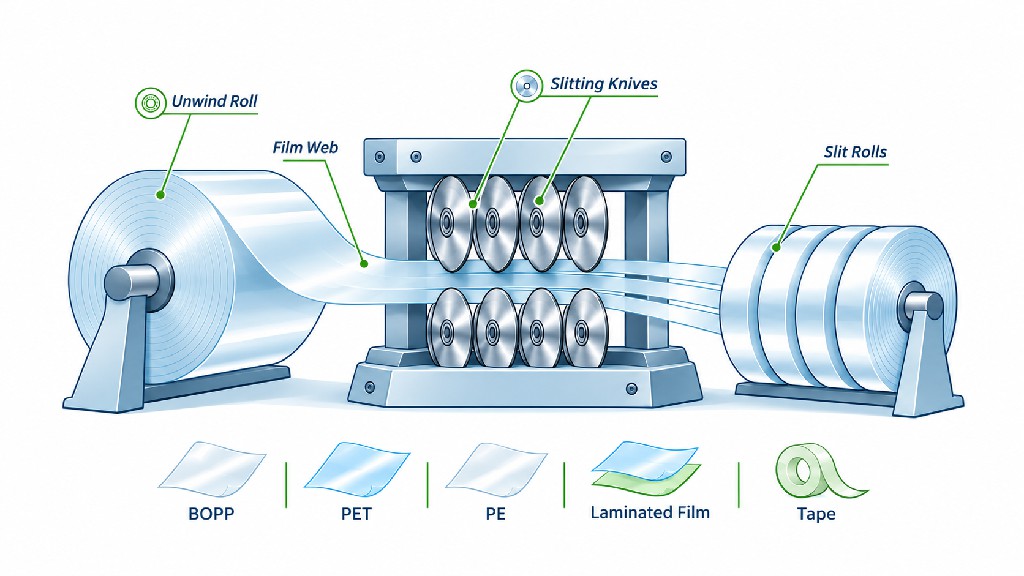
A master web is usually supplied wider than the customer's required roll. A slitter-rewinder moves the web through a controlled path, separates it into narrower lanes, and winds those lanes onto individual cores. The finished material may be plain film, printed flexible packaging, a metalized structure, a pressure-sensitive labelstock, or a multilayer barrier laminate. Despite their similar appearance on a purchase order, these materials can behave very differently at a cutting edge.
At the cutting station, a knife must initiate and continue a stable separation along the machine direction. The web should not drift sideways, wrinkle immediately before the blade, or repeatedly touch an unintended blade surface after separation. The slit must also be compatible with the winding section: even a visually smooth edge can become commercially unacceptable if neighboring reels telescope, edges interleave, or the roll cannot be processed downstream.
The word blade covers several distinct products. A disposable straight razor and a circular upper shear knife are not substitutes. A bottom anvil ring may be sold with a rotary knife although it is not sharpened like the upper blade. A score knife presses material against a hardened counter-roll, while a shear knife performs a scissors-like separation against a mating cutting face. Buyers who request only “one film knife, high-speed” risk receiving a perfectly manufactured component that does not fit the machine.
GUANG CHUAN describes its printing, packaging, and film business as including precision slitting and circular knives for plastic film, paper, foil, and adhesive tapes; its company profile identifies made-to-drawing customization as part of its offering. That supports a technical quotation process, but it is not evidence that any specific tool grade automatically achieves a stated run length on every converter's line.
The direct purchasing price is usually the easiest number to see and one of the least informative numbers to compare in isolation. The buyer also pays for knife changes, adjustment and startup waste, blade-related web breaks, technician time, regrinding, finished-roll inspection, packaging, shipping, and replacement stock. A lower quote can be economical when the process is simple and blades are changed quickly. It can be a false saving when an unplanned shutdown interrupts a high-value laminated packaging order.
For that reason, this guide evaluates knife selection from both the process side and the purchase side. A knife should be specified by what it must cut, how it mounts, how its performance will be measured, and which commercial risks the supplier can help reduce. The desired result is not the hardest blade or the sharpest marketing claim. It is the lowest verified cost of producing acceptable slit rolls.
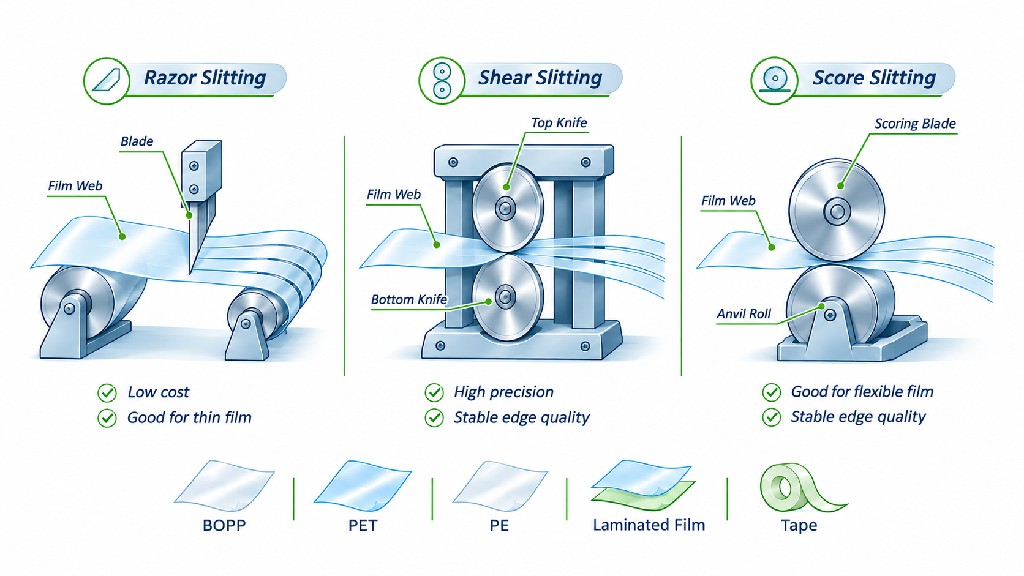
The three common slitting methods are different physical operations. Confusion here is more consequential than disagreement over whether a blade should be called a circular cutter, rotary knife, or slitter blade. A machine approved for razor slitting may need holders, support rollers, and blade presentation that have no equivalent in a paired-knife shear system.
A thin stationary blade cuts the moving web. In razor-in-air slitting, the web is supported by its own tension at the cutting location, with geometry controlled by the machine design. In razor-in-groove slitting, the blade enters a slot in a support roll. These are not identical arrangements; their blade exposure, mounting and acceptable web behavior must be checked separately.
Razor slitting can be attractive for thin, relatively clean, nonabrasive films because the consumable cost and changeover complexity may be low. Many simple packaging-film jobs can be evaluated on an OEM-approved razor station, especially when the edge-quality specification is not exceptionally demanding. However, high tension, film flutter, an excessively long exposed blade, contamination, and hard or filled coatings may accelerate wear or cause a distorted slit. On an adhesive product, material pickup can matter more than the price of the razor itself.
The decision is not “razor is always good for BOPP” or “razor is always bad for PET.” A film's exact grade, orientation, thickness, coating, and performance requirement control the result. Compare an actual trial at the proposed production speed, using the approved mounting method.
A rotary shear system uses an upper circular knife and a lower knife or anvil ring. Their cutting edges pass one another in a controlled relationship, like rotating scissors. Mechanical engagement involves geometry, horizontal side relationship, overlap, cant angle where applicable, and side force where a contact-loaded holder is used. Some machines drive both cutting elements; others drive the lower ring and rotate the upper knife through contact. Those details matter when ordering a replacement.
Rotary shear is often worth investigating for laminate structures, stiffer films, coatings, printed webs, and applications where a consistent edge under sustained production is worth additional tooling investment. It also allows the supplier to control a defined cutting geometry through ground faces and mating components. It is not automatically superior: an incorrectly configured shear pair can create rubbed edges, excessive dust, damaged anvils, and premature wear.
For machine terminology and upper/lower component roles, see GUANG CHUAN's top and bottom slitter knives guide and its industrial top and bottom slitter knife product. The cited product explicitly mentions synthetic films among possible applications; a film-specific blade still needs its own drawing and trial acceptance.
In score slitting, also called crush cutting in many web-converting contexts, a circular knife is pressed against an anvil roll and separates the material through localized compression. It is effective for selected papers, labelstock constructions, and more forgiving webs. Thin or highly extensible film can deform, whiten, fold, or produce an edge that is unsuitable for downstream sealing or winding. Therefore, do not order a score blade as a drop-in alternative to a rotary shear knife merely because both are circular.
Some adhesive tapes and supported specialty materials are deliberately processed by score systems. That makes the machine's approved process and the final edge criteria more important than a generalized prohibition. The correct commercial question is whether the chosen method achieves the agreed edge quality, reliable production, and acceptable consumable cost on the actual material.
| Slitting method | Cutting mechanics | Candidate applications to evaluate | Principal limitation | Information to confirm before buying |
|---|---|---|---|---|
| Razor-in-air | Stationary thin blade parts tensioned web | Selected thin monolayer films | Flutter, drag, rapid wear or edge strain on difficult webs | Blade dimensions, exposure, support, tension and guard |
| Razor-in-groove | Stationary blade enters supported roll groove | Selected clean, thin packaging films | Groove alignment, rubbing and contact damage | Groove shape, blade length, holder and web path |
| Rotary shear | Upper and lower rotating cutting faces cooperate | Films requiring controlled edge quality; certain laminates and coated webs | Greater alignment and paired-tool requirements | Upper/lower drawings, holder, overlap, side loading |
| Score/crush | Circular tool compresses web against anvil | Specific supported films, papers and tape constructions if approved | Potential edge compression or deformation | Approved anvil, load system, material trial and acceptance |
Practical purchasing rule: Compare methods only when the installed equipment supports them safely. It is not reasonable to recommend changing a blade type if that would require an unapproved modification to the holder, guarding, or machine control system.
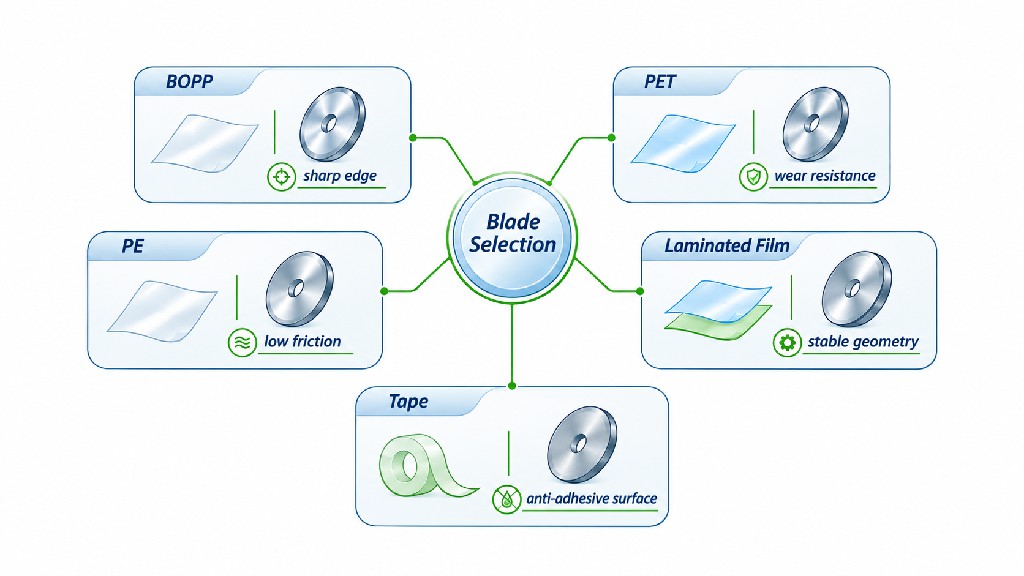
Polymer names describe broad families, not complete web specifications. BOPP is biaxially oriented polypropylene; PET is polyester, often biaxially oriented in packaging applications; PE includes several polyethylene formulations and processing histories. A laminate is a structure rather than a single resin. Two films of equal nominal thickness may have significantly different stiffness, extensibility, coating behavior, and sensitivity to localized drag.
BOPP combines a thin web with oriented properties that are not the same in the machine and transverse directions. It appears in flexible packaging, printed overwrap, labels, and other converted products. Depending on film design and surface treatment, the converter may be sensitive to edge whitening, scratches, splitting, curling, static charge, or instability at the rewind. The orientation history and the specific coating or metallization need to be known before selecting an edge.
For clean, uncoated BOPP on a suitable machine, a razor station may provide a sensible entry-level trial because it can offer low consumable cost and straightforward changeovers. But printed, coated, high-barrier, or very demanding BOPP applications may justify comparing a precision shear setup. Neither label should be treated as a universal default. The trial must establish whether the cut is continuous, whether edge dust remains acceptable, and whether finished reels perform properly after storage and unwinding.
A buyer should send the film producer's technical data sheet when possible, including thickness, orientation-sensitive tensile data, and any coating or metallization notes. Also specify whether the problem happens at the slit itself or only on the rewound roll. These two situations often have different causes and different remedies.
Packaging PET is typically stiffer than many flexible PE webs at a comparable gauge, but “PET” alone does not determine the ideal cutting action. Its high-strength oriented construction may make certain edge defects more visible or less forgiving. PET jobs can include plain packaging film, printed film, coating carriers, release liners, metallized film, and multilayer applications. Optical or technical PET may demand particle and scratch control far stricter than ordinary food-package webs.
A high-quality shear arrangement is worth evaluating when PET edge quality, debris control, or stable high-volume conversion is especially important. A razor may also be viable where the machine design and product specification support it. The purchasing team should not assume that a harder knife solves debris if the actual source is a scratched roller, a chipped lower ring, unstable tension, or edge contact after the slit point.
When comparing PET film slitter knives, request the finish and geometry of the actual cutting edge, not just a hardness value. In thin film, edge quality can depend strongly on microchipping, grinding marks, and the relationship between the active blade face and anvil. A polished-looking blade body is not proof that the functional cutting edge has the correct profile.
Polyethylene films include different densities, blends, sealant layers, and surface treatments. Some PE webs elongate noticeably before they separate, making tension control and local friction important. Heat-seal layers may transfer material, smear, or deform under unfavorable cutting conditions. Slip additives can also change the way the web runs over machine surfaces during storage and processing.
For this reason, PE film cutting blades should be evaluated for the particular PE formulation and web path. An aggressively thin cutting edge might produce a good initial slit but wear or chip too quickly if the holder is not rigid. A heavy, supported edge could be durable yet cause unacceptable local stretching. A different blade coating cannot be justified until the team knows whether the defect is abrasive wear, polymer pickup, or winding instability.
The ASTM description of D1894-24 specifically discusses plastic-film friction and notes that slip-additive effects may change with time. This is relevant to PE process troubleshooting, but a laboratory coefficient of friction is not a direct prescription for blade angle or knife pressure. It is one input to understanding web transport and winding behavior.
A laminated film can contain PET, BOPP, PE, CPP, aluminum foil, metallized layers, coatings, inks, and adhesives. A PET/PE structure may combine a comparatively stiff surface layer with a softer sealing layer. A PET/foil/PE package combines polymer layers with metal. A printed BOPP/CPP film presents another set of interfaces. The cutting edge must traverse the full construction without producing visible layer lift, uneven recovery, adhesive smear, or unacceptable debris.
This is why laminated film slitting knives should be evaluated using a construction map. Record each material and thickness, the adhesive or extrusion bonding process, the degree of cure where relevant, the slit direction, and the end-use acceptance requirements. A laminate that is insufficiently bonded may show ply separation at the slit regardless of the steel grade. Conversely, a satisfactory bond can still be damaged by a dull knife or excessive local side contact.
The scope of ASTM F904-22 covers techniques for initiating separation of plies so that bond strength of laminated flexible materials can subsequently be measured. The standard is not a slitting-knife setting guide. It provides a useful measurement framework when a buyer and a film producer need to distinguish weak lamination from mechanical damage introduced during conversion.
| Film or structure | Main purchasing concern | Knife approach worth evaluating | Important acceptance observation | Data to include in RFQ |
|---|---|---|---|---|
| Plain BOPP | Stretch, edge whitening, scratches and static-related handling | Razor on approved line; shear for tighter quality needs | Edge appearance and finished-reel behavior | Grade, gauge, print/coating, width, speed |
| Plain or coated PET | Edge debris, scratches and stable cutting | Fine, controlled razor or shear geometry according to machine | Microscope edge view and particle limits | Thickness, coating, final application |
| Monolayer PE | Elongation, curl and friction-related web behavior | Low-drag blade; trial method selected by machine | Uncut threads, edge stretch, winding | PE blend, gauge, COF data if available |
| PET/PE laminate | Differential deformation and layer lift | Precision shear often merits comparison | Ply separation and sealant-edge deformation | Full layer stack, bond condition, cure |
| BOPP/CPP laminate | Interface damage and roll presentation | Shear or qualified razor trial | Edge folds, interleaving and print damage | Layer stack and printed side |
| PET/foil/PE laminate | Foil fracture, particles and layer integrity | Precisely controlled shear arrangement where validated | Foil particles, edge delamination | Foil gauge, adhesives, inspection limit |
| Pressure-sensitive adhesive tape | Adhesive buildup, liner damage and blocking | Machine-approved razor, shear or score setup | Adhesive smear and liner integrity | Facestock, adhesive, liner and slit width |
The descriptions above are selection priorities, not standardized material-to-knife prescriptions. Film-formulation differences, equipment geometry, operating conditions and customer specifications can reverse the preferred option within the same row.
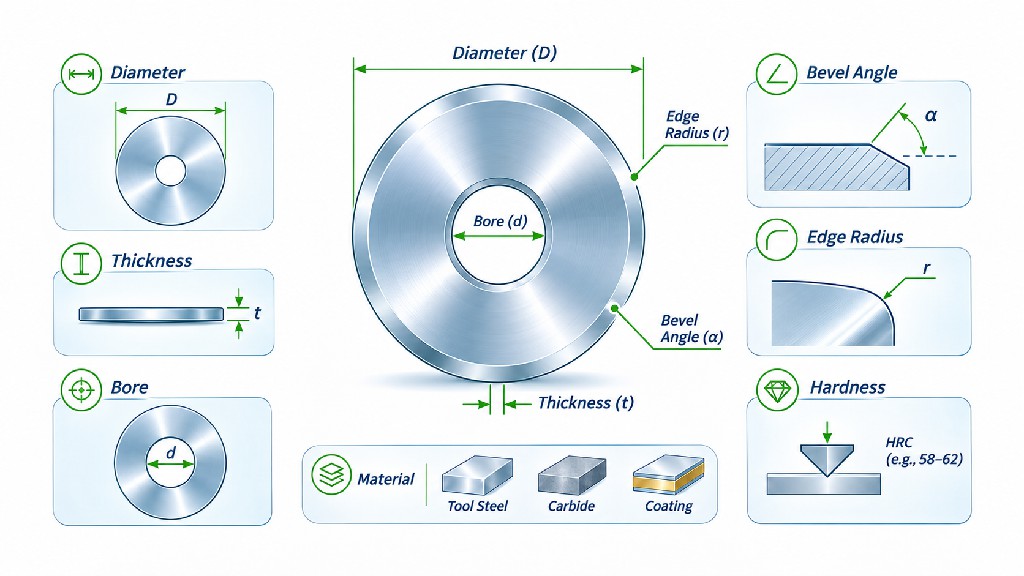
A supplier cannot reproduce a precision slitting knife from the phrase “100 mm round blade” alone. Even with the right material, the knife can cut differently if the active edge lies on the wrong side, the body has a different thickness, the bore has the wrong fit, or the grinding direction creates unwanted rubbing. For razor blades, shape, usable cutting length, thickness, mounting slots, and exposure may be more important than circular-tool dimensions. For rotary shear, a complete manufacturing drawing is essential.
Outside diameter (OD) determines the position of a rotary edge relative to the holder and anvil. Inside diameter (ID) determines fit on the shaft or knifeholder. Thickness determines support and may affect where the cutting face sits. In a multi-lane slitter, these dimensions also interact with spacers, anvils, web guides, and the maximum permitted regrind loss.
Suppose a rotary top knife is reground from 100.00 mm OD to 98.00 mm OD. Its radius has decreased by 1.00 mm. If nothing in the holder compensates, the geometric engagement with a fixed bottom ring will change. This is a dimensional fact, not evidence that the knife has become unsuitable. The regrind limit, resetting procedure, and installed machine travel must decide whether the blade can be reused safely. GUANG CHUAN explains that principle in its slitter knife overlap guide.
Bore fit must be reviewed together with clamping design, keys if used, cleanliness of mounting faces, and installed runout. Do not request an arbitrary “zero clearance” bore: bearings, thermal expansion, mounting method, and the manufacturer's datum system establish the correct fit. A drawing that reports high precision but omits how the dimension was measured is incomplete.
Bevel angle influences edge support and the manner in which the cut opens, but an angle without its reference face is ambiguous. A “30-degree knife” might describe the included tip angle, the angle of one ground face, or a specific grinding-machine setting. Single-bevel edges may have a handed installation and an active shearing face. Double-bevel designs distribute geometry differently. Dished or hollow-ground forms can reduce unwanted body contact after the cut where the machine design supports them.
For a film that stretches before separating, a finer functional edge and appropriate relief may reduce local deformation. But a narrower tip is also more vulnerable to chipping or accelerated wear in a contaminated or poorly aligned system. Conversely, a heavily supported tip might survive longer while producing more visible edge distortion. The most useful comparison controls the holder and web conditions, changes one blade variable at a time, and evaluates both edge quality and working life.
See GUANG CHUAN's guide to slitter knife bevel angles for a fuller explanation of included angle, bevel orientation and the need to distinguish material recommendations from knifeholder requirements. It is safer to reproduce the approved drawing than to prescribe one universal bevel angle for PET or BOPP.
A knife can feel sharp and still carry a damaged microscopic cutting edge. Small chips, heavy grinding scratches, or uneven edge preparation can initiate periodic defects across many meters of film. On a coated or metalized web, those defects may create visible edge particles. On a ductile PE layer, they may produce a small uncut thread or stretched tail. On adhesive tape, a rough flank may collect residue that later changes the edge profile.
Specify an inspection method, if the application requires it: for example, a calibrated optical microscope with agreed magnification, illumination, sampling positions, and a reference photograph. “Mirror finish” is too subjective to serve as the only acceptance requirement. The supplier should identify the functional face, bevel surfaces, and any coating or treatment that could change the effective edge radius. A hard coating is not automatically beneficial if the coating process rounds the tip or complicates future sharpening.
Radial runout changes the apparent position of the active cutting edge as a circular knife rotates. Axial runout changes the side relationship between cutting faces. Both can affect slit repeatability. Flatness and parallelism influence mounting and contact, but blade-only inspection cannot prove that an installed assembly will run correctly. A dirty shoulder, worn bearing, incorrect clamping, or damaged anvil can overwhelm a fine factory tolerance.
One GUANG CHUAN product listing for a multi-groove multi-edge bottom slitter gives flatness and parallelism of ≤0.003 mm and radial runout of ≤0.005 mm for that specific product family. These are published supplier specifications, not universal tolerances for film slitting blades and not an automatic guarantee for a mounted machine. If equivalent control is necessary on a film converter, it must be placed on the actual drawing with inspection datums and a measurement method.
| Drawing or inspection field | Why the buyer needs it | What a vague quotation might miss |
|---|---|---|
| OD and usable regrind diameter | Determines engagement and holder travel | New knife fits; reground knife will not reset |
| ID, mounting slots and face orientation | Locates the knife on the shaft or cartridge | Wrong fit, reversed bevel or unsafe mounting |
| Body thickness and active edge location | Controls lateral knife position and support | Edge shifts relative to lower anvil |
| Included angle, relief and edge preparation | Influences cutting force and stability | Same quoted angle, different cutting action |
| Flatness, parallelism and axial/radial runout | Improves installed repeatability when mounting is sound | Supplier tests wrong datum or only blade body |
| Material grade, hardness and heat treatment | Helps control wear and toughness | Generic “HSS” with unidentified alloy or process |
| Surface treatment and coating | May affect friction, corrosion and regrinding | New treatment changes tip or regrind policy |
| Lot identification and inspection record | Supports reproducibility | Replacement batch differs from approved trial |
The material decision should follow the process and edge design. It is tempting to rank knife grades simply by nominal hardness, but hardness is only one contributor to performance. Wear resistance, toughness, microstructure, grinding quality, edge geometry, contamination, and the actual mating tool determine service life. A brittle blade that chips during startup may be more expensive than a less wear-resistant steel that delivers stable operation for an entire production campaign.
D2-family cold-work tool steels are familiar industrial choices where abrasion resistance and established heat treatment are important. They can be cost-effective for certain circular slitting applications and are commonly available for customized knives. However, material nomenclature and equivalent grades need verification: two suppliers describing a blade as “D2-type” may not be offering identical chemistry or heat treatment. A high-hardness D2 edge may also become vulnerable to damage if anvil alignment or contact loading is incorrect.
A purchase specification should include a named grade, target condition, finished hardness range where applicable, and a drawing that controls the working edge. If the main observed failure is a repeatable chipped section rather than gradual wear, improving the holder and contact condition may be more valuable than demanding a higher hardness.
M2 high-speed steel is commonly evaluated where converters want a balance of edge retention, toughness, and regrindability in demanding duty. M42 contains cobalt and can be considered for selected higher-wear requirements, but it should not be sold as a guaranteed upgrade for every thin film. The relevant question is whether an actual application trial shows a measurable improvement in acceptable meters per knife, fewer edge defects, or longer intervals between interventions.
A film-processing operation that cuts clean, unfilled PE without abnormal wear may not recover the premium cost of a sophisticated grade. A demanding coated or abrasive laminate might benefit. The answer depends on the conversion process, edge geometry, lower tooling, and operating discipline. For more detailed metallurgy and procurement trade-offs, consult the site's D2 versus M2/M42 HSS versus tungsten carbide comparison.
Cemented carbide can offer high abrasion resistance in the right cutting system. It may be worth testing for high-volume production or abrasive coatings, particularly when frequent steel-knife changes dominate costs. Yet “carbide” is not a single universal specification. Grain size, binder chemistry and content, toughness, edge preparation, and the required blade geometry can vary substantially. A very hard, fine edge may be susceptible to impact or contact damage if the machine has runout, unstable side force, or mishandling during installation.
A carbide quotation should identify the grade or meaningful properties, the supplied edge finish, regrinding options, and handling instructions. The business case should include the risk and cost of a damaged blade, not only the ideal wear interval. For many simple razor-cut webs, changing to an expensive precision carbide rotary blade would be an unjustified decision if the machine does not use that cutting method.
For disposable razor systems, manufacturers may use different high-carbon or stainless blade steels and edge coatings. Corrosion resistance, edge sharpness, blade consistency, and safe handling can matter. If an operation has no validated need for a reusable circular knife, a consistent disposable blade program may be commercially sensible. However, the operator must change razors based on visible performance criteria, contamination conditions, or approved interval—not continue using a blade merely because its purchase price was low.
| Material or product family | Potential buying advantage | Main technical caution | Best evidence before award |
|---|---|---|---|
| Disposable razor steel | Low unit cost, easy replacement in compatible holders | Short wear life or drag on difficult webs; safe changeover | Batch consistency, edge finish and trial run |
| D2 / SKD11-type tool steel | Familiar tooling supply and economical regrinding | Chipping or wear if edge/support unsuitable | Grade certificate, hardness, trial and regrind history |
| M2 HSS | Candidate for improved sustained edge retention | Higher acquisition price does not ensure lower total cost | Controlled side-by-side run against baseline |
| M42 HSS | Premium option for selected challenging applications | May offer little benefit on simple clean films | Measured accepted meters and damage mode |
| Cemented tungsten carbide | Strong abrasion-resistance potential | Brittleness, grade dependence and regrind expense | Grade data, mounted trial, breakage and cost analysis |
This table is a decision framework, not a material-property certification. Do not substitute generalized hardness figures for a lot-specific report. If a supplier advertises a fixed hardness, use it only in the context of its exact grade and heat-treatment condition.
Technical standards are useful because they give buyers and suppliers a common measurement language. They do not normally prescribe a specific film slitter knife model, angle, blade hardness, side force, or machine speed. Standards that measure film properties and laminate performance can still make a purchase decision more repeatable. Without clear measurement methods, two trial reports may appear to disagree only because they examined different properties.
The following references are publicly identifiable official standards. Their full texts may require purchase or licensed access; the short descriptions below summarize their applicability rather than reproducing protected procedures.
| Published standard | What it addresses | How it helps a film-slitting project | What it does not determine |
|---|---|---|---|
| ISO 4593:1993 | Thickness of plastic film and sheeting by mechanical scanning; explicitly unsuitable for embossed film | Consistent incoming-gauge reporting | Blade overlap or nominal knife diameter |
| ASTM D882-26 | Tensile properties of thin plastic sheeting and films under 1.0 mm | Material stiffness/elongation comparisons with documented method | Universal acceptable tension or knife type |
| ASTM D1894-24 | Static and kinetic coefficients of friction for film and sheeting | Understanding slip and contact behavior in web handling | Shear side force or razor exposure |
| ISO 8295:1995 | Starting and sliding friction of film/sheeting, primarily for quality control | Another clearly defined friction testing method | Overall machinability or interchangeable ASTM COF values |
| ASTM F904-22 | Techniques for initiating ply separation before flexible-laminate bond-strength measurement | Preparing comparable plies for laminate adhesion investigation | Knife sharpness specification |
| ASTM F88/F88M-23 | Seal strength of flexible barrier materials | Assessing downstream seal performance where relevant | Slitting edge width or recommended knife angle |
For example, a converter comparing 12 µm and 50 µm film must not simply copy a pressure setting from one material to the other. The gauges are 0.012 mm and 0.050 mm respectively, a thickness ratio of approximately 4.17:1. That calculation is exact from the nominal gauges, yet it says nothing by itself about the proper blade material or slit speed. A laminate with several thin layers may still behave differently from a single film of the same overall gauge.
Similarly, ASTM D882-26 covers thin plastic sheeting below 1.0 mm and provides a consistent approach to tensile properties. The resulting data can help identify sensitivity to elongation, but the cutting process includes local deformation, friction and fracture that cannot be predicted from one tensile value alone. A strong procurement specification combines laboratory properties with a real slitting trial.
A further caution concerns COF data. The ASTM D1894-24 description specifically notes that some film slip-additive effects change over time and that its results should not simply be compared with those from ISO 8295 as if the procedures were equivalent. When a buyer receives two COF numbers, ask whether they were measured by the same method, sample age, contact surface, and conditions. Otherwise, an apparently precise technical comparison may be misleading.
A film slitting machine has several adjustable variables, and confusing their meanings can destroy a well-made knife. In a rotary shear system, overlap usually describes geometric engagement of the projected upper and lower cutting circles. Side force describes the lateral contact force in applicable holders. Horizontal clearance describes lateral separation or contact geometry at the shearing faces. Web tension keeps the material moving and winding in a controlled manner. These are not interchangeable values.
A film can show feathered or stretched edges even when the upper blade is new, because the anvil is damaged, the holder is moving, the film is unsupported, or tension changes during acceleration. Similarly, excessive side loading can increase contact wear and debris even if nominal overlap is within a published range. Knife pressure shown by a pneumatic regulator is not automatically the same as measured side force; holder mechanics determine the relationship.
The site's clearance, overlap and side-force setup guide explains the terminology in detail. It also distinguishes manufacturer-specific unloaded gaps from actual working clearance. This matters because copying a value from the wrong machine can create an unsafe contact condition.
A useful industrial article may cite published numbers, but numbers require their original context. For example, manufacturer literature on certain paper-winder slitters gives overlap guidance by paper grade, while a different shear holder may have its own reference geometry. Those values must not be presented as a BOPP or PET standard. If the original machine manual is available, it takes precedence over a general-purpose editorial table.
Instead of inventing a film-specific overlap, record the actual holder model, upper and lower tool diameters, approved machine setting, actual measured engagement, and evidence that the slit remains stable from startup through full operating speed. The optimum is the minimum stable engagement within the approved envelope that repeatedly produces a complete, acceptable cut without unnecessary body contact or abnormal wear.
Line speed changes the rate at which the web passes the blade and can amplify dynamic issues: flutter, vibration, bearing behavior, electrostatic charge, debris transport, and winding instability. Tension is also not a single fixed number throughout a converting line. Unwind, processing, and rewind zones may be controlled differently; taper tension may change as rolls grow. A knife that works well at reduced speed should not automatically be approved for the production maximum.
Use the OEM's operating envelope and qualified web recipe. A supplier-provided table of “maximum speed for BOPP” cannot be used as a universal material limit unless the actual slitter design, film gauge, tension, winding arrangement, and edge acceptance are equivalent. For a fair trial, compare blade candidates at the same confirmed web conditions and document speed changes rather than crediting every quality improvement to the knife.
Adhesive tape deserves its own buying decision because the substrate is usually more than a plastic film. A pressure-sensitive construction may include BOPP or PET backing, an adhesive layer, and sometimes a release liner. A masking tape may use a different backing entirely. The chosen equipment may slit a wide jumbo roll into strips before rewinding, or cut already-wound logs into narrower rolls. These two operations use different machine geometry and different knives; purchasing departments should not combine them into a single unqualified “tape blade” order.
For adhesive-backed BOPP, the immediate problems can be adhesive transfer to the working face, uneven roll sides, debris, heat accumulation, and sticking after cutting. A knife with a highly polished flank or a profile that reduces unwanted contact may be worth testing, but only with the actual adhesive chemistry and line setup. Excessive local pressure and an incorrectly supported blade can worsen the problem even when the steel itself is suitable.
GUANG CHUAN lists a specific 250 mm circular slitting blade for BOPP and masking-tape rolls. Its published product data names M2/M42 HSS and D2-family steels, customizable edge geometry, and an OD product range of 100–800 mm. Those are supplier-stated specifications for that product family, not a recommendation that every tape converter needs a 250 mm knife. Before quoting, confirm whether the machine is a web slitter, a rotary shear line, or a log-slitting machine and supply the original tool drawing or sample.
In a tape trial, inspect both the tape roll and the tool. A seemingly clean sidewall on the first roll can deteriorate as adhesive builds up. Record how frequently operators must stop for cleaning and whether cleaning itself risks edge damage. A more expensive blade may pay for itself by reducing residue-related stoppages, even if the nominal wear life is similar to the baseline. Equally, a low-cost, easily changed blade may remain preferable on a short-batch converting operation.
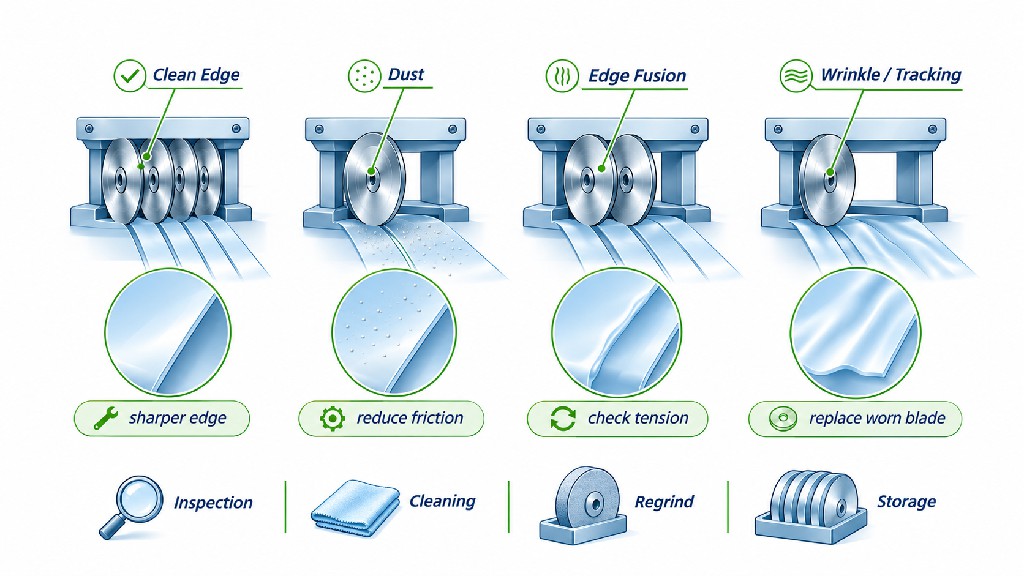
Replacing knives is not always the correct first action. A stable troubleshooting sequence separates blade wear from machine and material causes. Many film defects are multi-factor problems: the cut may initiate correctly, but poor slit separation or winding can damage the edge afterward. A new knife may temporarily hide the symptom without addressing the actual process fault.
| Observed issue | Plausible causes to investigate | Immediate inspection priority | Blade-purchase implication |
|---|---|---|---|
| Uncut threads or intermittent bridges | Dull edge, moving holder, insufficient effective cut, local web flutter | Edge at microscope, holder movement, OEM setup | Regrind or replace only after geometry is checked |
| Edge whitening or stretched lip | Film strain, excessive drag, unfavorable bevel, tension | Web support, contact path, film grade | Compare lower-drag geometry in a controlled trial |
| Tiny edge particles | Microchipping, rubbing faces, coating fracture, damaged anvil | Both knives, lower face, coating and particle source | Specify edge inspection and mating-tool condition |
| Laminate layer lift | Weak or incompletely cured bond, excessive cutting deformation | Lamination history, ply adhesion, sample cross-section | Do not attribute all delamination to knife hardness |
| Adhesive smear on tape | Adhesive pickup, heat, blade finish, excess contact | Residue pattern and cleaning frequency | Consider profile or finish trial, not material alone |
| Repeating defect once per revolution | Tool damage, mounted eccentricity, roller problem | Circumferential blade and anvil inspection | Request runout measurements with datums |
| Irregular roll sides or telescoping | Winding/tension/guiding faults, lane position | Rewind recipe, core, nip and separator geometry | Verify roll formation before condemning edge |
| Sudden short knife life after replacement | Wrong geometry, contact force, poor mounting or material change | Compare approved drawing and setup history | Require root-cause investigation and lot traceability |
First, preserve evidence. Retain a defective roll with the web direction, slit lane, date, blade lot, and operating conditions recorded. Photograph the edge at both low and higher magnification. If the issue is intermittent, note whether it follows a particular lane, roll diameter, speed, or material batch.
Second, check mechanical condition with the machine locked out under the site's safety procedure. Examine knife seating, lower-ring condition, holder play, and mounting contamination. Verify the approved setup dimensions and the actual knife drawing. Do not touch or adjust a moving razor or shear station by hand. When a machine's setup uses air cylinders, isolate stored energy as required by the manufacturer's instructions.
Third, check the material. Compare incoming thickness, surface condition, coating, adhesion, and age with the validated recipe. A newly introduced slip additive or lamination process change can alter web behavior without any change to the blade. Fourth, run a controlled comparison: change one variable, document the result at several operating conditions, and reject a candidate only against an agreed quality limit rather than subjective appearance alone.
These steps also support a more productive supplier discussion. Instead of sending “our PET knife is bad,” the buyer can send the original drawing, a photograph of the worn edge, microscope images of the film, the measured setup, and a brief record of when the problem began. That gives a manufacturing partner enough information to distinguish a material upgrade from a geometry correction.
A sample blade should not be approved just because it survives a few minutes at slow speed. Define the baseline process before installation: existing blade grade and drawing, material lot, thickness, full layer structure, line configuration, winding recipe, running speed, target slit width, and customer defect requirements. After changeover, confirm the machine is mechanically correct and safe. Only then start a trial.
The qualification should capture accepted finished length or accepted rolls, not merely the distance that passed through the machine. A knife may run for a long distance but produce increasing edge damage during its last operating hours. For suppliers who claim exceptional service life, specify the criterion that ends the test: for example, the first sustained failure against an agreed edge particle or uncut-thread limit. That makes lifetime comparisons repeatable.
| Trial data field | Baseline blade A | Candidate blade B | Required comparison rule |
|---|---|---|---|
| Film and lot | Record actual material | Same lot if practical | Match film construction and condition |
| Speed and tension recipe | Record controlled settings | Same approved settings | Note necessary changes separately |
| Knife and lower-ring geometry | Drawing ID and revision | Drawing ID and revision | Avoid hidden design differences |
| Starting edge inspection | Photographs or documented score | Same method | Use same magnification and lighting |
| Accepted output to removal | Measured meters or rolls | Same metric | Stop at same quality threshold |
| Blade changes and cleaning stops | Number and minutes | Number and minutes | Include non-wear interventions |
| Reject/scrap caused by cut | Verified affected length or mass | Same method | Do not attribute unrelated defects |
| Regrinds or repair costs | Actual invoices | Actual invoices | Track life-cycle rather than new price |
| Final slit edge evaluation | Predefined inspection and acceptance | Same protocol | Examine multiple positions and lanes |
A trial with one blade of each type can identify a promising direction, but it cannot establish a reliable statistical life distribution. If commercial consequences are significant, repeat trials over several lots or comparable production campaigns and report variation. Record any failed installation or accidental collision separately from normal abrasive wear; neither should be silently ignored, but they represent different risks.
For critical flexible packaging, assess downstream performance too. A laminate with an acceptable-looking edge may still have an unacceptable layer disturbance or sealing effect. The relevant material tests and quality checks should match the customer's specification and end use, not be invented by the knife supplier. In medical, food-contact, or other regulated packaging, comply with the applicable product, quality, and contamination requirements; an industrial blade advertisement is not evidence of regulatory approval.
The best commercial knife minimizes the cost of acceptable output, not necessarily the price per blade. A proper model includes acquisition or sharpening, changes and cleaning, production downtime, quality loss, and logistics. The following example is deliberately illustrative, with invented planning assumptions. It is not measured GUANG CHUAN performance, an industry benchmark, a supplier price quotation, or a guaranteed service-life ratio.
Assume a line evaluates two otherwise compatible rotary shear blade options over a planned 1,000,000 meters of web. Blade A costs US$40 and lasts 40,000 accepted meters on average. Blade B costs US$110 and lasts 120,000 accepted meters. Each change consumes 15 minutes of useful production time, and the internal value assigned to unavailable production capacity is US$180 per hour. The model excludes scrap, regrinding, freight, and inventory cost to keep the assumptions transparent. For an apples-to-apples estimate, fractional quantities below describe long-run average consumption, not the number of physical blades bought in one order.
| Illustrative model input or result | Blade A | Blade B |
|---|---|---|
| Assumed new-blade price | US$40 | US$110 |
| Assumed accepted life per blade | 40,000 m | 120,000 m |
| Average blades consumed per 1,000,000 m | 25.00 | 8.33 |
| Modeled blade spend | US$1,000 | US$916.67 |
| Changeover time at 15 minutes each | 6.25 h | 2.08 h |
| Modeled downtime value at US$180/h | US$1,125 | US$375 |
| Modeled total of listed costs | US$2,125 | US$1,291.67 |
| Modeled listed cost per 1,000 m accepted | US$2.125 | US$1.292 |
Using these assumptions, Blade B's listed cost is approximately 39.2% lower, despite the higher unit price. The example demonstrates why purchasing based exclusively on price per knife can be misleading. It does not show that Blade B will actually last three times longer; that is a trial hypothesis to validate.
The calculation can be adapted to real data: tooling cost per accepted meter = purchase and qualified sharpening cost divided by accepted production meters. Add changeover cost per accepted meter = total verified changeover hours multiplied by the applicable capacity or labor cost, divided by accepted meters. Scrap costs and recurring cleaning can be added in the same way. Keep quality losses separate from ordinary planned setup scrap so that the trial does not overstate blade savings.
Be careful with the “cost of downtime” input. An accounting burden rate is not always equal to lost contribution margin; a plant with spare capacity or scheduled maintenance may value a changeover differently from a fully booked operation. Likewise, if a line changes products every 30,000 meters, an edge that lasts 120,000 meters may offer less benefit than the simple model predicts because planned changeovers already provide natural service windows. A responsible commercial proposal states these assumptions and invites the customer to replace them with their actual operating data.
A quote becomes more accurate when the inquiry separates what is known from what needs engineering review. The minimum useful package usually includes an existing blade drawing or sample, machine model, knifeholder or station type, cutting method, substrate information, operating envelope, and the customer's defect criteria. Add forecast quantity and delivery requirements. If there is no approved drawing, identify which dimensions can be measured and which need validation at installation.
| RFQ item | Example of useful information | Why it matters |
|---|---|---|
| Blade type and station | Razor-in-groove; upper shear; lower anvil; tape log cutting | Prevents wrong-process quotation |
| Equipment | OEM, machine model, holder model, driven/free-running knife | Establishes mounting and motion |
| Original drawing or sample | OD, ID, thickness, holes, slots, bevel hand, finish | Protects fit and interchangeability |
| Substrate | BOPP, PET, PE, metallized film, PET/PE or tape laminate | Identifies likely failure mechanisms |
| Film construction | Layer sequence and individual gauges, adhesive, coating, filler | Determines cutting-interface challenges |
| Operation | Web width, lane widths, line speed, tension recipe | Establishes load and production context |
| Quality target | Edge photographs, particle or layer-lift acceptance, width tolerance | Turns claims into measurable deliverables |
| Current knife result | Accepted meters, wear mode, cleaning frequency, failure photographs | Provides a reference for improvement |
| Procurement | Quantity, delivery region, required documents and repeat-order plan | Enables practical commercial quotation |
For buyers of rotary slitting tools, the circular slitting and rewinding blades category and circular slitter knives selection guide are useful starting points. To compare a tape-oriented product rather than a general upper/lower shear set, review the BOPP and masking-tape circular blade listing. These links identify actual product and technical contexts; they do not replace a compatibility check.
Ask the supplier to confirm the finished drawing revision, material identity, heat-treatment and hardness documentation where relevant, edge orientation, tolerances and measurement datums, inspection requirements, and packaging method. Ask which features are standard and which require custom machining, special material purchase, or additional inspection. For replacement stock, request lot traceability and a repeat-order specification so future blades do not silently drift away from the validated sample.
If the supplier proposes a change from D2 to M2, M42, or carbide, ask for the reason in terms of your specific failure mode. Is the current blade wearing gradually, chipping unexpectedly, collecting adhesive, or producing unacceptable particles despite correct alignment? A useful recommendation answers that question and identifies how a trial would prove the proposed benefit. Claims such as “longest life,” “zero dust,” and “perfect slitting at any speed” should be replaced with measurable, substrate-specific acceptance criteria.
There is no single best blade for all BOPP films. Start with the machine's approved method and the actual BOPP grade. Razor slitting can be economical for suitable clean, thin films; rotary shear may be justified where coating, edge cleanliness, or dimensional consistency is more demanding. Compare finished-roll quality and accepted output, not just the initial edge appearance.
No. PET film slitter knives must match the machine and product requirement. A precision shear system may perform well on demanding PET jobs, while an OEM-approved razor arrangement may be suitable for others. The real decision depends on film gauge, surface condition, allowable debris, winding quality, blade wear, and installed station design.
Possible causes include excessive local drag, unsuitable blade profile, film extension before separation, web flutter, or an incorrect tension and winding recipe. Inspect the blade and web path together. A harder material grade alone is unlikely to correct a mechanical setup problem.
These structures contain layers with different mechanical behavior and bonded interfaces. The cutting action must separate all layers without unacceptable stretching, particles or ply lift. Document the structure and bonding condition, then use a trial with clearly defined downstream acceptance. Bond-related testing can help distinguish weak lamination from blade-induced damage.
No. Carbide can offer abrasion resistance, but grade, brittleness, impact sensitivity, machine condition, finishing, and sharpening cost matter. HSS or tool steel may deliver lower cost on many stable jobs. Carbide earns its premium only when a controlled production trial proves better cost per acceptable output.
Usually not safely. Provide thickness, edge geometry, bevel hand, mounting features, tolerances, and information about the mating lower ring or anvil. Even a visually identical blade may put its working edge in the wrong lateral position. A drawing or approved sample is much better than a photograph alone.
Replace or resharpen when the agreed edge-quality threshold, machine safety rule, or tool wear limit is reached. No universal meter interval applies across different polymer grades, slitting methods, line speeds, and knife materials. Tracking accepted production length and failure mode establishes the most useful local replacement schedule.
Possibly. Adhesive-coated webs can cause buildup, blocking and additional cleaning, while tape log cutting can use a completely different blade system from longitudinal film slitting. Specify the substrate construction and actual machine process before deciding whether a common knife is suitable.
A successful film-slitting purchase starts with a precise question: Which knife and setup can produce our specified roll quality at an economically defensible cost? The answer comes from the actual cutting method, BOPP/PET/PE or laminate structure, blade drawing, holder condition, measured edge quality, and comparative trial data. Standards can make film characterization more consistent, and supplier product specifications can define what is available, but neither can substitute for validating performance on the customer's line.
For basic films on suitable equipment, a simple razor program may be the strongest commercial decision. For demanding films, coated structures, and laminated packaging, a correctly designed rotary shear pair may justify more precise tooling and inspection. D2, M2, M42 and carbide should be selected in response to identified wear and defect mechanisms, not as a ranking of fashionable materials.
Request a film slitting blade quotation from GUANG CHUAN. Send your existing knife drawing or sample, film construction, machine model, target widths, operating conditions, current defects, and expected order quantity through the contact page. For technical comparison before ordering, explore the company's film-capable top and bottom slitting knives or its BOPP and masking-tape circular blade product. A well-defined inquiry is the first step toward repeatable cutting quality, accountable inspection, and a blade supply program based on actual production needs.

Leave A Message
Scan to WhatsApp :

 English