




If you search for replacement cutters for a slitter rewinder, one catalog may advertise circular slitter blades, another may list rotary slitter knives, and a third may use circular slitting knives. The product photographs can look almost identical. Yet two products with the same outside diameter may have completely different functions—and may not be interchangeable in your machine.
That raises an important question for converters, purchasing managers, OEM engineers and maintenance teams: do these names describe different tools, or simply different ways of describing the same tool?
The short answer: In many industrial catalogs, circular slitter blade and rotary slitter knife are overlapping names for a round cutting tool that rotates during a slitting operation. Neither phrase, on its own, establishes a universal technical category. The real distinction is usually the cutting method, upper or lower knife position, edge profile, mounting interface, and relationship with the mating component. A circular blade designed for shear slitting is not automatically suitable for score slitting, even though both may be described as rotary knives.
The practical buying rule is therefore simple: match the cutting assembly, not the product name. Start with what the machine actually does, identify the cutting pair or anvil arrangement, then confirm drawings and measurable dimensions before placing an order.
GUANG CHUAN supplies industrial circular slitting and rewinding tools used with paper, film, foil and other converting equipment. Buyers can browse the Circular Slitting & Rewinding Blades category or examine a specific top-and-bottom knife set for paper converting machinery. This comparison explains the naming question in detail while showing how to avoid expensive replacement-tool mistakes.
At a glance: “Circular” describes the round shape; “rotary” describes rotation; “slitter” describes the longitudinal cutting task; and “blade” or “knife” usually describes the cutting tool. Those words are helpful search terms, but they are not a substitute for a technical specification.
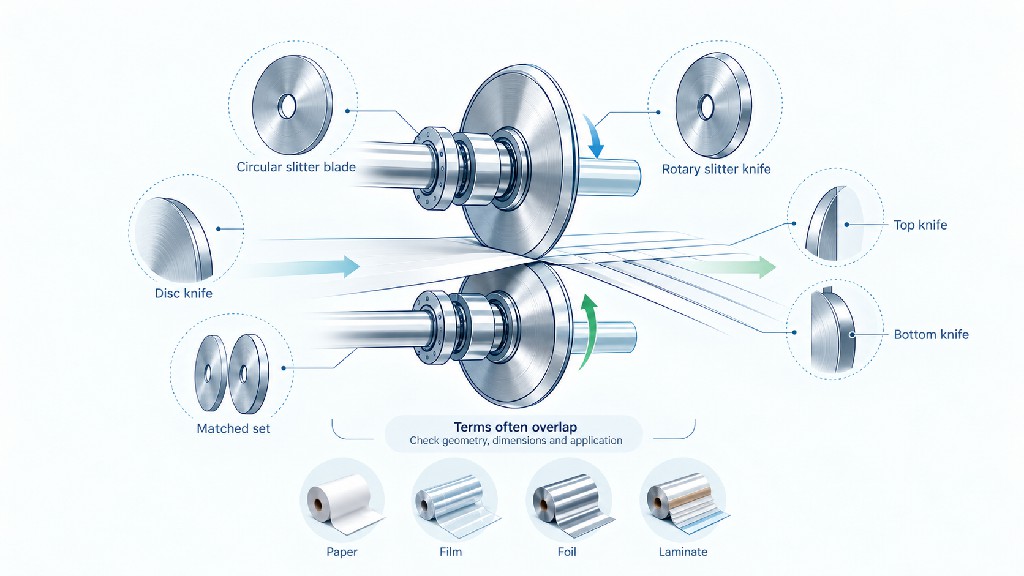
A circular slitter blade is a disk-shaped cutting component used to separate an incoming web, sheet or strip into narrower widths. The blade has a circular outer profile and typically an accurately machined central bore, sometimes combined with mounting holes, a keyway, a hub or a holder-specific clamping arrangement. The cutting edge may be sharpened around its circumference, or the disk may incorporate a specialized profile that works against a mating surface.
In a conventional shear slitter, a top circular blade approaches a rotating lower knife or anvil ring and cuts the material along a narrow contact zone. In another design, a rotating score blade presses material against a hardened anvil roll. Both may appear in online searches for circular slitter blades, but their cutting actions and replacement requirements differ.
The term slitting is especially important. In web converting, slitting normally means dividing a continuously moving material in the machine direction rather than making a transverse cut across its entire width. On a slitter rewinder, the original roll is unwound, divided into narrower lanes, and rewound. In sheet or strip processing, related rotary cutting systems can perform analogous longitudinal divisions without always following the same web path.
When a supplier says a blade is “circular,” you learn something about its shape, but little about its bevel, operating load, edge contact, or compatibility. For example, a smooth-edged circular blade for a film rewinder may look similar to a knife for adhesive-tape converting, but the holder may require a different center bore, knife thickness or bevel orientation. A disk with a visually similar face can also be an anvil, a ring spacer or a guide component rather than the active cutting knife.
A useful first question is not “Do you sell circular slitter blades?” but “Do you supply the upper cutting knife, lower mating knife, or complete slitting set for this machine and material?” That wording immediately narrows the technical possibilities.
A rotary slitter knife is a cutting tool used in a slitting arrangement in which the knife rotates around an axis. The term emphasizes how the knife operates rather than merely how it looks. Most common industrial rotary slitter knives are circular disks or rings because a circular profile provides a continuous cutting perimeter as the tool turns.
In a paired shear arrangement, the upper and lower rotary cutting tools interact much like continuously operating scissors. The edges do not need to open and close as handheld scissors do; relative rotation and controlled contact establish the cutting point while the moving material passes through. The terminology in the industry often includes top knife, male knife, bottom knife, female knife, anvil ring, and shear-cut knife. However, “male” and “female” do not always map neatly to every proprietary holder design, so a drawing should specify actual function and orientation.
“Rotary” is also broader than “slitting.” Rotary cutting knives are used for trimming, cross-cutting, perforating and certain specialized manufacturing operations. A product marketed as a rotary cutting knife may be intended for a completely different machine even if it has a similar diameter. The presence of the word rotary does not prove that the product is a suitable slitter replacement.
The distinction becomes clearer when the intended task is stated. A rotary slitter knife is a rotary cutter for slitting; a rotary cutting knife may cover many rotary-cutting tasks. Likewise, a circular slitter blade is not necessarily a toothed circular saw blade. Sawing and slitting use different mechanical principles and require different edge arrangements. Ordering a saw blade for a shear slitter simply because it is circular would be a serious specification error.
For readers who need a broader overview of tool families, applications and materials, see GUANG CHUAN's existing Circular Slitter Knives: Types, Applications, Materials and Selection Guide. The present article stays focused on terminology, physical configuration and replacement fitment.
One reason searches for “slitter blades vs knives” cause confusion is that suppliers may choose labels for commercial reasons rather than according to a mandatory industry dictionary. Regional usage, machine-builder terminology, translations and product catalogs all influence the names used. There is no reliable one-word rule that says every “blade” has one geometry and every “knife” has another.
| Catalog term | What the wording normally communicates | What it does not establish | Best follow-up question |
|---|---|---|---|
| Circular slitter blade | Round blade intended for a slitting task | Shear versus score configuration | Does it work with a lower knife, an anvil roll or another surface? |
| Rotary slitter knife | Rotating cutting tool for longitudinal slitting | Upper versus lower location | Is it the top knife, bottom knife or a complete matched set? |
| Circular slitting knife | Common alternative to circular slitter blade | Specific bevel or hole pattern | Can you provide an edge-section drawing? |
| Top slitter knife | Cutting component on the upper side of a paired system | Universal fit with any bottom knife | Which mating bottom knife and holder are used? |
| Bottom slitter knife / anvil ring | Lower cutting or mating component | Identical role in all machines | Is the cutting edge on a shoulder, groove or ring face? |
| Rotary cutting knife | Broad rotating cutting-tool description | That the tool is specifically a slitter | What process and substrate is it designed for? |
| Score or crush-cut knife | Rotating knife pressing into material against an anvil | Suitability for rotary shear slitting | What is the anvil surface and specified contact load? |
| Razor slitting blade | Very sharp blade cutting thin moving material | That the blade rotates | Is the razor stationary, holder-mounted or part of a rotating design? |
The table intentionally avoids claiming that the terms form a formal classification standard. Product names are a starting point for communication; they are not proof of equivalence. The most useful technical terms are those that identify role, process and interfaces. For example, “100 mm OD pneumatic-holder dished upper shear knife with a left-hand bevel” is much more actionable than “100 mm rotary knife.”
For search and purchasing teams, it is reasonable to include both circular slitter blades and rotary slitter knives in an inquiry so vendors understand the product family. But as soon as a supplier replies, move the conversation from keywords to drawings, mating parts and measurable specifications. This is especially important when a machine uses an OEM-specific knife holder or nonstandard cutting profile.
Sometimes they are the same product under different names. Sometimes they are entirely different parts. The answer depends on the actual machine assembly, not the words used on a product page. A suitable replacement must satisfy all relevant functional and dimensional requirements—not just appear similar in a photograph.
Consider three common inquiries. Buyer A requests a “rotary slitter knife” for a paper converting line and supplies a drawing of a dished upper shear blade. Buyer B requests a “circular slitter blade” for the same machine, with the same drawing number, same holder and same material. These requests may refer to the same component. Buyer C requests a “circular slitter blade” with the same outside diameter but a symmetrical scoring edge intended to press against a steel roller. Buyer C is not requesting an equivalent shear knife.
A technical purchasing decision should therefore answer five questions. What is the cutting method? Where does the knife sit? What does it contact during cutting? How is it mounted? What material and quality requirement does it serve? Two descriptions are compatible only when their answers line up closely enough to meet the machine maker's specifications.
A machine's spare-parts catalog and component drawing should generally take priority over informal labels. If a drawing calls a part “upper knife” while a distributor sells it as a “rotary slitter blade,” there is no inherent conflict. However, if the replacement's thickness, face relief or bore geometry differs, the name match is meaningless.
This is also why reverse engineering a worn sample requires care. A damaged edge may no longer reflect its original bevel; a bore can have wear or fretting; and repeated sharpening may have changed the outside diameter. Where possible, use the OEM drawing or a known-good reference tool alongside the sample. GUANG CHUAN's industrial top and bottom slitter knives product information explicitly requests drawings and dimensional tolerances for custom work.
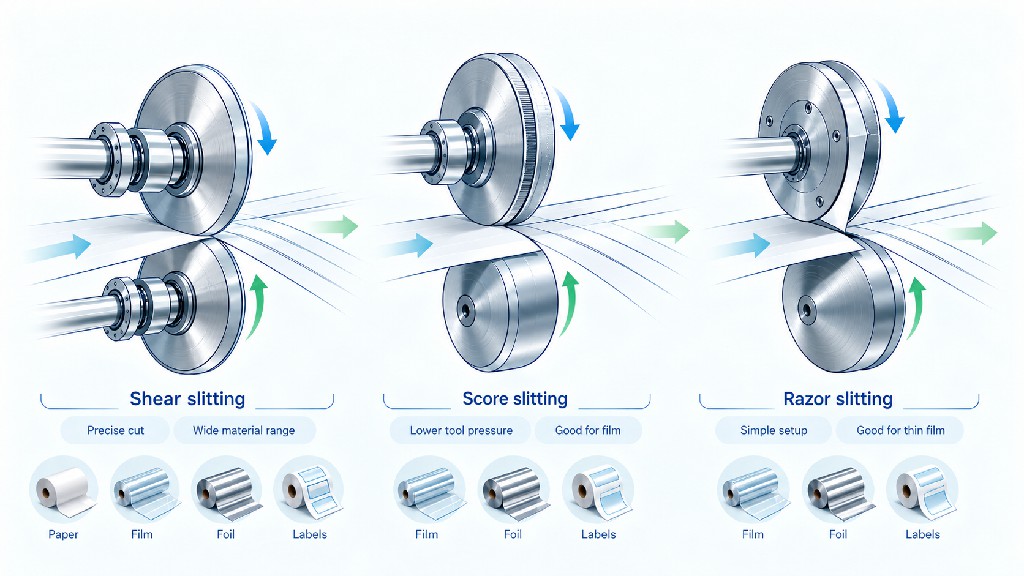
The primary engineering separation is not between the words blade and knife. It is between the ways the material is actually separated. Shear, score/crush and razor slitting place different loads on the edge and impose different requirements on the mounting system. This distinction is the core of a safe replacement decision.
In a rotary shear slitter, an upper cutting blade meets a lower knife, ring or appropriately shaped anvil to establish a controlled cut point. Material passes between these components and is divided by a shearing action. For converting applications this arrangement often provides precise slit edges, especially when the machine's tension, geometry and knife alignment are well controlled.
The geometry is more nuanced than simply pressing two sharp circles together. The cut point depends on the position of the two tools. The upper knife's cant or shear angle establishes the contact relationship. Radial overlap determines how far the upper knife engages relative to the lower knife's tangential surface. Dimensional runout and side contact influence whether that relationship remains stable while running.
The industrial specialist DIENES describes the cut point, shear angle, overlap and dimensional runout as key geometric relationships in its Slitting Reference Guide. Its guidance is useful for understanding why two nominally identical round blades can behave differently when installed in holders with different stiffness or geometry. These are machine- and material-dependent variables, not universal settings that can be copied indiscriminately from one line to another.
The upper knife may be spring-loaded, pneumatically actuated or mechanically positioned. The lower knife may be driven, shaft-mounted or incorporated into a more specialized assembly. Both tools and their supporting holders must remain stable in operation. A sharper upper edge cannot compensate for a lower ring that is damaged or poorly mounted.
In score or crush slitting, a round knife presses the moving material into a hardened supporting roller or anvil. Material separation occurs through concentrated compressive loading and local fracture rather than the same paired-shear action used by a top-and-bottom shear system. The knife can still be advertised as a circular slitter blade or rotary knife.
That naming overlap is precisely where ordering mistakes occur. A score knife's edge design, support requirements and load conditions differ from those of a paired shear knife. Even if its outside diameter matches, its working edge and holder interface may not. The anvil surface also becomes an essential part of the system; damage or wear there can change the result independently of the knife.
Score slitting can suit certain pressure-sensitive, abrasive or lower-edge-critical applications, but performance depends on the substrate and the target finish. It should not be described as inherently better or worse in every case. DIENES provides a separate Crush Cutting Reference Guide, reflecting the fact that crush cutting has a distinct force and setup logic from rotary shear slitting.
Razor slitting places a very sharp blade into a moving web, often with a stationary blade held in a simple holder. It may be economical and quick to set up for compatible thin films, but razor wear, friction and film behavior can become important limitations. Not every razor is circular, and many common razor-slitting systems are not rotary systems at all.
An engineer searching for rotary slitter knives may encounter razor options in a general slitting-tool catalog. That does not mean a razor can replace an upper rotary shear knife in the same holder. The machine architecture must support the method. It also does not follow that a rotating cutter is automatically superior: the appropriate method is the one that meets the substrate's edge-quality and throughput requirements with a practical setup.
| Slitting method | Typical working relationship | Primary separation action | Why name-only purchasing fails |
|---|---|---|---|
| Rotary shear | Upper knife working with lower knife/anvil ring | Controlled shear/fracture at mating edges | Needs correct upper/lower geometry, engagement and support |
| Score / crush | Rotating knife pressing against a hardened anvil surface | Concentrated compression and fracture | Requires a scoring edge and compatible anvil/load system |
| Razor | Sharp razor engaging moving web, often stationary | Penetration and cutting along the web path | Often uses a completely different holder and blade form |
A technical review by Tidland/Maxcess describes tangent shear slitting as a controlled fracture at the contact between a round upper blade and a lower anvil. Its discussion of overspeed and edge defects also demonstrates that web properties and operating conditions influence the finished edge. For a detailed operational treatment, GUANG CHUAN separately covers clearance, overlap and side force in paper, film and foil slitting.
Unlike the broad “blade versus knife” wording, upper versus lower describes a meaningful working relationship in many shear-slitting assemblies. These parts can both be circular and rotary, yet they do different jobs. Their dimensions, profiles and surface conditions are often specified differently.
An upper shear knife is commonly the sharper, thinner or specially profiled cutting member. Its edge may be single-bevel, double-bevel, dished, flat-faced with relief, or designed for a particular holder system. The upper knife contacts the mating lower ring at the defined cutting point. Its cant angle, radial position and lateral force are controlled by the holder design and machine setup.
This makes the upper knife especially sensitive to incorrect edge geometry. A replacement that appears interchangeable because the OD and bore match may still have the wrong face orientation or thickness. That can change the cutting contact, promote unnecessary rubbing, or prevent correct engagement. A knife selected for a right-hand cutting orientation may not function identically when reversed or installed on the opposite side of a slit lane.
In practical terms, the buyer should identify the top-knife holder model, the permitted knife envelope, and the exact edge-section drawing. Ask whether the knife is designed to be reground and whether dimensional changes after regrinding are acceptable to the holder. Avoid assuming that every dished top knife can be swapped for a flat knife of the same dimensions.
A lower shear knife, sometimes described as a bottom knife or anvil ring, provides the mating cutting interface and may also contribute to web support. It might be a plain ring with a precision-ground shoulder, a lower disk positioned with spacers, or a more complex grooved component. Some systems use multiple rings or grooves to define several slit lanes.
Lower components may be mounted in a stacked arrangement on an arbor. In that case, individual ring dimensions, spacer thickness and cumulative axial tolerances are important. Another machine may use independent lower anvils rather than an entire shaft stack. Consequently, the phrase “bottom rotary knife” does not reveal how the component is retained, driven or positioned.
A practical example is GUANG CHUAN's multi-groove multi-edge bottom slitter blade. Its published product description identifies a specialized multi-groove lower component, not simply an interchangeable upper blade. That configuration illustrates why a buyer should include the number of grooves, groove pitch and mating knife requirements in any replacement request.
A mismatched pair can produce defects even when both components are individually well made. If the lower cutting face is worn or the installed ring stack runs out, fitting a new upper knife may not resolve the problem. Similarly, a redesigned upper bevel may require a corresponding lower contact arrangement. The question is always whether the working pair forms the cut point the machine needs.
When replacement problems repeat, send the manufacturer photographs and dimensions of both knives—not only the visibly damaged upper part. Include spacer arrangements, shaft location and holder information if available. A supplier may confirm that only one part needs replacement, or recommend evaluating the matched assembly. A technically defensible recommendation depends on inspection and operating conditions, not on an automatic rule that both knives must always be replaced together.
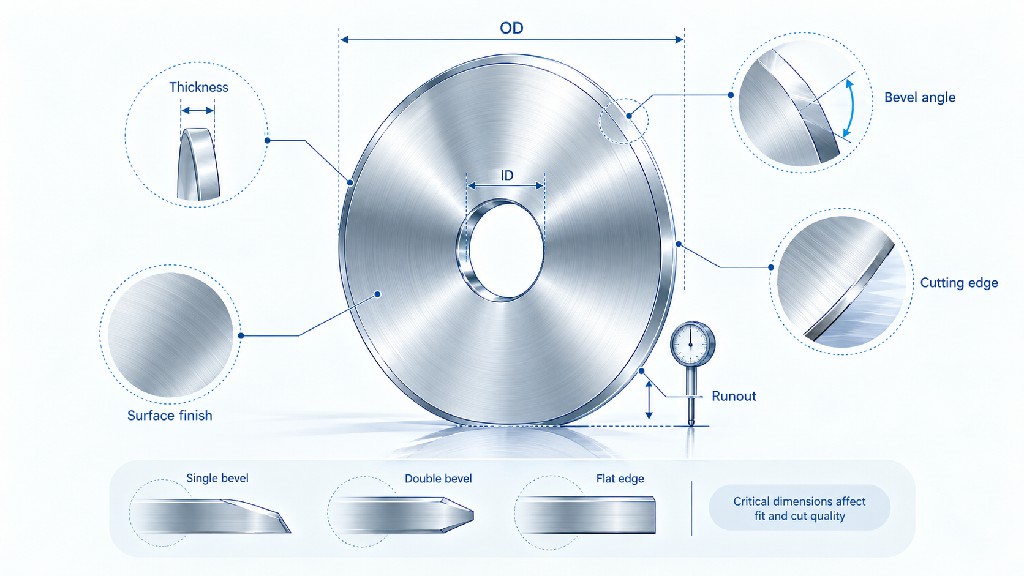
The word circular tells you nothing about what happens at the working edge. Yet the edge section is one of the most important determinants of how the knife enters the substrate, how it touches a mating part, and what force it experiences. A professional inquiry should describe the cross-section, not only show a photograph of the front face.
Single-bevel profiles have an angled cutting face on one side. They can be selected to create a required relationship with an adjacent mating surface or slit edge. Double-bevel profiles distribute the edge shape across both sides and can be useful in other cutting arrangements. Neither is universally superior. The correct choice depends on the knife's role, holder geometry, cut orientation, substrate and desired edge condition.
Dished or concave upper knives incorporate a designed face shape that can help establish contact at the intended cutting edge while limiting unnecessary face rubbing. A dished profile is not merely a cosmetic feature or an indication of manufacturing distortion. Conversely, an accidentally warped flat blade must never be treated as a correctly specified dished design. The drawing should distinguish intentional geometry from flatness error.
Flat or ring-shaped lower knives may provide a supporting cutting face or shoulder. Grooved bottom knives contain multiple precisely positioned working features, so groove pitch and groove geometry become as important as the total outside diameter. The term rotary slitter knife may be applied to all these forms in online catalogs, but the geometry is not interchangeable.
Even edge handedness deserves explicit attention. A knife with a bevel intended to face the left side of a slit may not have the same function when flipped. In a multiple-lane slitter, opposite-hand upper blades can be present in one machine, depending on holder layout and finished-roll requirements. Record the working face, rotation direction and orientation relative to the web. Do not assume that a supplier's photographed side is the installed working side.
A common purchasing shortcut is to order by outer diameter, inner diameter and nominal thickness alone. Those are necessary measurements, but insufficient for complex profiles. Add a simple section view showing the bevel or relief, the side that contacts the mating knife, and any required radius, chamfer or groove. If the original geometry is not known, ask the OEM or a qualified tool manufacturer to review the assembly before substituting a different edge design.
Industrial slitter knives are precision machine components. Their cutting performance depends not only on the steel edge but also on how accurately they locate on the machine. Two knives that both measure 150 mm outside diameter might have incompatible bores, flange faces, hubs, locating steps or thickness tolerances. A minor-looking difference may cause runout, clamping distortion or interference with adjacent tooling.
The following specification fields are more informative than the product name alone:
| Specification field | Why it matters for replacement fit | Common information to supply |
|---|---|---|
| Outside diameter (OD) | Changes radial reach and permissible engagement | Nominal OD and permitted range after regrinding |
| Bore / inside diameter (ID) | Determines centering on shaft or holder | Bore diameter, tolerance, fit and any bushing details |
| Overall thickness | Affects clamping stack and tool envelope | Nominal dimension, thickness tolerance and reference faces |
| Edge-section profile | Determines the real cutting contact | Scaled cross-section, bevel side and angle |
| Flatness and parallelism | Affect face stability, stack alignment and contact | Drawing tolerance and inspection reference faces |
| Radial and axial runout | Influence dynamic edge position | Permitted total indicated runout in assembled condition |
| Hub, holes and keyway | Determine mechanical retention and indexing | Full bolt circle, hole diameter, key size and orientation |
| Knife handedness | Controls how cutting faces meet | Left/right orientation shown from a defined view |
| Mating component | Establishes the shear pair or scoring contact | Lower knife/anvil model, size and working condition |
| Operating speed and load | Influence dynamic behavior and required design | Machine speed, holder pressure and duty information |
A drawing should also state which surfaces are datum references. Without datums, even apparently precise tolerance values can be misunderstood. For example, a stated “runout” could mean radial deviation measured at the OD, axial face wobble, or movement of the assembled tool on its machine arbor. These measurements describe different behaviors. A supplier cannot responsibly guarantee assembled performance without understanding the condition of the shaft, clamp and mating components.
GUANG CHUAN's published specification for its industrial top-and-bottom slitter knives lists an outside-diameter offering of 50–500 mm and product-page figures of 0.003 mm flatness/parallelism and 0.005 mm runout. These are manufacturer-published product specifications, not industry-wide acceptance limits or guaranteed values for every custom part. A particular order must confirm the applicable measurement definition, attainable tolerances, inspection method and quotation requirements.
This distinction matters because an attractive catalog number is not the same as a complete quality agreement. The correct tolerance is one that supports the application and can be verified consistently. Excessively tight specifications can increase manufacturing cost without delivering a practical benefit if the machine itself has greater shaft or holder variation. Conversely, a low-cost replacement with inadequate control of critical faces may cost far more in rejects and downtime.
Not because of the name. Since the two terms frequently describe the same tool family, it is misleading to claim that a “rotary knife” is inherently faster, sharper or more durable than a “circular blade.” Throughput depends on the complete process: feed speed, blade diameter, rotational speed, contact geometry, machine stability, material properties and target slit quality.
Rotational speed and linear edge speed are related by a straightforward geometric equation. If a circular knife has an outside diameter D in meters and rotates at N revolutions per minute, its nominal circumferential speed v is:
v = π × D × N ÷ 60 (meters per second).
This equation converts rotational motion into nominal surface speed. It does not determine the correct web speed, the required overspeed ratio, the permitted cutting speed or a safe operating setting. Those depend on the particular machine and cutting process. The following numbers are calculated illustrations, not recommended conditions.
| Example knife OD | Example rotational speed | Calculated circumference per revolution | Calculated nominal edge speed |
|---|---|---|---|
| 100 mm | 600 rpm | 0.314 m | 3.14 m/s |
| 150 mm | 600 rpm | 0.471 m | 4.71 m/s |
| 200 mm | 900 rpm | 0.628 m | 9.42 m/s |
| 250 mm | 1,200 rpm | 0.785 m | 15.71 m/s |
A buyer who compares product descriptions only by rpm may miss the significance of diameter. A 200 mm tool at 900 rpm has a higher nominal peripheral speed than a 100 mm tool at 600 rpm. But two cutters with equal nominal peripheral speed may still behave differently because they contact the web at different positions and are supported by different holders.
The situation becomes more subtle in tangent shear slitting, where the blade/anvil speed relationship to the moving web can affect cutting behavior. The Tidland/Maxcess technical article on overspeed presents a field example in which reducing a previously used overspeed setting helped eliminate an edge-fiber defect. This is evidence that process settings can change edge quality—not evidence of a universal “best” overspeed for every material.
For replacement purchasing, ask whether the proposed circular slitter blade is rated and designed for the actual machine arrangement and operating duty. The useful comparison is tool-and-holder performance at the specified line condition, not an advertising claim that one name denotes a faster cutting product.
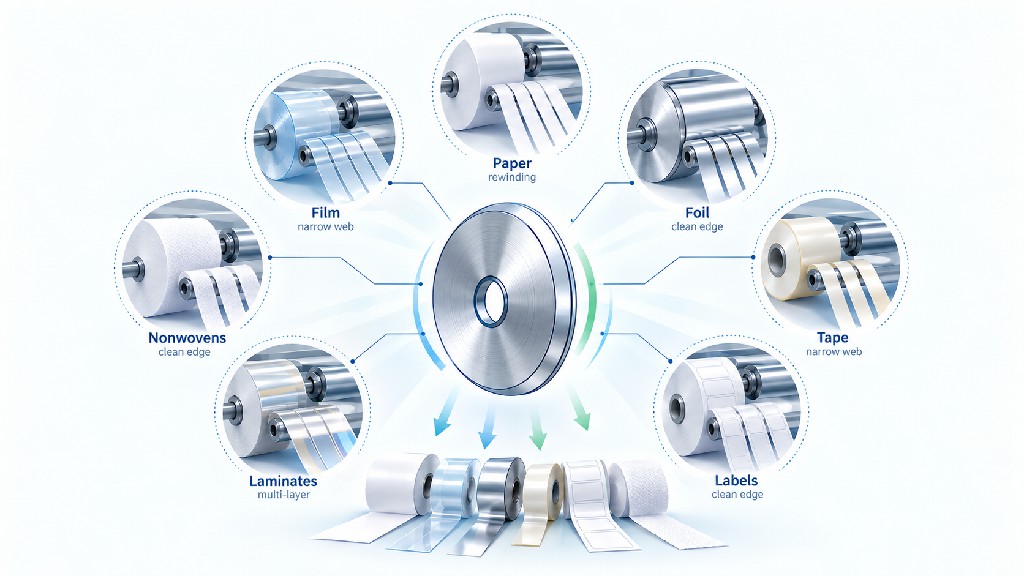
The phrase rotary slitter knives appears across paper converting, flexible packaging, label production, foil processing and other industries. The common language can disguise significant differences in machine architecture. Application context should therefore be included in every inquiry, even when a dimensional drawing is already available.
Paper lines often employ paired shear cutting because consistent slit width, low dust and clean edges are valuable in downstream printing, laminating or rewinding. Buyers may refer to an upper cutter as either a circular slitter blade or a rotary slitter knife. The lower knife may be a precision-ground ring or a lower cutter with a corresponding edge.
A paper converter reporting increasing edge fuzz should not assume that the “blade” must be replaced with a product advertised as a “knife.” Investigate edge condition, web tension, engagement and lower ring condition. If the machine has a pneumatic upper holder, obtain the holder model and the specified knife section before requesting a replacement.
For this category, GUANG CHUAN provides a dedicated paper converting top-and-bottom knife product. Paper thickness can be documented using appropriate methods such as those described in ISO 534:2011, which covers thickness measurements for paper and board within its defined scope; it does not define slitter-knife interchangeability or universal cutting settings.
Film converting presents a different set of concerns. A flexible web can stretch, wrinkle, heat at the cutting contact or develop irregular edges when tension and knife geometry are unsuitable. The term circular slitting knives can describe the paired shear tools, while other lines may instead use razor slitting for compatible films. The replacement part must match the machine's selected cutting method.
When requesting a quotation, provide the film type, layer construction, nominal thickness and whether the material is coated, laminated or printed. A thickness value by itself may not fully describe cutting behavior. The active ASTM D6988-26 guide concerns methods for determining thickness of plastic film test specimens; it is a measurement reference, not a certification that any slitting knife will work on the measured film.
Adhesive products introduce possible buildup on the tool and changes in contact behavior. Their release liner, backing film or paper and adhesive chemistry can create different cutting demands. A knife that works adequately on an uncoated substrate may behave differently on a finished pressure-sensitive construction. Catalog labels such as “rotary cutting knife” offer little help unless the supplier knows the actual laminated structure.
Useful inquiry details include the face that contacts adhesive, the cleaning procedure, the intended rewind width and the acceptable edge appearance. For a shear-slitting holder, check the mating lower ring and orientation of the upper knife. If a production line uses score slitting, specify its anvil surface and process arrangement instead of ordering a generic upper shear knife.
Thin metal foils can be sensitive to burrs, edge deformation and handling damage. Although they may be slit with round rotary tooling, compatibility depends on the actual cutting design, foil thickness and the expected finish. Industrial catalogs may place foil tools beside paper knives because both are circular, but a buyer should not infer that the tooling is the same.
Confirm whether the machine has paired upper and lower knives, the arrangement of the cutting edges, the limits on burr height, and the need to protect the web from scratches or marking. A replacement tool may need a different edge section or mating ring from one used for paper. The relevant distinction is not blade versus knife; it is the complete foil-slitting system.
Some machines divide a wide web into many lanes using groups of upper and lower components. A grooved bottom tool may establish multiple repeated cutting positions in one component. This is particularly important when closely spaced tracks are required. The buyer may search for “circular slitter blades” but actually need a specialized multi-groove rotary lower knife.
Specify the number of working grooves, groove center spacing, groove profile, overall width and exact relationship to the upper knives. Also record which grooves show damage; premature wear in one location may indicate alignment or contact problems rather than uniform material deterioration. GUANG CHUAN's multi-groove bottom slitter knife shows a relevant product family, but interchangeability must be verified from a drawing.
Credible technical documentation is useful, but standards are sometimes invoked incorrectly in blade marketing. A specification can refer to several different kinds of evidence: material test methods, machine guarding requirements, inspection practices, or a manufacturer's own drawing tolerances. Those are not interchangeable, and there is no single number that makes all circular slitter blades compatible with all rotary slitters.
For example, ISO 534 is relevant when communicating paper or board thickness within its intended scope. ASTM D6988-26 provides guidance on plastic-film test-specimen thickness. The United States' OSHA 29 CFR 1910.212 addresses machine guarding hazards, including points of operation, ingoing nip points and rotating parts. It does not certify a cutter as suitable for a given holder. DIENES and Maxcess publications offer engineering guidance, but their illustrative settings are not automatically specifications for another OEM's slitting machine.
| Reference or measurement | What it supports | What it does not prove |
|---|---|---|
| OEM knife drawing | Mechanical geometry, fits and specified tolerances | Actual machine is free of wear or misalignment |
| Incoming inspection report | Measured dimensions of the supplied component | Finished slit will be acceptable under all conditions |
| ISO 534:2011 | Paper/board thickness measurement within standard scope | Universal knife selection or blade performance |
| ASTM D6988-26 | Plastic film test-specimen thickness methods | Universal rotary-knife compatibility |
| DIENES slitting guide | Understanding cutting geometry and typical relationships | One-size-fits-all process settings |
| OSHA 29 CFR 1910.212 | U.S. general machine-guarding obligations where applicable | Knife-specific certification or global regulatory compliance |
Where a customer requires a hardness value, grade identification, surface finish, concentricity or a dimensional inspection report, those requirements belong in the purchasing drawing or quality agreement. A material certificate alone cannot substitute for a blade profile drawing. Similarly, a precise part may still fail operationally if installed incorrectly or used against a damaged mating surface.
Avoid writing “international standard tolerance” beside an arbitrary catalog number unless the specific standard and relevant clause genuinely define it. A clearer statement is: “Manufacture and inspect to the agreed drawing; provide the specified inspection report.” This wording is more defensible for buyers and manufacturers alike.
A request for quotation should remove ambiguity before price discussions begin. If your current supplier calls the part a rotary slitter knife and the new supplier calls it a circular slitter blade, that difference is usually manageable. Missing technical information is far more expensive.
A complete RFQ should contain the equipment make and model, the original part number if available, whether the knife is upper or lower, the working mechanism, the drawing with datums and tolerances, the actual substrate, and the required operating duty. State whether you need a single replacement, matched set, spacer rings, or a quantity for scheduled maintenance.
Illustrative RFQ format (all values below are hypothetical, not GUANG CHUAN stock specifications):
| Field | Example description to put in an inquiry |
|---|---|
| Equipment | Slitter rewinder, OEM and model to be supplied |
| Process | Rotary shear slitting, upper knife engaging bottom anvil ring |
| Requested component | Replacement upper circular slitter knife; 12 pieces |
| Nominal geometry | OD 120 mm; bore 60 mm; thickness 2.5 mm |
| Edge form | Single-bevel/dished design as shown in attached section drawing |
| Mounting | Pneumatic holder, manufacturer and part number supplied |
| Substrate | Coated paper web, thickness and basis weight documented |
| Mating knife | Lower-ring drawing and installed condition provided |
| Speed / operation | Typical and maximum line conditions to be confirmed |
| Acceptance | Inspection of dimensions, edge profile and designated critical features |
| Commercial details | Delivery destination, quantity, documentation and packaging needs |
The figures in this example illustrate how to communicate dimensions; they are not a recommended knife geometry or a claim that these dimensions fit any specific machine. The actual print must define the right bore tolerance, cutting-face orientation and edge-section details. If the sample is worn, clearly identify which measurements came from the used part and which came from the original design.
Photographs can support an RFQ, but they rarely replace the drawing. A useful photo set shows both faces, the edge cross-section, the mounting arrangement, the mating knife and the installed tool inside the machine. Include a scale or measuring instrument in close-ups where appropriate, while keeping personnel out of hazardous areas and following the machine's isolation procedures.
To help evaluate the supplier's answer, ask whether its quotation is based on the exact drawing, an alternative geometry requiring approval, or a proposed engineering review. Those are different commercial offers. Do not accept “same diameter” as the entire compatibility argument.
Tool purchasing teams sometimes compare only unit prices. However, the cost of a slitting tool includes the amount spent on replacements and the cost of interrupting production. The following example demonstrates a hypothetical cost calculation, not a field trial or a claim about GUANG CHUAN's products.
Assume that a converting facility operates one line for a month and evaluates two correctly specified replacement choices for the same machine. Option A has a lower purchase price but is replaced more frequently. Option B costs more per piece but has fewer planned changes. To keep the example easy to audit, suppose every maintenance event changes one knife and the stated downtime cost is an internal accounting assumption.
| Assumption / calculated outcome | Option A | Option B |
|---|---|---|
| Purchase price per knife | $80 | $115 |
| Replacement events per month | 6 | 4 |
| Stoppage per replacement | 25 minutes | 20 minutes |
| Assumed cost of stopped production | $240 per hour | $240 per hour |
| Monthly knife expenditure | $480 | $460 |
| Monthly replacement downtime | 150 minutes | 80 minutes |
| Estimated downtime cost | $600 | $320 |
| Illustrative monthly total | $1,080 | $780 |
Using only these assumptions, Option B costs $300 less per month even though its price per knife is $35 higher. The arithmetic is straightforward: monthly tooling expense equals knife price multiplied by replacement count; downtime expense equals stopped hours multiplied by the assumed cost per hour. In a real factory, these inputs must come from observed operations, and the analysis should include scrap, extra labor, storage, regrinding, machine availability and procurement overhead where material.
The example does not prove that more expensive tooling is always better. A poorly matched high-priced knife could create more downtime than a lower-cost knife that actually fits the assembly. The first commercial priority remains choosing the correct cutting method and geometry. Only after compatibility is established does comparing service intervals and total operating cost become meaningful.
This distinction also affects supplier qualification. Rather than request “your best rotary slitter knife,” ask for documentation of the proposed construction and a trial plan using your own acceptance criteria. Record baseline edge defects, replacement frequency and changeover time. When practical, test candidates under comparable production conditions so that the decision rests on measured results, not a label or an unverified marketing promise.
Several avoidable mistakes recur when a maintenance department changes suppliers or translates an OEM spare-parts description into a purchasing request. They are not limited to any brand; they arise because a short catalog term hides the functional details of the tool.
Mistake 1: treating “knife” as premium and “blade” as basic. Neither word reliably identifies quality, material grade or expected service life. Compare manufacturing drawings, supplied documentation, inspection criteria and field results instead of assuming one label implies superior performance.
Mistake 2: ordering a matching OD without checking the edge section. The tool may physically enter the holder but present the wrong contact face to the lower knife. Confirm bevel orientation, dish/relief, bore fit, thickness and the exact mating component before approving an alternative.
Mistake 3: calling a lower anvil ring an upper cutting knife. Both may be round rotary components, but they often have different profiles and functions. Specify the installed location and send a photograph or assembly view that shows the relationship between the parts.
Mistake 4: substituting a score knife for a shear knife. Both may be described as rotary slitter knives. Their operating principles are different, so the machine needs the corresponding holder and anvil arrangement. Check the process before comparing prices.
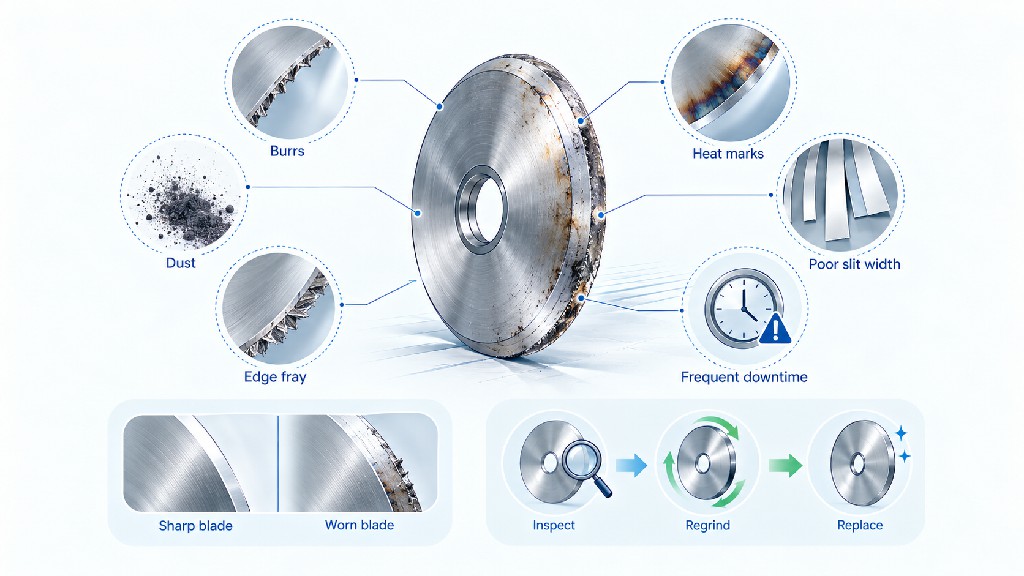
Mistake 5: blaming every bad edge on a dull knife. Worn edges matter, but unstable material tension, poor knife engagement, damaged lower tooling, inaccurate mounting and unsuitable process conditions can also create defects. Investigate the assembly before repeatedly purchasing replacement upper knives.
Mistake 6: treating published precision figures as universal standards. Supplier figures can demonstrate manufacturing capabilities for the described product range. They do not override the actual machine drawing. Confirm the exact ordered specification, inspection method and tolerance definitions.
Mistake 7: evaluating total cost using unit price alone. Replacement frequency, downtime, handling and scrap may outweigh a small difference in initial purchase price. Use production records to test whether a proposed alternative improves the outcome on the specific machine.
Finally, follow the machine manufacturer's lockout, guarding, installation and restart procedures. Rotating slitter tooling introduces sharp-edge, nip-point and stored-energy hazards. The applicable safety rules depend on jurisdiction and machine design; OSHA's machine-guarding regulation is one useful U.S. reference, not a replacement for local requirements or OEM instructions. Never attempt to confirm blade contact by reaching into a moving cutting assembly.
Often, yes. The terms are commonly used for rotating circular tools that slit paper, film, foil or related materials. But they are not sufficient descriptions of an interchangeable part. A shear-slitting top knife, a bottom anvil ring and a score-cut knife may all appear under related catalog terms. Confirm the cutting method, mounting dimensions, edge profile and working position before ordering.
There is no universal industry rule that makes a slitter blade functionally different from a slitter knife. “Blade” and “knife” frequently overlap in marketing and technical communication. The differences that matter are usually upper versus lower, shear versus score, edge geometry, and machine compatibility. A supplier's part drawing is more authoritative for replacement fit than the product name.
Not necessarily, although many conventional shear-slitting knives have a continuous sharpened circumference rather than saw-like teeth. Specialized rotating tools may incorporate grooves, reliefs or other edge features. A toothed circular saw blade should not be assumed to be a suitable rotary slitter replacement. Specify the cutting process and the exact edge section.
It may be possible if the bottom knife is compatible and remains in acceptable condition. First inspect the lower cutting surface, alignment and mounting, because damage to the mating component can shorten the life of a new top knife or continue causing poor slit quality. Whether to replace one part or a matched set depends on inspection findings, the OEM procedure and the process requirement.
No. Both can use rotating circular tools, but the mechanisms differ. Rotary shear uses a mating upper and lower cutting relationship, while score/crush cutting uses a knife pressing material against an anvil surface. The appropriate holder, knife profile and cutting setup differ. Changing from one process to another generally requires evaluation of the machine system, not merely selecting a different disk.
At minimum, record the outside diameter, bore, thickness and edge-section design, then add mounting-hole or keyway dimensions, required flatness and runout definitions, bevel orientation and the mating knife details where applicable. Also identify the holder model, original part number, substrate and operating conditions. A worn sample may not preserve the original OD or edge geometry, so an OEM drawing is preferable when available.
Use the OEM part designation if available and supplement it with descriptive wording. For example, “upper rotary shear-slitter knife (circular blade), drawing ABC-123, for holder XYZ” is far more precise than either generic term by itself. Include the drawing revision, quantity, acceptance requirements and any approved alternate materials or processing treatments.
Some machine-knife designs can serve multiple substrates, but suitability should never be assumed. Paper, polymer films and foils have different fracture, deformation, surface and contamination concerns. The machine geometry and quality criteria matter as much as the substrate name. Confirm the intended material and application with the tooling supplier and, where necessary, run controlled trials.
No. Hardness alone cannot establish service life. A usable tool must also have appropriate toughness, edge integrity, profile stability and fit for the cutting forces. Even a well-made hard knife can fail early in an unstable or misaligned assembly. For a comprehensive discussion of blade-grade options, consult GUANG CHUAN's circular slitter knife selection guide rather than treating hardness as the deciding factor in this terminology comparison.
A responsible review starts with the drawing and machine information. The manufacturer compares the proposed part's mounting interface, edge section and required tolerances with the OEM component and the mating cutting assembly. Depending on application criticality, dimensional inspection, sample approval and a controlled production trial may be appropriate. An identical photograph or a shared catalog keyword is not enough to establish compatibility.
For industrial buyers, the debate over circular slitter blades vs rotary slitter knives has a straightforward answer. The expressions frequently overlap, and neither phrase guarantees a distinct material, speed, design or performance level. The true purchasing distinctions are the cutting method, upper/lower function, edge geometry, mounting dimensions, mating component and operating requirement.
That conclusion is useful commercially. It prevents teams from ordering visually similar but incompatible tools, makes supplier quotations easier to compare, and shifts evaluation toward measurable outcomes: correct fit, acceptable slit quality, predictable maintenance and documented production performance. Whether your purchasing department calls the component a circular slitting knife, a rotary slitter blade or a top shear knife, the drawing and application must tell the same technical story.
GUANG CHUAN manufactures precision industrial machine knives and supports made-to-drawing replacement tooling. To discuss a specific project, review the Circular Slitting & Rewinding Blades product category, explore the industrial top and bottom slitter knife range, or learn more about the company's manufacturing and customization capabilities.
Request a compatibility review or quotation: Send your machine model, knife drawing or sample measurements, upper/lower working position, mating knife information, substrate and expected operating conditions. GUANG CHUAN can use those details to discuss an appropriate circular slitter blade or rotary slitter knife configuration and the relevant quotation and inspection requirements. For direct contact details, see the GUANG CHUAN product inquiry page.

Leave A Message
Scan to WhatsApp :

 English