




A vertical form-fill-seal line can have the correct film, a reliable dosing system and well-adjusted sealing jaws yet still produce bags joined by thin tails of plastic. At the other extreme, an aggressive replacement knife may separate every bag while leaving a rough edge, weakening an easy-open feature or cutting too close to the seal. Both problems cost money. The cutting blade is a small component, but choosing it correctly is a matter of film behavior, knife geometry, machine fit and repeatable production quality, not just price or nominal steel hardness.
This practical buying guide explains how to specify VFFS cutting blades for snack pouches, powdered-food sachets, granular products, pet-food bags and other flexible packaging. It compares fine and coarse teeth, scalloped and straight profiles, commonly offered steels, heat-treatment decisions, mounting requirements, supplier documentation and cost per acceptable bag. It is written for packaging engineers, maintenance teams, OEM buyers and procurement managers comparing VFFS knives, vertical packaging machine blades, VFFS serrated blades, bagging machine knives and vertical form fill seal blades.
Quick answer: Begin with the exact cutting mechanism and the current bag defect. Match the tooth profile to the actual film and required finished edge. Preserve all critical dimensions and the relationship to the opposing surface. Select blade steel and heat treatment only after those facts are clear. Finally, qualify a replacement by measuring acceptable-pack yield, service life and maintenance effort on the production line.
Scope and evidence: This article distinguishes established machine principles, published manufacturer product information and explicitly illustrative calculations. Application recommendations are engineering starting points, not universal settings or independent test results. Final dimensions, materials and acceptable defects must be confirmed against the machine manufacturer's instructions, approved drawings and real packaging samples.
In This Guide
A typical vertical form-fill-seal machine unwinds flat packaging film, shapes it around a forming tube, makes a longitudinal seal, dispenses product and forms transverse seals to close consecutive bags. A cutoff mechanism separates the completed package from the film tube. In many common heat-sealing arrangements, the knife moves between the cross-sealing jaws; other systems have a different sequence or use separate clamping and cutting components. Bosch Packaging Technology's Guide to Vertical Form-Fill-Seal Baggers explains the typical arrangement and shows why cutting and sealing must be considered together.
The cutting knife is not the component that creates a hermetic seal. Heat, pressure, dwell time, clean material and jaw condition establish the seal; the blade separates material at the specified position. A poorly positioned or oversized knife can nevertheless damage an otherwise sound seal. Conversely, replacing a knife will not repair low heat-seal strength caused by inadequate jaw temperature or product contamination in the seal area.
At 100 acceptable bags per minute, a line theoretically produces 6,000 bags per hour or 48,000 bags in an eight-hour run with no interruptions. That arithmetic is an illustrative production-rate example, not a benchmark for every VFFS machine. If inadequate cutting stops the line for fifteen minutes, 1,500 bag opportunities disappear at that same nominal rate. Real losses also include restart scrap, inspection, rework and operator time. This is why a slightly more expensive knife can be an economically better purchase if it reduces unplanned blade changes and defective packages.
The essential performance measures are complete separation, consistent cut position, satisfactory edge appearance, no damage to the approved seal, no problematic film pickup, and predictable time until the next replacement. These are measurable outcomes. Words such as “premium,” “high speed” and “ultra-sharp” are not substitutes for such evidence.
“Packaging blade” is a broad commercial label. A VFFS cross-cut knife is not necessarily interchangeable with a rotary flow-wrapper knife, a long slitter or a perimeter die. In a reciprocating VFFS system, a straight-bodied knife may carry a serrated edge and move linearly across the web. In another machine, the knife is fixed while a moving counter-element creates the cut. Some assemblies incorporate a tear-notch feature; others use an independent punch. Before discussing steel grades, obtain the machine model, OEM part number, installed knife photograph and drawing.
Distinguish the shape of the knife body from the shape of the cutting edge. A product sold as a “straight tooth blade” may have a physically straight mounting body and a row of teeth along its working edge. That is not equivalent to a smooth, unserrated knife. Similarly, a T-shaped knife refers primarily to its mounting form; the cutting profile may still require a separate specification.
GUANG CHUAN's published packaging machine toothed blades category illustrates a range of blade forms. Its T-type HSS vertical packaging serrated blade is particularly relevant when a customer needs to replicate a T-form mounting configuration. Neither a catalog photograph nor a generic description proves fit in a specific VFFS model.
Ask the maintenance technician where the blade moves, what opposes its edge, whether the film is stationary during cutting, and whether any shim, spacer or holder sets the engagement depth. Observe a safely guarded operating cycle or review the OEM mechanical drawing. If the line cuts during continuous web motion, timing and support requirements may differ materially from an intermittent machine. Those details are more useful to a custom knife manufacturer than a machine brand alone.
This distinction prevents one of the most common specification errors. Blade tooth pitch describes the spacing between corresponding cutting teeth. Sealing-jaw serration pitch describes the spacing of the ridges or grooves that press on the film while making a transverse seal. They belong to different components and solve different problems. A supplier should never use a published jaw-serration setting as the default pitch for a cutting knife.
Bosch's VFFS technical guide discusses the horizontal and vertical serrations of sealing jaws separately from the cutoff blade. It also describes fine, coarse and non-serrated blade edges according to the packaging material and the finished-edge requirement. For example, a relatively coarse blade edge can leave notches that encourage opening on a suitable heavy paper-based bag; thin material that tears easily generally warrants a finer profile. This guidance is useful, but it does not impose a universal pitch in millimeters for every knife.
In a common blade arrangement, the tooth tips contact the film first and initiate local penetration. Material failure then progresses between teeth as the knife advances. This staged engagement can help when thin film otherwise bends or stretches away from a smooth edge. Actual cutting force depends on blade sharpness, film construction, stiffness, support, stroke, timing and counter-surface; it would be misleading to promise that serration always reduces force.
The engineering question is not “Which teeth are the sharpest?” It is “Which profile produces a complete and repeatable cut without unacceptable edge damage under this machine's conditions?” The answer changes when the packaging material changes, even if bag width and cycle rate do not. Record the correct component in the RFQ: cross-cut knife tooth geometry, seal-jaw rib geometry or both, as applicable.
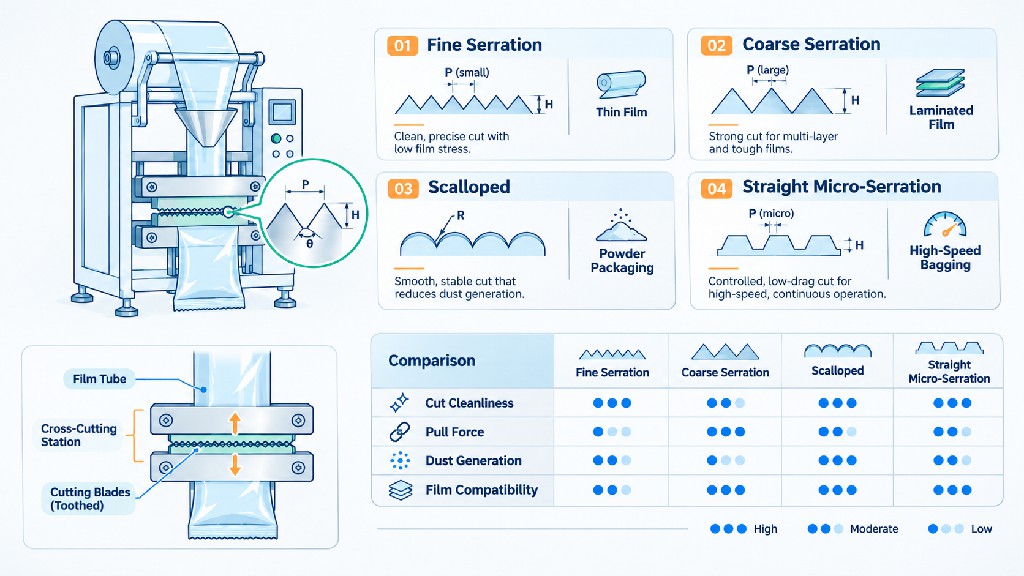
The main candidates are a continuous straight cutting edge, fine serration, coarse serration, rounded or scalloped teeth, zigzag or V-tooth patterns, and specialized perforation or tear-notch geometries. These are functional descriptions rather than fixed international blade standards. Two suppliers can both say “fine serration” while supplying different tooth pitch, tooth depth, tip radius, bevel angle and edge finish. A sample or dimensioned drawing is therefore the most reliable specification.
| Profile | Most useful starting application | Main advantage to investigate | Main risk or question |
|---|---|---|---|
| Smooth, continuous edge | Well-supported film needing a neat, straight finish | Clean visible edge when shear and support are correct | Can push or stretch inadequately supported film |
| Fine serration | Thin films or laminates susceptible to uncontrolled tearing | Distributed initiation points and relatively small edge notches | Small teeth can foul or wear; complete separation still requires testing |
| Coarse serration | Selected heavier papers or tougher laminates needing easy-tear initiation | More pronounced notches and robust tooth spacing | Deep edge notches may cause premature tearing or unacceptable appearance |
| Scalloped or rounded teeth | Materials where aggressive sharp points create objectionable tears | A different initiation/tear behavior worth trialing | May be less decisive on some elastic webs |
| V-tooth or zigzag edge | Specified zigzag bag edge or opening behavior | Deliberate visual and functional edge profile | Must preserve cut location and sufficient sealed margin |
| Perforating or intermittent tooth pattern | Connected bags or tear-off features designed into the pack | Deliberately leaves controlled film bridges | Incorrect bridge size causes poor tearing or accidental separation |
A fine serration should not be defined solely by a marketing adjective. State pitch in millimeters, tooth height or depth, tip form, flank angles and tolerance. The customer's original profile may be the safest starting point, especially when the packaging specification is validated. A coarse serration is not inherently better for a stronger laminate: it is useful only when its more pronounced notch geometry is compatible with the pack's seal and opening behavior.
Scalloped and rounded tooth descriptions can vary among vendors. The practical lesson is to send a close-up photograph, a profile trace or a sample along with the drawing. If the new supplier proposes a change, request a sample and compare it against the current knife using the same web lot and machine conditions. A full-cut knife must separate the bag completely; a perforating knife deliberately does not. Confusing the two can create a serious commissioning problem.
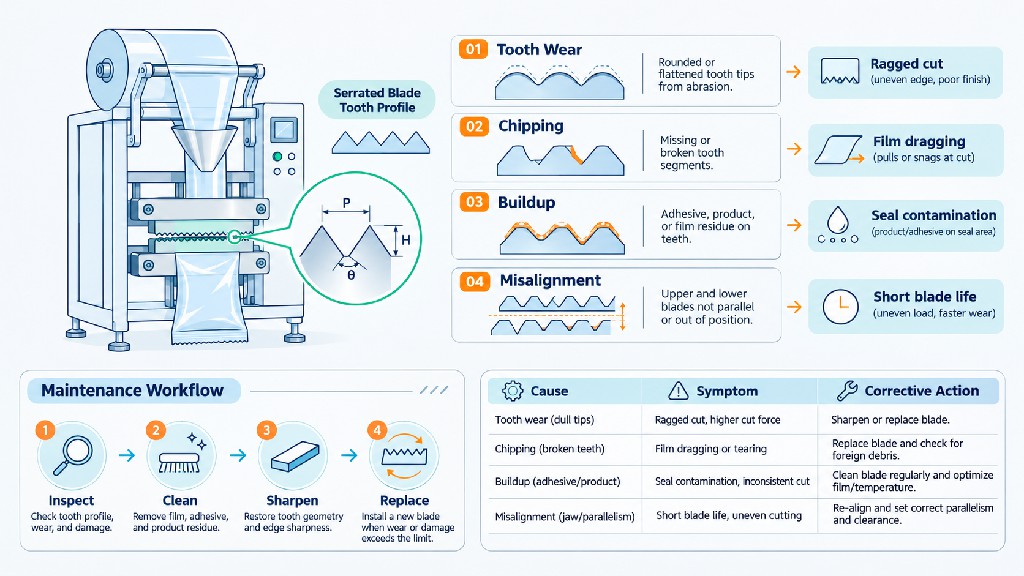
Tooth pitch is the center-to-center distance between equivalent points on adjacent teeth, usually written as P. Tooth depth or height is the distance from the crest to the root of the profile. Tip radius controls how concentrated the initial contact is. Flank angles influence the shape of the notch and the load carried by each tooth. The main edge bevel affects wedge action and clearance. On an asymmetrical knife, identify which face is flat and which is beveled, because reversing the edge can change how the film is displaced during cutting.
As a simple drawing example, a 150 mm cutting span with a nominal 2.0 mm pitch contains approximately 75 pitch intervals across that span. This is a geometry calculation, not a recommendation to manufacture exactly 75 complete teeth: terminal tooth positions, edge margins and how the span is measured must still be drawn explicitly. The calculation makes clear why changing pitch can materially alter the number of initiation points even if the knife length is unchanged.
GUANG CHUAN's published industrial stainless steel serrated packaging blade lists custom pitch in the 1–3 mm range and particular precision claims for that product range. Those figures are supplier-listed options, not an industry-wide default, and a quotation should state which tolerance can actually be achieved and inspected for the ordered part. A buyer should never copy a 1–3 mm value into a drawing without matching it to the existing profile or validated film trials.
Ask the supplier for a magnified tooth drawing or a first-article inspection measurement before ordering a large batch. Include the cutting edge orientation and required surface finish. A smooth mirror-like face can reduce certain forms of adhesion, but film pickup also depends on temperature, adhesive exposure, static, web tension and contamination. A coating should be considered only after those causes have been evaluated.
Packaging material is not a single category. PE films may be flexible and extensible; oriented PP and PET can respond differently to a local notch; metallized or foil-containing laminates introduce stiff and ductile layers; kraft or coated paper may create fibers, dust and a different fracture path. Some films have adhesive or coated layers that become problematic near heated jaws. The same blade can work well on one material and poorly on another despite identical nominal thickness.
For a thin mono-material film, first determine whether incomplete cutting comes from an edge that has rounded, insufficient support or material moving out of the knife path. A finer serration may help initiate the cut while controlling the visible notch, but it should be tested for unplanned tearing during filling, handling and consumer opening. A smooth edge can also work very well when an effective shear support exists.
For a PET/PE laminate, check both the stiffer outer layer and the more extensible sealant layer. A knife that fractures the PET but stretches the PE can leave hanging threads or tails. Sharpening may improve the result; changing the profile or engagement depth may be necessary if the film structure has changed. Record the laminate construction and thickness of each layer when available rather than relying on one total gauge.
For paper-based or foil laminates, inspect the edge for fiber pull-out, foil folding, delamination and flaking. Consider whether repeated abrasive contact justifies a more wear-resistant steel. For metallized films, do not assume the metallization is equivalent to a thick aluminum foil layer. Ask the film supplier for the construction and any relevant handling limitations.
For recyclable mono-material structures, material changes made for sustainability can alter stretch, seal behavior and cutting response. Revalidate the knife after a material change rather than carrying over the old acceptance criterion by habit. Cutting defects are application-specific; a supplier cannot guarantee universal compatibility simply because its catalog lists BOPP, PET, PE and laminates.
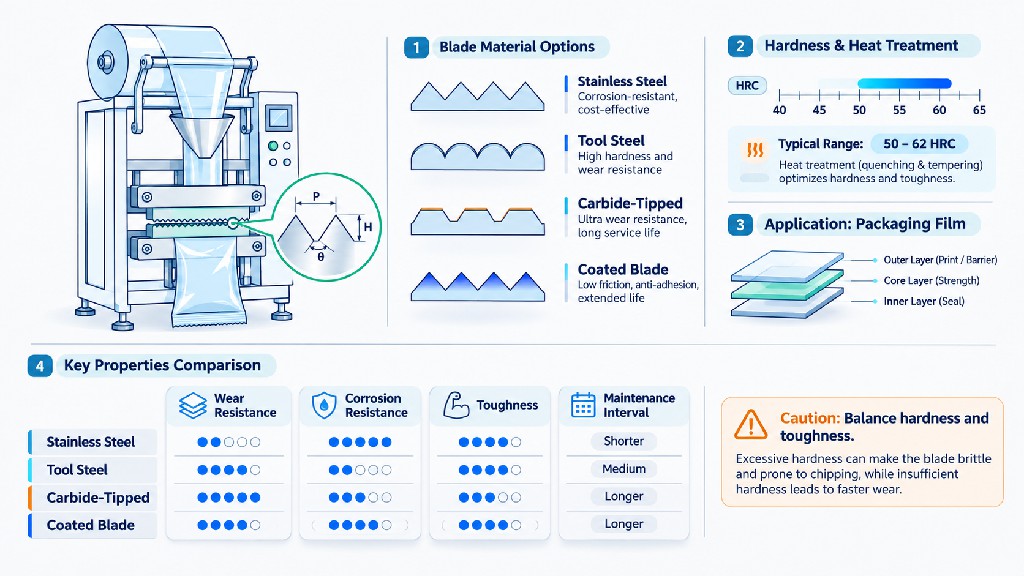
Material selection is about a balance among abrasive wear, edge chipping, corrosion, toughness, machinability, cost and the ability to hold the required tooth geometry after heat treatment. Common purchasing candidates include D2-type cold-work tool steel, M2 high-speed steel, hardenable martensitic stainless grades such as 420 and 440C, and special grades or carbide for applications that justify them. None is universally superior.
| Candidate material | Potential strength | Main concern | Practical buying question |
|---|---|---|---|
| D2 / similar SKD11-type cold-work steel | Good abrasive wear resistance in suitable cutting duties | Edge chipping under impact or poor alignment; limited corrosion resistance | Is wear actually the failure mechanism, and what heat treatment is proposed? |
| M2 high-speed steel (HSS) | Useful combination of hardness, hot-hardness and wear resistance after proper treatment | Higher cost and sensitivity to geometry and grinding quality | Does the application justify the material and its heat-treatment route? |
| 420-series martensitic stainless steel | Corrosion resistance with hardenable knife-grade variants | Exact carbon level and achievable hardness vary by specification | Which precise 420 designation and target hardness are being supplied? |
| 440C martensitic stainless steel | Corrosion resistance with higher hardening potential than many 420 variants | Can still chip or corrode in unsuitable conditions | Is washdown exposure high enough to justify this grade? |
| Tungsten carbide or special composite design | High wear resistance in carefully matched applications | Brittleness, mounting sensitivity and total cost | Is recurring abrasive wear proven, and can the holder protect the edge? |
For an authoritative description of D2-type steel, Uddeholm identifies its Sverker 21 as an AISI D2 reference grade that prioritizes high abrasive wear resistance, with a trade-off in resistance to chipping. That is useful material-selection context, not evidence that every D2 VFFS knife will outperform an HSS knife. Similarly, the manufacturer of BÖHLER S600 identifies it with the conventional M2/1.3343 family of high-speed steels. Exact supply condition and heat treatment matter.
“Stainless steel” must be specified carefully. AISI 420 is a family label often used loosely in catalog language, and 420J2 is not identical to every higher-carbon 420 variant. Chromium content alone does not guarantee an ideal knife. If corrosion is recurring, identify the cleaning chemicals, rinse practices, condensation and periods of wet storage; then evaluate a correctly specified grade and finish. If the cutting mechanism is dry and abrasive wear dominates, tool steel may offer a stronger business case.
A supplier's advertised hardness range is a starting point, not an acceptance criterion for every blade. For example, GUANG CHUAN's published serrated-blade product page lists a 55–62 HRC offering for its product range. It does not mean that every listed alloy can or should be heat-treated to every value in that interval. The appropriate target must be written by grade, geometry and duty, with the testing method agreed in advance.
Two knives from the same nominal steel grade may behave differently after different heat-treatment cycles. Hardening and tempering change hardness, internal stresses, retained austenite and the toughness of thin tooth tips. Poor temperature control or distortion can affect straightness and the relationship between mounting surfaces and edge. A process description such as “vacuum heat treated” is helpful, but it is not an inspection report.
For a replacement trial, request the steel grade or equivalent reference, target hardness range, permitted variation, relevant batch identification and grinding inspection. The supplier should be able to explain how burrs are removed from the tooth roots without rolling or blunting the cutting tips. If an unusual coating is offered, ask what failure mode it addresses and whether its thickness affects fit, edge radius or tooth dimensions.
Titanium nitride and diamond-like carbon can be considered for certain wear or friction problems. Non-stick coatings may help certain adhesive pickup conditions. However, a coating can introduce its own concerns: adhesion to the steel, cracking at thin tips, chemical compatibility, cleaning behavior or debris if damaged. Never buy a coated blade solely because the coating name sounds advanced. Compare an uncoated reference and a coated sample under equal film, speed, maintenance and washdown conditions.
Hardness measurements should follow an appropriate recognized method. ASTM E18 addresses Rockwell hardness testing of metallic materials and warns that a measurement at one location may not represent the whole part. Thin or narrow knives may require an appropriate testing strategy or a witness coupon, as agreed with the manufacturer and inspection provider. A single HRC number cannot by itself demonstrate sharpness, tooth strength, dimensional accuracy or safe machine compatibility.
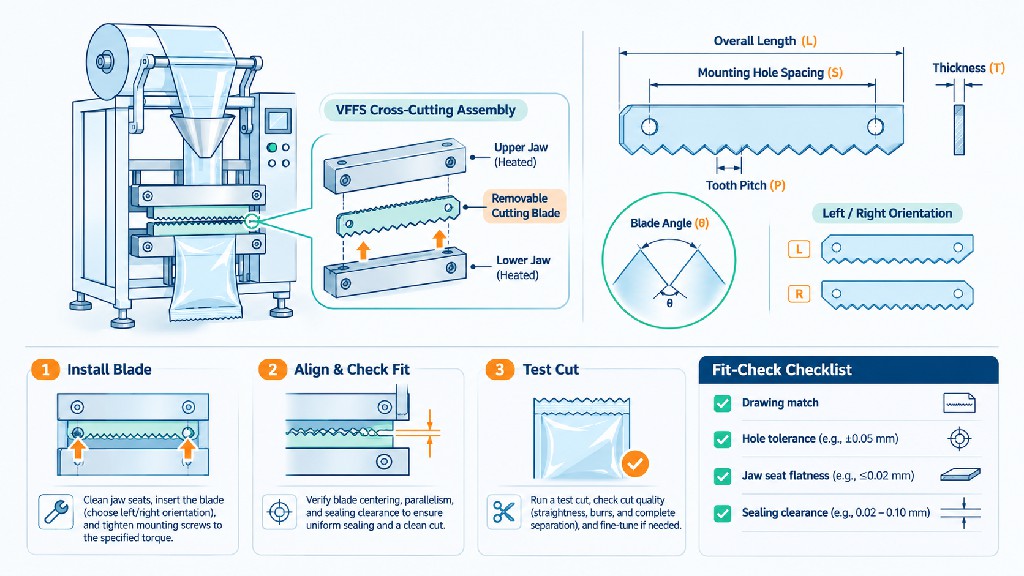
A custom VFFS knife can be machined from excellent steel and still be unusable because the holes are wrong or the edge sits a fraction of a millimeter in the wrong location relative to the holder. Buyers should specify overall length, body height, thickness, working-edge length, all hole and slot dimensions, hole-to-edge position, datum references, flatness or straightness where relevant, and the side carrying the bevel. Use the OEM drawing where available and mark any features that must not change.
A photograph is helpful for identification but poor for reliable measurement. Perspective distortion can make equally spaced holes appear unequal. A worn sample can hide original tooth geometry and dimensional accuracy. When reverse engineering is necessary, combine multiple measurements, undamaged reference features and a first-article comparison with the machine holder. Identify any missing teeth or bent features on the sample rather than reproducing their damage.
The mounting interface must carry the actual cutting load without vibration, rotation or loosening. Slotted holes can allow adjustment, but a replacement knife should not need excessive compensation to fit. Define blade protrusion, edge position, critical clearance and the mating anvil or slot geometry where relevant. Those are machine-specific values: do not apply a generic clearance setting from another VFFS model.
GUANG CHUAN's custom industrial blade services describe manufacturing from technical drawings and replication from physical samples. That is particularly relevant when the OEM part number is discontinued or the machine has been modified. Ask whether the supplier will provide a drawing revision, inspection report and approved sample before a full order. Control that revision number for repeat orders so the next batch is not made from an obsolete photograph.
Inspection should connect to failure risk. Critical features often include tooth pitch and height, edge-to-hole location, flatness, thickness, bevel orientation and burr condition. Not every dimension requires the same tolerance. A useful drawing identifies functional datums and distinguishes mandatory fit dimensions from ordinary noncritical dimensions. The aim is not to purchase the tightest possible number; it is to make a knife that repeatedly fits and cuts within an approved process window.
A supplier may advertise micron-level grinding capabilities. That is not the same as delivering every component to a universal micron-level tolerance. GUANG CHUAN, for example, publishes some specific tooth-pitch and flatness figures on certain product pages. Ask which values apply to your exact drawing, which gauges will be used and whether the requested inspection can be documented. A pitch result taken at three positions tells a different story from a result covering the whole working edge.
| Inspection item | Evidence to request | Acceptance principle |
|---|---|---|
| Material identity | Material declaration or relevant traceable certificate | Matches the ordered grade or approved substitute |
| Overall fit | Dimensioned first-article report against drawing datums | Meets all critical dimensions and mounting clearances |
| Tooth geometry | Profile images or measured pitch, depth and edge condition | Matches approved profile drawing or master sample |
| Heat treatment | Hardness results with stated method and measurement location | Meets a grade-specific target agreed before manufacture |
| Surface and edge | Magnified inspection for burrs, chipping and visible grinding defects | No defect likely to damage film or the machine |
| Production trial | Recorded good-pack yield, defects and knife life | Meets the line's written acceptance criteria |
Do not confuse dimensional precision with operational qualification. A knife can meet every drawing dimension yet fail because the film construction or machine timing changed. Conversely, a well-performing original knife is valuable evidence, even if the old supplier did not issue a modern digital drawing. The strongest qualification combines documented geometry with an observed production trial.
For purchase orders, agree on inspection frequency and response to nonconforming parts. A first article may receive comprehensive inspection, while subsequent production uses defined sampling and traceability. Ask how the supplier protects individual tooth edges during transport. A perfectly ground knife that arrives with crushed tooth tips is still a defective supply outcome.
Step 1 — Define the job. Identify whether the knife makes a complete cross-cut, forms a controlled perforation or cuts a tear notch. State the finished-edge expectation, required seal margin, film structure and whether the bag uses an easy-open feature. Separate the cutting specification from sealing-jaw serration details.
Step 2 — Record the current baseline. Save the installed knife's part number, material if known, profile photographs, mounting geometry, machine operating rate, typical service life and the latest cut defects. Collect samples of good and defective bags. A complaint such as “bad cutting” is too vague; “5% of bags have a remaining PE tail at the right edge” is actionable.
Step 3 — Inspect the entire cutting assembly. Confirm blade holder condition, fasteners, counter-surface, jaw alignment, stroke, timing and web support. If anvil wear is causing the defect, a harder replacement knife alone may not solve it. Record any recent maintenance or film changes.
Step 4 — Select an initial geometry. Duplicate a proven OEM tooth form where possible. If a controlled modification is necessary, change one major variable at a time, such as pitch, tooth shape or bevel, rather than changing all of them along with steel grade. Document the hypothesis the modification is meant to test.
Step 5 — Choose the steel and manufacturing route. Use the observed failure mode: wear, chipping, corrosion, buildup or fit. Compare D2-type tool steel, M2 HSS and a specified stainless grade where appropriate. Ask the vendor to propose an achievable heat-treatment target and any coating only with a reason.
Step 6 — Approve first articles. Verify dimensions and tooth geometry before exposing a production machine to a new knife. Confirm clean installation and machine clearances using the OEM procedure. Test on representative film lots and the actual range of bag sizes or operating conditions.
Step 7 — Qualify the commercial result. Count good and defective bags, record line stoppages, track blade wear and compare total cost per acceptable package. Approve the exact drawing revision and material. Hold the supplier to the accepted specification in recurring orders rather than relying on a verbal description of a “similar knife.”
This process reduces risk because it makes each decision explainable. It also helps GUANG CHUAN or any other manufacturer quote accurately: a clear problem statement, complete part information and measurable acceptance criteria shorten the back-and-forth and reduce trial-and-error expense.
Connected bags or uncut film tails. Inspect for rounded teeth, local tooth damage, insufficient penetration, worn counter-surface, low or uneven web support and loss of alignment. Determine whether the defect appears in one repeatable position along the width. If the right-hand end consistently stays joined, investigate local geometry and engagement before replacing the steel grade throughout the assembly.
Ragged or stretched edges. Look for film movement before fracture, excessive drag, a blunt edge, incompatible tooth depth or tension changes. An aggressive knife can tear a ductile layer rather than shear it. Verify that the installed blade faces the correct direction and that the film has not been changed to a more extensible grade. Compare slow-speed and production-speed samples under controlled conditions.
Broken tooth tips. Check machine interference, improper clearance, a hard anvil contact, loosened holder, contamination or foreign material, and a brittle heat-treatment/geometry combination. Tooth fractures are not always evidence of inferior steel. If chipping occurs at the same tooth location, that pattern may reveal a mechanical collision. Stop and investigate; simply choosing a higher hardness may make damage more severe.
Film sticking to the blade. Determine whether the material is melting, adhesive is transferring, static is attracting scraps, or residue has built up around the jaws. Examine cleaning chemistry, dwell exposure and knife surface finish. A non-stick coating could help some applications, but it will not repair excessive temperature or poor machine timing.
Package leaks after a knife replacement. Inspect the actual failure path. If the knife penetrates into the transverse seal or disturbs the newly formed seam, geometry or timing may be implicated. If the seam itself has insufficient bonding, examine sealing temperature, pressure, dwell time, product-in-seal contamination and jaw condition. Use the site-specific validated seal-integrity test instead of declaring a knife successful merely because bags now separate.
Uneven edge appearance across the width. Compare tooth wear and blade protrusion at several positions. Check blade straightness, parallel mounting, anvil wear, holder rigidity and any thickened laminate areas near a longitudinal seam. One bad location suggests a localized cause; progressive deterioration over the full edge may indicate abrasive wear or broad process drift.
The point of troubleshooting is to avoid replacing a component that is not the cause. An informed supplier will ask for photographs, failure timing and film data rather than treating every problem as a request for a “stronger” blade.
Scenario A: snack pouches from a thin printed laminate. The current knife leaves a small polymer tail on some packs. The customer wants visually neat edges and no additional easy-open notching. Start by inspecting the existing fine-tooth profile, blade wear and counter-edge condition. Test an accurately replicated knife first. If material support is poor, a new steel grade alone is unlikely to cure the defect. Evaluate one controlled change to edge form only after the mounting and timing are verified.
Scenario B: a heavy paper-and-plastic pet-food bag. The buyer wants consumers to initiate a tear from the bag's top edge. A coarser tooth form might be appropriate if it creates the intended notches without damaging the required seal. This is consistent with the application distinction in the Bosch guide. The supplier must still check the tear behavior after filling, distribution and handling; a notch that helps open a bag can also weaken it prematurely.
Scenario C: sauce or detergent sachets in a damp cleaning environment. The installed tool-steel knife corrodes during downtime. Verify cleaning practices and whether water or chemicals are trapped at mounting interfaces. A correctly specified hardenable stainless grade may be a better candidate, but corrosion resistance must be considered alongside tooth strength and wear. Evaluate cleaning compatibility and require material identification rather than accepting the phrase “food-grade stainless” as proof.
Scenario D: a high-cycle line with recurring tooth chipping. The maintenance team proposes tungsten carbide because its hardness is greater. That could be the wrong direction if tooth fracture is driven by impact against an incorrectly adjusted counter-edge. Inspect the collision and adjust the mechanism according to OEM instructions. After mechanical problems are corrected, compare toughness and edge geometry before considering a more wear-resistant but potentially more brittle option.
Scenario E: changing from a conventional laminate to a recyclable structure. The new film stretches differently and the old knife begins leaving fine tails. Keep the machine settings and existing blade documented as a baseline, then perform a controlled trial with the new film. Capture samples throughout the run because changes in temperature and buildup can emerge after warm-up. A film conversion is a legitimate reason to requalify the cutting system rather than automatically blaming a production operator.
These scenarios are illustrative engineering examples, not customer case studies or test results from GUANG CHUAN. They demonstrate why tooth form, material, machine geometry and operating environment must be evaluated together.
Purchase price is visible on an invoice; downtime and scrap often are not. A simple calculation begins with knife purchase cost divided by the number of acceptable packages produced over the knife's service life. Add the cost of replacement labor, line interruption, scrap and other directly attributable expenses. Avoid double-counting lost output and scrap: choose an accounting method that fits the plant's reporting system.
Illustrative comparison, not measured product performance: Candidate A costs $18 and produces 120,000 acceptable bags before replacement. Its direct purchase cost is $0.15 per 1,000 good bags. Candidate B costs $32 and produces 300,000 acceptable bags. Its direct purchase cost is approximately $0.107 per 1,000 good bags. Despite the higher unit price, B is cheaper on a blade-purchase-only basis under these hypothetical conditions.
Now consider planned replacement labor and downtime. Suppose a change requires 12 minutes of stopped production and the plant assigns $180 per stopped hour to the relevant operating-cost model. Each change would represent $36 of modeled downtime. A total of $54 for A ($18 blade plus $36 downtime) spread over 120,000 acceptable bags equals $0.45 per 1,000 good bags. A total of $68 for B ($32 plus $36) spread over 300,000 acceptable bags equals about $0.227 per 1,000 good bags. These are examples for comparing quotes, not guaranteed savings, market prices or measured blade-life figures.
The formulas are straightforward: purchase-only cost per 1,000 good bags = blade price ÷ acceptable bags × 1,000; cost including one change = (blade price + attributable change cost) ÷ acceptable bags × 1,000. A plant can expand the model to include scrap material, restart losses and shipping premiums. Apply exactly the same accounting rules to each candidate.
Be careful when a supplier quotes “cuts per blade.” One machine cycle might correspond to one package separation, but the count can differ with multi-lane arrangements or more complicated cutting actions. State whether life is measured in strokes, separated bags, running hours or accepted packages. The last is most useful for procurement but requires reject data. The cheapest blade is not necessarily the lowest-cost blade, and the highest-hardness blade is not automatically the longest-lived.
A meaningful blade comparison should be boringly controlled. Use the same machine, approved settings, comparable film lots and bag design, and the same inspection criteria. Record the reason for testing the new knife: missing cuts, excessive edge damage, premature wear, corrosion or cost. Change one significant variable at a time where practical. If steel, tooth form and surface coating are all changed simultaneously, it becomes difficult to know what caused any improvement.
Before the trial, define acceptance criteria in operational language. Examples might include “no remaining connected tails in a sample of a defined size,” “no cut encroachment into the validated seal area,” “no tooth chips after a specified number of cycles” and “acceptable visual edge quality according to the approved reference sample.” The numerical thresholds must come from the customer's risk assessment and product requirements; a universal acceptable defect percentage would be misleading.
Take photographs of the new edge, record first-article dimensions and inspect the holder condition. Note machine speed, film identification and ambient conditions. Measure results shortly after installation and again later in the run, because adhesive buildup or thermal expansion may change performance. If the plant operates multiple speeds, validate the relevant speeds instead of testing only an unusually slow commissioning mode.
Record not only knife condition but also cleaning time, changes in machine parameters, operator interventions and how many packs are rejected for cutting versus sealing reasons. Have quality, engineering and purchasing sign off against the same evaluation. A trial that improves cut appearance while increasing leakage is not a successful change.
Once a candidate qualifies, freeze the material specification, profile revision, inspection requirements and approved supplier part number. Keep a retained sample or detailed tooth-profile image to support future deliveries. Requalification should be considered after meaningful changes to film, blade design, sealing-jaw assembly or process conditions.
Many VFFS lines package food, pharmaceuticals or products that are sensitive to contamination. A blade does not become compliant merely because a supplier describes it as “food grade.” Compliance depends on intended use, actual contact, the full material and coating system, cleaning practices, migration or contamination risk where relevant, and the laws and customer specifications applicable to the market.
For an EU food-contact application, the general principles under Regulation (EC) No 1935/2004 and applicable measures should be considered according to whether and how the component or its residues may contact food. The EU also publishes Regulation (EC) No 2023/2006 concerning good manufacturing practice for food-contact materials and articles. For the United States, the FDA provides food-contact substance information, and specific use conditions matter. These references are regulatory context, not evidence that a particular GUANG CHUAN knife has regulatory approval.
The practical procurement request is for the supplier's exact steel identity, coating specification if present, cleaning and corrosion guidance, and any application-specific declarations supported by evidence. Quality teams should determine which documents are necessary for the intended contact conditions. For a pharmaceutical or medical packaging line, the purchaser must validate the machine component within its own qualified process; vague claims of universal medical suitability are inappropriate.
Edge chipping is a contamination concern as well as a mechanical concern. Include routine visual inspection for broken tips, abnormal wear and retained fragments. Select cleaning methods compatible with the metal, coating and mounting assembly. Do not use an unapproved abrasive method that creates burrs or leaves residues. Record knife changes and incidents in the equipment history so corrective action is possible if a defect is discovered later.
Only trained personnel should install, adjust or remove VFFS knives. Follow the machine maker's lockout/tagout, stored-energy, hot-surface, pneumatic-pressure and guarding instructions. The cutting area may have heated sealing jaws, sharp edges and mechanisms capable of moving unexpectedly. Never use a trial knife to bypass an interlock or reach inside an operating machine to “check alignment.”
Before fitting a new knife, compare it with the approved part and verify all critical dimensions. Inspect holder surfaces and fasteners for damage, clean contamination from the mating parts using approved procedures and install the knife in the specified orientation. Tighten fasteners using the machine maker's procedure and verify the cutting path and engagement with the equipment safely isolated. Restore protection and perform the authorized startup checks.
Routine blade inspection should focus on the symptoms most predictive of failure: rounding of the tooth tips, chipped teeth, residue, corrosion, bending, uneven wear and changes in cut quality. There is no defensible universal replacement interval for every VFFS blade. Replace or service according to the documented maintenance plan and actual process performance, not simply because a calendar day has passed.
Regrinding is not automatically economical. Grinding may alter tooth pitch, height, blade protrusion, bevel orientation and the available adjustment range. In a small precision knife, there may be no safe remaining material allowance. If regrinding is contemplated, require an approved refurbishment drawing, minimum material limits and post-process inspection. Otherwise, replacing the blade with a controlled new part may carry less risk.
Store spare knives dry and separated so their tips cannot strike each other. Mark the package with part number, revision, material if necessary, purchase lot and the intended machine. Avoid casual mixing of similar-looking knives with different profiles. Edge protection, moisture control and traceability matter especially for overseas shipments and maintenance stores holding multiple machine types.
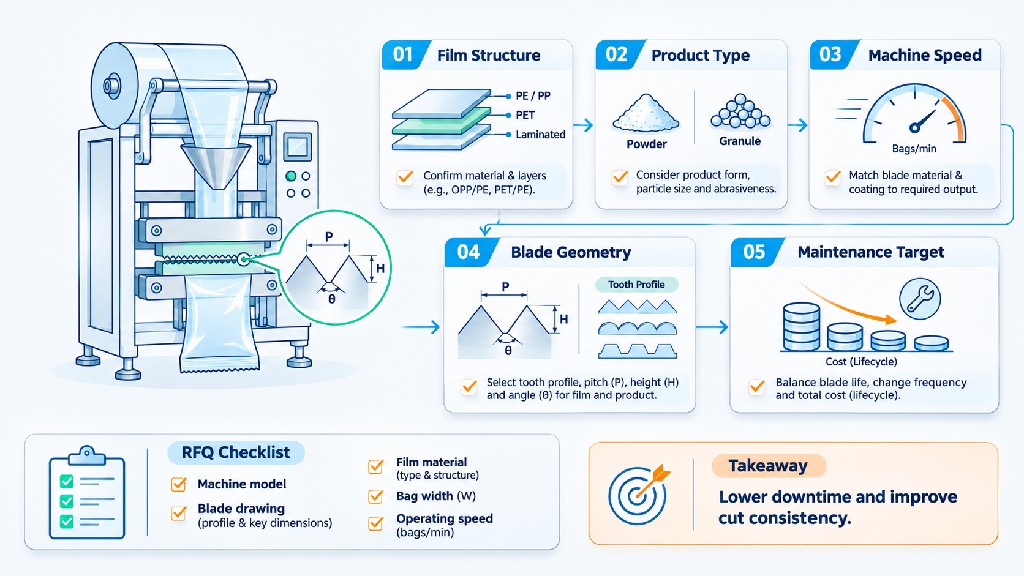
A good request for quotation is specific enough that two suppliers can price the same work. Start with the machine manufacturer, model, original part number, intended cutting action and a clear statement of the problem. Attach dimensioned drawings in PDF and, if available, CAD files. Include front, back and side photographs showing the full knife and a close-up of the edge. An undamaged original sample is particularly valuable for complex or discontinued profiles.
Then describe the flexible packaging: film supplier, structure if known, total thickness, bag width, any unusual layer combinations and whether the knife is exposed to cleaning water, product dust or adhesives. Include operating speed as a measured machine setting, not merely the machine's marketing maximum. State if the desired edge is smooth, finely serrated, coarsely serrated, easy-open or perforated, and provide a good-bag reference photograph.
Specify the steel grade if already validated, or describe the service problem and invite the supplier to propose alternatives. Request a target heat-treatment condition, dimensional inspection, tooth-profile evidence, first-article approval and a clear policy on substitutions. Set an expected trial quantity, annual consumption estimate if known, packaging requirement and delivery destination. Avoid telling vendors to “make it harder than OEM” without evidence that wear rather than chipping is the problem.
A practical sample message is: “We require a replacement cross-cut knife for a VFFS machine. Please quote to the attached drawing and existing profile, including steel grade, target hardness, tooth geometry, first-article report, lead time and shipping. Current defect: intermittent PE tails after approximately [verified run length]. Film: [construction and gauge]. Please identify any proposed deviation from our approved sample.” The bracketed fields should be completed with real plant data; they are not fictional facts about a customer's machine.
Ask vendors to quote separately for like-for-like replacement and engineering-change trial if both are required. This keeps a safe production fallback while allowing technical improvement. A supplier who refuses to document material substitutions, mounting changes or critical tolerances may create unnecessary risk even if its unit price is attractive.
GUANG CHUAN identifies itself as Ma'anshan Guangchuan Machinery Knife Mold Technology Co., Ltd. Its company introduction describes industrial blades, precision molds, packaging applications, CNC machining and grinding. Its published service description includes drawing-based custom manufacturing, sample replication, material selection, heat treatment and dimensional inspection. These are relevant capabilities to discuss with a buyer seeking a controlled VFFS replacement.
The serrated blades for automatic packaging machines page describes different tooth forms and material options, while the HSS serrated packaging blade and straight-body serrated packaging knife pages provide useful examples of the product family. For a reader choosing among broader knife configurations, GUANG CHUAN also publishes Packaging Machine Knives: Types, Materials and Selection Guide and Serrated vs Straight Packaging Blades: Which Cutting Edge Is Better?.
A buyer should still evaluate a real quotation. Discuss whether the company can manufacture the specified geometry, what drawing revision it will use, how it verifies the tooth profile, what steel identification accompanies the batch and how first articles will be evaluated. Published marketing descriptions do not replace a signed specification or independently established performance data. Claims about lead time, price, service-life improvement and availability should be confirmed for the individual order.
The most useful first conversation is not a request for the “best VFFS cutting blade.” It is a technical inquiry that supplies a machine model, knife drawing or sample, film details and the defect the line needs to eliminate. Buyers can use GUANG CHUAN's contact page to begin that discussion and request a quotation for approved replacements, custom tooth profiles or engineering samples.
The cutting blade separates the finished bag or makes a specified tear feature; sealing jaws apply pressure and, where relevant, heat to bond the packaging material. Their serrations are different geometries. A change to cutting teeth does not automatically correct poor heat-seal bonding. In some machines, the functions are coordinated in one assembly, so mechanical location and timing still matter.
No. Serrated teeth can help initiate cuts in certain flexible webs and deliberately form an easy-tear edge, but an accurately supported straight shear can create excellent smooth cuts. Select between them according to the film, opposing mechanism and desired edge quality. When an OEM design already works, reproducing the proven profile is usually the lower-risk first trial.
There is no universal pitch. A finer profile may be useful on thin or easily torn materials, but the appropriate value depends on the existing machine, tooth depth, edge radius, film structure and acceptable appearance. Obtain the original knife profile or run controlled tests with documented samples rather than adopting a number from an unrelated product catalog.
Neither wins every application. D2-type cold-work steel offers strong abrasive wear resistance in suitable duties, while M2 HSS provides a different balance of hardness, wear behavior and manufacturing cost. If the present knife chips rather than wears evenly, first investigate machine interference and tooth toughness. The correct selection requires heat-treatment details and a line trial, not grade names alone.
Only after specifying the exact grade and the actual environment. Hardenable stainless steel can be relevant where washdown, humidity or cleaning chemicals threaten tool steel, but its performance depends on heat treatment and corrosion conditions. Neither label by itself establishes food-contact compliance. Request documentation suited to the intended use and approval from the site's quality team.
Its published custom blade services describe sample replication and manufacture from drawings. Feasibility and exact reproduction require supplier review, especially when the sample is worn, bent or damaged. Provide the machine model, installation dimensions, a representative film sample and a drawing where possible, then approve a first article before committing to recurring production.
Service life varies with film, tooth geometry, steel, heat treatment, operating conditions, alignment and cleaning. A vendor cannot responsibly guarantee a universal number of strokes without a defined test. Track actual acceptable packages between changes and investigate which failure mode ends the knife's useful life. That measure is more meaningful commercially than a large unsupported “million cuts” claim.
Yes, indirectly. A blade that cuts into a seal, displaces hot film or has the wrong stroke position may damage a previously acceptable pack. But a leaking seal can also result from contaminated jaws, insufficient heat or pressure, or film incompatibility. Identify where the leak occurs, inspect the cut location and use the established seal validation method before attributing the defect to one component.
Send the machine model and OEM knife part number, an approved drawing or reference sample, dimensions and mounting-hole locations, tooth profile and bevel orientation, film construction and thickness, operating conditions, failure description, steel requirements if known, target quantity and inspection needs. State whether you want an exact replacement or a proposed performance modification; this prevents accidental design changes.
The right VFFS knife is not necessarily the hardest, most complicated or cheapest blade in the catalog. It is the component that reproduces the intended cut at the correct position, survives the actual duty and can be reordered reliably. Establish what the machine is doing, confirm the existing mounting and counter-surface, select the tooth geometry according to the package, then choose a grade and heat-treatment route that address the real wear or damage mechanism.
For a new procurement project, make the first purchase a documented, inspectable trial. Require a clear drawing revision, known material, agreed tooth profile and measurable good-pack acceptance criteria. Compare proposals using total cost per acceptable package rather than unit price alone. When those conditions are in place, the supplier's manufacturing capability becomes commercially useful because it can be verified instead of merely advertised.
Request a VFFS blade quotation from GUANG CHUAN: Share your drawing or sample, machine model, packaging film and current cutting problem through the GUANG CHUAN contact page. Ask for a like-for-like replacement option and, if warranted, a separately specified tooth-profile or material trial. A properly scoped RFQ is the fastest route to a knife that fits the machine and solves the actual production problem.

Leave A Message
Scan to WhatsApp :

 English