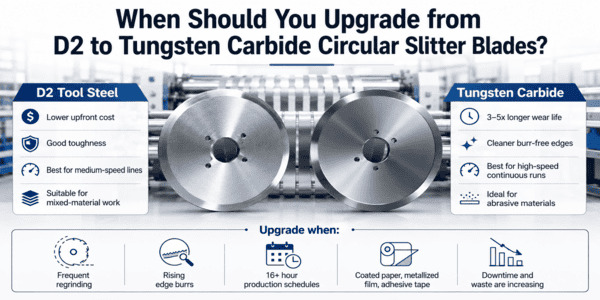
Deciding whether to upgrade from D2 to tungsten carbide circular slitter blades is a common dilemma for slitting line managers. While D2 steel works well for many applications, upgrading at the right time cuts downtime and reduces long-term costs. As a specialized maker of precision circular slitting & rewinding blades, Guangchuan Blade outlines clear signals and cost logic to guide your decision.
Key Signs It’s Time to Upgrade
If your D2 blades require frequent regrinding, produce increasing edge burrs, or fail to keep up with 24-hour production schedules, upgrading is likely cost-effective. High-abrasive materials like coated paper, metallized film and adhesive tape also wear D2 steel rapidly, raising per-cut costs over time. Many operations delay upgrades only to accumu...
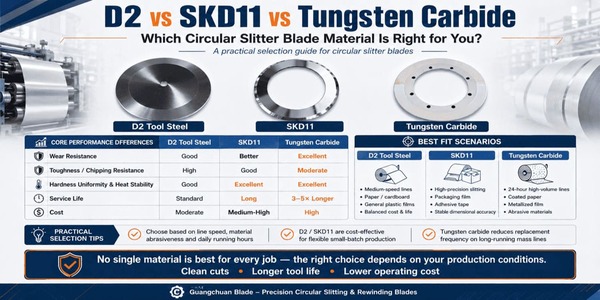
Selecting the right material for circular slitter blades directly impacts cut quality, service life and total production costs. A mismatched material leads to premature dulling, frequent downtime and unexpected material waste. As an experienced manufacturer of precision circular slitting & rewinding blades, Guangchuan Blade breaks down core differences of three mainstream materials to simplify your selection.
Core Performance Differences
D2 tool steel offers good wear resistance and high toughness at moderate cost, with strong edge chipping resistance under impact loads. SKD11, as an upgraded alloy steel, delivers better hardness uniformity and heat treatment stability for consistent slitting performance. Tungsten carbide stands out with exceptional wear resistance, lasting 3 to...





 English